Displaced Gazans search for warm clothes as cold draws in

1 / 5
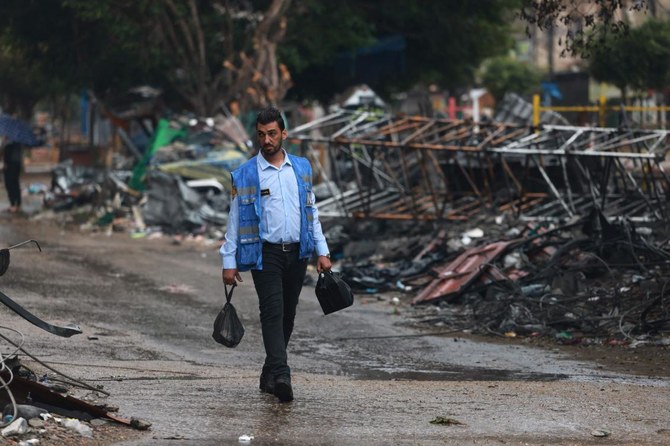
A Palestinian man wearing a United Nations blue vest walks past the debris following the Israeli bombardment of Rafah in the southern Gaza Strip on Nov. 14, 2023. (AFP)
2 / 5
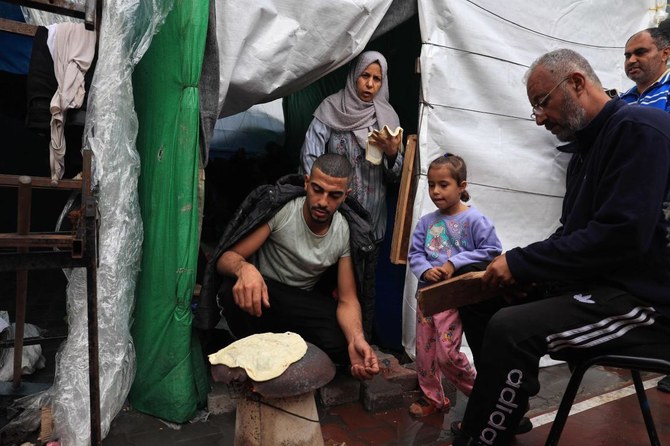
The war between Israel and Hamas has displaced almost 1.6 million Palestinians, according UNRWA, leaving hundreds of thousands living in cramped shelters with little food and insufficient water. (AFP)
3 / 5
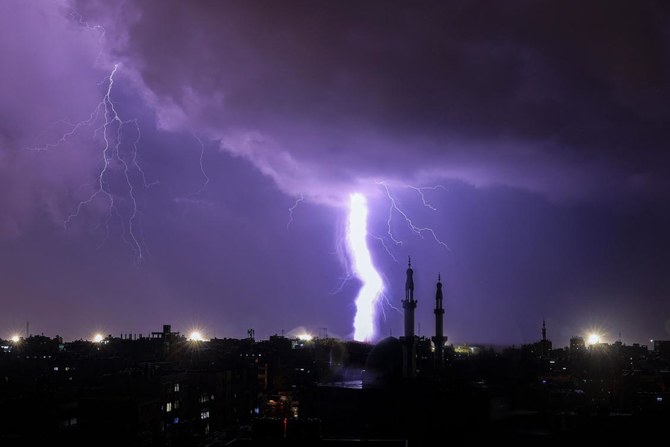
Lightening illuminates the sky during a storm over Rafah in the southern Gaza Strip on Nov. 14, 2023. (AFP)
4 / 5
An internally displaced Palestinian woman living in a school run by the UN agency for Palestinian refugees (UNRWA), walks in slippers along a wet courtyard following overnight rainstorms in Rafah in the southern Gaza Strip on Nov. 15, 2023. (AFP)
5 / 5
A Palestinian man covered with a blanket, stand in the debris of a home following the Israeli bombardment of the Rafah refugee camp in the southern Gaza Strip on Nov. 15, 2023. (AFP)
Short Url
Updated 17 November 2023
Follow

Displaced Gazans search for warm clothes as cold draws in

  • The exodus came after Israel’s military began a relentless bombardment of Gaza
  • Even before the war, life in the Gaza Strip was difficult

RAFAH, Palestinian Territories: When Khulud Jarboueh and her children fled their home in the northern Gaza Strip under Israeli bombardment in early October, the young ones were wearing just shorts and T-shirts.
The heat of late summer still lingered then. But now she rummages through piles of clothing looking for something to keep them warm in the rain and bitter cold.
“We left Gaza City with 20 members of the family more than a month ago,” the 29-year-old told AFP at a second-hand clothes stall outside a school in Rafah run by the UN agency for Palestinian refugees (UNRWA).
They had left the north of the Palestinian territory after Israel warned people to flee south, saying it was safer there.
The exodus came after Israel’s military began a relentless bombardment of Gaza after Hamas militants stormed across the border on October 7 and killed around 1,200 people, mostly civilians.
They also seized around 240 hostages in attacks that sparked massive retaliation from Israel. The Hamas government in Gaza says Israeli attacks have killed around 11,500 people, including thousands of children.
Now Jarboueh and her family sleep on the floor of the UNRWA school.
“We didn’t take any clothes with us. But now it’s cold and I have to buy winter stuff,” she said at the stall where items of clothing go for a shekel each (around $0.25).
Even before the war, life in the Gaza Strip was difficult.
The United Nations estimates that in 2022, the blockade Israel had enforced against the territory since 2007 had “hollowed out Gaza’s economy.”
“The restrictions on movement also impede access to health and other essential services, as 80 percent of Gazans depend on international aid,” said UNCTAD, the UN Conference on Trade and Development.
Unemployment in the densely populated strip of land squeezed between Israel, Egypt and the Mediterranean Sea was 45 percent.
Today, the UN says, all 2.4 million people in Gaza are going hungry, and 1.65 million have been displaced by the war. With almost half the houses in Gaza destroyed or damaged, poverty will only get worse.
“It’s the first time in my life I’ve had to buy second-hand clothes,” said Jarboueh. “We’re not rich, but I can usually afford to pay 10 shekels for an item of clothing for the children.
“Now they’re coughing because it’s so cold. I have no other choice.”
She said she was sure the old clothes were “full of germs.”
“But they’re going to have to put them straight on. I don’t have the water to shower my children, let alone do the laundry.”
On a road lined with stalls, hundreds of Palestinians held up items to check sizes or compare fabrics. The temperature has now dropped and downpours are common.
Farmer Walid Sbeh said he has been uprooted from his land, and does not have a shekel to his name. He camps at the UNRWA school each night with his wife and 13 children.
“I can’t stand it, seeing my children still in their summer clothes go hungry, and I know I can’t buy them anything,” he told AFP.
“This is no life. They force us from our homes and kill us in cold blood. If we don’t die in the bombing we die of hunger or thirst, sickness and cold,” he said.
Sbeh said that when they left after their house was bombed they brought blankets with them.
“But on the road, the Israeli soldiers told us to drop everything and keep our hands up.”
He said some people gave them warmer clothing their own children had outgrown.
Adel Harzallah, who runs a clothes shop, said his stock of winter pyjamas sold out in two days.
“The war began when we were waiting for winter wear to arrive. It was due to come across the border” but that shut after the October 7 attacks in Israel.
Now his goods were stuck in containers, like food, drinking water and fuel, all only to be released for a high price.
One potential customer left Harzallah’s store disappointed.
“Seventy shekels for a jacket? I can’t pay that — I’ve got five kids,” she said.
Abdelnasser Abu Dia, 27, told AFP he “doesn’t have enough to buy bread, let alone clothes.”
For a month he had only the clothes in which he fled.
But as the temperature dropped, “someone gave me and my kids sportswear jackets. We’ve been wearing them non-stop for a week.”


Turkiye asks Britain’s MI6 to step up protection of Syria’s Sharaa, sources say 

Updated 8 sec ago
Follow

Turkiye asks Britain’s MI6 to step up protection of Syria’s Sharaa, sources say 

  • A Turkish source said that MIT appealed to MI6 for more support after one such incident last month
  • A senior Syrian security source said the request came after a “high-risk assassination plot”

ISTANBUL/DAMASCUS/LONDON: Turkiye’s intelligence agency asked its British counterpart MI6 last month to take a larger role in protecting Syrian President Ahmed Al-Sharaa after recent assassination plots, according to five people familiar with the matter.
The request highlights efforts by foreign allies to shore up a country still shaken by sporadic violence 15 months after the overthrow of president Bashar Assad, with the US-Israeli war on Iran now rattling the wider region.
Those allies see Sharaa as crucial to preventing a relapse into sectarian fighting or civil war, after 14 years of civil conflict drove millions of refugees abroad and allowed Daesh to control swathes of Syria.
The militants last month stepped up attacks on military and security personnel across Syria and declared Sharaa, a former rebel, their “number one foe.”
It was unclear what specifically Turkiye’s National Intelligence Organization, or MIT, had asked of MI6, or what new role, if ⁠any, MI6 ⁠had taken up.

ANXIETY RISES IN SYRIA OVER DAESH
Turkiye, Britain and the US last year threw their backing behind Sharaa to try to reunite and rebuild his country of 26 million. London and Washington have scrapped most sanctions on Syria and on Hayat Tahrir Al-Sham (HTS), the Islamist group he once led.
The sources who spoke to Reuters requested anonymity owing to the sensitivity of the matter.
MIT, the Turkish foreign ministry, Britain’s foreign office and Syria’s defense and interior ministries did not respond to requests for comment.
The sources, including Syrian and foreign officials, all cited rising anxiety over a series ⁠of reported Daesh plots to kill Sharaa.
A Turkish source said that MIT, which has played a key role in helping the new government to establish itself, appealed to MI6 for more support after one such incident last month. A senior Syrian security source said the request came after a “high-risk assassination plot”, adding that MIT, MI6 and Syrian authorities were constantly sharing intelligence.
Details of the plot were unclear. A separate Western intelligence source briefed on the matter believed Turkiye wanted to introduce a Western presence in Damascus to provide something of a buffer between the agencies of Turkiye and Israel, currently at loggerheads.

REPORTED ASSASSINATION ATTEMPTS AGAINST SHARAA Last year, Sharaa and two senior cabinet ministers were targeted by Daesh in five foiled assassination attempts, according to the UN Office of Counter-Terrorism. In November, Reuters reported that Syrian authorities had foiled two of the attempts.
Describing Sharaa as a “watchdog” of the global anti-Daesh coalition, ⁠the group mounted six attacks ⁠on Syrian authorities last month in what it called a “new phase.”
On Thursday, Damascus openly acknowledged for the first time that it coordinates with MIT, saying they had cooperated to foil an Daesh attack in the capital.
Turkish security sources said MIT had identified a team of three preparing remote bomb attacks, enabling Syrian counterparts to prevent an “imminent assault.”
A US diplomat briefed on the matter said MIT’s request to MI6 had been prompted by the Daesh resurgence.
The Western intelligence source said the two agencies could intensify joint planning and technical operations, but that no decision had been made on whether to send British personnel to Damascus. A Syrian security source said a physical British presence would be “highly risky.”
They said MI6 had been discussed at a meeting in Damascus on February 26 between a delegation headed by Britain’s special envoy for Syria, Ann Snow, and Syria’s deputy interior minister, Major General Abdulqader Tahan.
Sharaa was a commander of Al Qaeda’s Nusra Front in Syria before cutting ties with the group in 2016, then led a coalition of Islamist rebel factions in late 2024 to topple Assad.