

Displaced pack Gaza hospitals, others flee as Israelis and Hamas clash

1 / 3
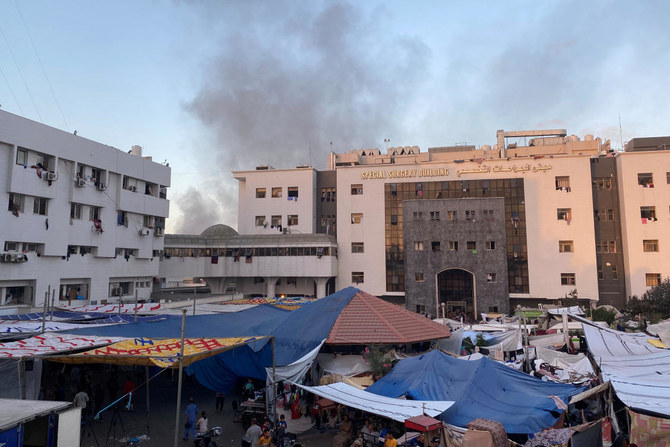
Smoke rises as displaced Palestinians take shelter at Al Shifa hospital, amid the ongoing conflict between Hamas and Israel, in Gaza City, on Nov. 8, 2023. (Reuters)
2 / 3
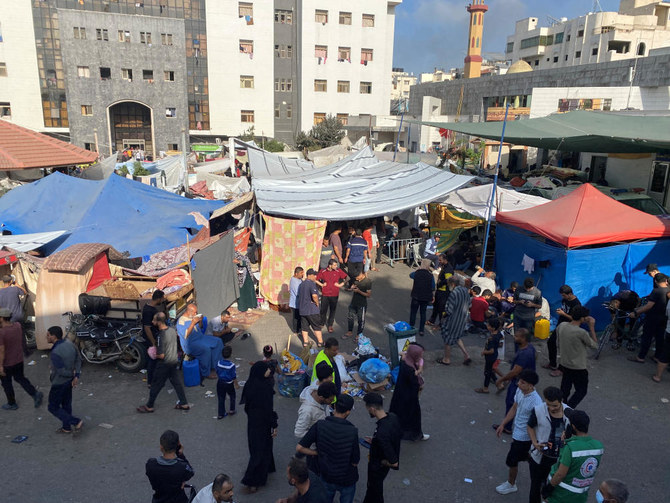
Displaced Palestinians gather at Al Shifa hospital where they take shelter, amid the ongoing conflict between Hamas and Israel, in Gaza City, on Nov. 8, 2023. (Reuters)
3 / 3
A displaced Palestinian woman, who fled her house due to Israeli strikes, sits with her grandchildren in a makeshift shelter at Shifa hospital, in Gaza City on Nov. 5, 2023. (Reuters)
Short Url
Updated 09 November 2023
Follow

Displaced pack Gaza hospitals, others flee as Israelis and Hamas clash

  • Many are staying in the north, packed into the Al Shifa Hospital and Al-Quds Hospital as ground battles rage around them
  • Israel says its Hamas foes have command centers embedded in the hospitals

GAZA/JERUSALEM: Israeli forces fought Hamas militants among ruined buildings in the north of the Gaza Strip on Thursday, inching their way closer to two big hospitals as the plight of civilians in the besieged Palestinian territory worsened.
Thousands more Palestinians were fleeing from the embattled north to the south along a perilous frontline path after Israel told them to evacuate, residents say.
But many are staying in the north, packed into the Al Shifa Hospital and Al-Quds Hospital as ground battles rage around them and more Israeli air strikes rain down from above.
Israel says its Hamas foes have command centers embedded in the hospitals.
In Paris, officials from about 80 countries and organizations were meeting to coordinate humanitarian aid to Gaza and find ways to help wounded civilians escape the siege, now in its second month.
“Without a cease-fire, lifting of siege and indiscriminate bombarding and warfare, the haemorrhage of human lives will continue,” said Jan Egeland, Secretary General of the Norwegian Refugee Council, calling Israel’s actions collective punishment.
The United Nations and the International Red Cross also called for a ceasefire. Israel and its main backer the United States say a full ceasefire would benefit Hamas, but limited pauses are possible.
Israel unleashed its assault on Gaza in response to a cross-border Hamas raid on southern Israel on Oct. 7 in which gunmen killed 1,400 people, mostly civilians, and took about 240 hostages, according to Israeli tallies.
It was the single worst day of bloodshed in Israel’s 75-year history and drew international condemnation of Hamas and sympathy and support for Israel.
But Israel’s retaliation in the Hamas-ruled enclave has caused great concern as a humanitarian catastrophe has unfolded.
Palestinian officials said 10,812 Gaza residents had been killed as of Thursday, about 40 percent of them children, in air and artillery strikes while basic supplies are running out and areas laid waste by unrelenting Israeli bombardments.
Residents in Gaza City, a Hamas stronghold, said Israeli tanks were stationed around the area. Both sides reported inflicting heavy casualties on one another in intense street battles.
Israel, which has vowed to wipe out Hamas, says 33 of its soldiers have been killed in its ground operation as they advanced into the heart of Gaza City.
Israeli troops had secured a Hamas military stronghold called Compound 17 in Jabalya in northern Gaza after 10 hours of combat with Hamas and Islamic Jihad militants above and below the ground, the Israeli military said on Wednesday.
It said troops killed dozens of militants, seized weapons, exposed tunnel shafts and discovered a Hamas weapons manufacturing site in a residential building in the Sheikh Radwan neighborhood.
Israeli military footage showed soldiers walking through rubble into a building where one wall had been blasted away, finding weapons-manufacturing equipment, instruction manuals and a tunnel shaft.
Nearby was a girl’s bedroom with pink walls, pink wardrobes and three little beds.
The armed wing of Hamas said it had killed a greater number of Israeli soldiers than the military has announced, and had destroyed dozens of tanks, bulldozers and other vehicles. It released footage of fighters firing anti-tank rockets and scoring direct hits to vehicles.

NOWHERE TO RUN TO
Thousands of Palestinians have sought refuge at Al Shifa hospital inside Gaza City despite Israel’s orders to evacuate the area it has encircled. They are sheltering in tents in the hospital grounds and say they have nowhere else to go.
The UN humanitarian office OCHA said Israeli had again told residents of the north to move southwards, opening a four-hour corridor for the fifth consecutive day. About 50,000 people left the area on Wednesday, it said.
Clashes and shelling around the main road continued, OCHA said, endangering evacuees. Corpses lay alongside the road, while most evacuees were moving on foot as the Israeli military had told them to leave vehicles, it said.
One resident, who asked not to be named, said he had crossed with his wife and six children after having initially taken shelter in Gaza City from their home in Beit Hanoun close to the frontier with Israel.
“There are no taxis and you can only take a small amount with you. You have to hold your ID card in your hand and raise it as you go past the Israeli tanks and then walk several more kilometers searching for a lift,” he said.
Huge numbers of displaced people from among Gaza’s 2.3 million population are already crammed into schools, hospitals and other sites in the south.
Southern areas have also come under regular attack. In Khan Younis, Gaza’s main southern city, residents picked through the rubble and twisted debris of a building destroyed by an Israeli air strike, hoping to find survivors, on Thursday morning, witnesses said.
On another front, Lebanese group Hezbollah said it fired missiles over the border into Israel, and Israel’s military said it responded with artillery fire.

CEASEFIRE CALLS
The conference in Paris, attended by Arab nations, Western powers, G20 members and NGO groups such as Doctors Without Borders, was discussing measures to alleviate the suffering in Gaza, but without a pause in the fighting expectations are low.
President Emmanuel Macron, opened the conference calling for a humanitarian pause: “The situation is serious and getting worse each day,” he said.
Palestinian Prime Minister Mohammad Shtayyeh, whose Palestinian Authority has limited self-rule in the Israeli-occupied West Bank but was driven out of Gaza by Hamas in 2007, was present at the conference. Israel was not invited.
“How many Palestinians must be killed for the war to stop,” Shtayyeh asked. “Is killing 10,000 people in 30 days enough?“


Gaza’s living conditions worsen as strong winds and hypothermia kill 5

Updated 14 January 2026
Follow

Gaza’s living conditions worsen as strong winds and hypothermia kill 5

  • Hundreds of tents and makeshift shelters were blown away or heavily damaged, the UN humanitarian office reported

DEIR AL-BALAH, Gaza Strip: Strong winter winds collapsed walls onto flimsy tents for Palestinians displaced by war in Gaza, killing at least four people, hospital authorities said Tuesday.
Dangerous living conditions persist in Gaza after more than two years of devastating Israeli bombardment and aid shortfalls. A ceasefire has been in effect since Oct. 10. But aid groups say that Palestinians broadly lack the shelter necessary to withstand frequent winter storms.
The dead include two women, a girl and a man, according to Shifa Hospital, Gaza City’s largest, which received the bodies.
The Gaza Health Ministry said Tuesday a 1-year-old boy died of hypothermia overnight, while the spokesman for the UN’s children agency said over 100 children and teenagers have been killed by “military means” since the ceasefire began.
Meanwhile, Israel’s military said it exchanged fire Tuesday with six people spotted near its troops deployed in southern Gaza, killing at least two of them in western Rafah.
Family mourns relatives killed by wall collapse
Three members of the same family — 72-year-old Mohamed Hamouda, his 15-year-old granddaughter and his daughter-in-law — were killed when an 8-meter (26-foot) high wall collapsed onto their tent in a coastal area along the Mediterranean shore of Gaza City, Shifa Hospital said. At least five others were injured.
Their relatives on Tuesday began removing the rubble that had buried their loved ones and rebuilding the tent shelters for survivors.
“The world has allowed us to witness death in all its forms,” Bassel Hamouda said after the funeral. “It’s true the bombing may have temporarily stopped, but we have witnessed every conceivable cause of death in the world in the Gaza Strip.”
A second woman was killed when a wall fell on her tent in the western part of the city, Shifa Hospital said.
Hundreds of tents and makeshift shelters were blown away or heavily damaged, the UN humanitarian office reported.
The UN and its humanitarian partners were distributing tents, tarps, blankets and clothes as well as nutrition and hygiene items across Gaza, said the UN Office for the Coordination of Humanitarian Affairs.
The majority of Palestinians live in makeshift tents since their homes were reduced to rubble during the war. When storms strike the territory, Palestinian rescue workers warn people against seeking shelter inside damaged buildings for fears of collapse. Aid groups say not enough shelter materials are entering Gaza during the truce.
In the central town of Zawaida, Associated Press footage showed inundated tents Tuesday morning, with people trying to rebuild their shelters.
Yasmin Shalha, a displaced woman from the northern town of Beit Lahiya, stood against winds that lifted the tarps of tents around her as she stitched hers back together with needle and thread. She said it had fallen on top of her family the night before, as they slept.
“The winds were very, very strong. The tent collapsed over us,” the mother of five told AP. “As you can see, our situation is dire.”
On the shore in southern Gaza, tents were swept into the Mediterranean. Families pulled what was left from the sea, while some built sand barriers to hold back rising water.
“The sea took our mattresses, our tents, our food and everything we owned,” Shaban Abu Ishaq said, as he dragged part of his tent out of the sea in the Muwasi area of Khan Younis.
Mohamed Al-Sawalha, a 72-year-old man from the northern refugee camp of Jabaliya, said the conditions most Palestinians in Gaza endure are barely livable.
“It doesn’t work neither in summer nor in winter,” he said of the tent. “We left behind houses and buildings (with) doors that could be opened and closed. Now we live in a tent. Even sheep don’t live like we do.”
Residents aren’t able to return to their homes in Israeli-controlled areas of the Gaza Strip.
Child death toll in Gaza rises
Gaza’s Health Ministry said the 1-year-old in the central town of Deir Al-Balah was the seventh fatality due to the cold conditions since winter started. Others included a baby just seven days old and a 4-year-old girl, whose deaths were announced Monday.
The ministry, part of the Hamas-run government, says more than 440 people were killed by Israeli fire and their bodies brought to hospitals since the ceasefire went into effect. The ministry maintains detailed casualty records that are seen as generally reliable by UN agencies and independent experts.
UNICEF spokesman James Elder said Tuesday at least 100 children under the age of 18 — 60 boys and 40 girls — have been killed since the truce began due to military operations, including drone strikes, airstrikes, tank shelling and use of live ammunition. Those figures, he said, reflect incidents where enough details have been compiled to warrant recording, but the total toll is expected to be higher. He said hundreds of children have been wounded.
While “bombings and shootings have slowed” during the ceasefire, they have not stopped, Elder told reporters at a UN briefing in Geneva by video from Gaza City. “So what the world now calls calm would be considered a crisis anywhere else,” he said.
Gaza’s population of more than 2 million people has been struggling to keep the cold weather and storms at bay while facing shortages of humanitarian aid and a lack of more substantial temporary housing, which is badly needed during the winter months. It’s the third winter since the war between Israel and Hamas started on Oct. 7, 2023, when militants stormed into southern Israel and killed around 1,200 people and abducted 251 others into Gaza.
Gaza’s Health Ministry says more than 71,400 Palestinians have been killed in Israel’s retaliatory offensive.