

Afghans driven from Pakistan rebuilding lives from ‘zero’

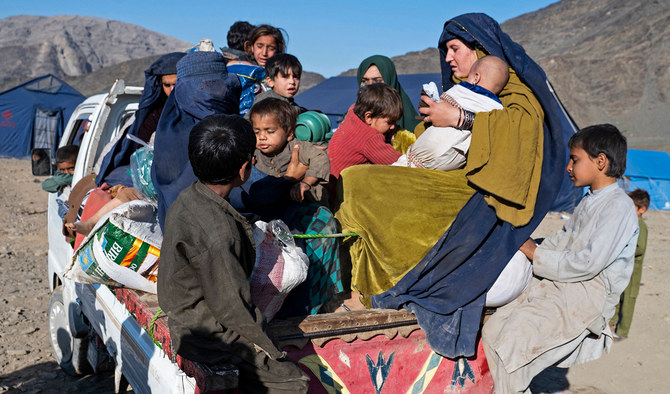
Afghan refugee Shazia, mother to three children, holds an infant after boarding a truck to Jalalabad, at a makeshift camp near the Afghanistan-Pakistan Torkham border in Nangarhar province, days after their deportation from Pakistan on November 12, 2023. (AFP)
Short Url
Updated 17 November 2023
Follow

Afghans driven from Pakistan rebuilding lives from ‘zero’

  • Officials say at least 210,000 Afghans have passed through Torkham crossing since Pakistan ordered them to leave
  • From the reception camp, they have dispersed to various Afghan provinces with a handout of just 205 dollars

TORKHAM: Rocked gently on his mother’s knees, a fly on his nose, a baby sleeps fitfully in a tent in a barren border camp as his family prepares to leave the waypoint to rebuild their lives in Afghanistan. 

In the transit camp at Torkham, where returnees driven out of Pakistan sweat in burning heat during the day and shiver through the night, many of the blue tents at the foot of rocky mountains standing stark against a cloudless sky have already emptied. 

Trucks overloaded with several families, carrying cushions, brightly colored blankets and kitchen utensils, are readied to set off. 

Border officials say at least 210,000 Afghans, including many who have lived decades, if not their whole lives, outside their country, have passed through the Torkham border point since Pakistan ordered those without documents to leave. 

From the reception camp, they have dispersed to various Afghan provinces with a handout of around 15,000 afghanis ($205) — just enough to support a family for a month. 

For many, nothing, and no one, awaits them. 

“We have nowhere to go, we don’t have a house, or land, I don’t have any work,” said Sher Aga, a former security guard in Pakistan. 

He bundled his nine children and all the family’s belongings into a truck to head north, to Kunduz province, where he was born. 

But the 43-year-old has no memory of his homeland, having left Afghanistan when he was five. 

“I don’t have any family there anymore,” he told AFP. 

“My children ask me, ‘What country are we going to?’“ 

In a tent that she, her husband and their 10 children are sheltering in, 40-year-old Amina hides her face behind a red headscarf. 

They are destined for Jalalabad, capital of Nangarhar province where Torkham is located, and where she has “many brothers.” 

“I asked my family to find us a house” to rent, she said, “but they say there are none.” 

“No one has called us or come to see us,” she added. 

In Pakistan, her sons worked selling vegetables or driving rickshaws to pull in enough money to sustain the family, but Amina fears for their prospects in Afghanistan, wracked by economic crisis and unemployment. 

“If the boys don’t work, we’re not going to make it.” 

Another nearby tent is crammed with the 16 members of Gul Pari’s family, who have been sleeping on cardboard boxes without blankets since arriving at the transit camp. 

Her voice is drowned out by the honking of tanker trucks delivering much-needed water to the camp, with clusters of laughing, barefoot children clinging to the back. 

The 46-year-old grandmother, her grandchild’s rail-thin body cradled in her lap, said that in five days they will leave for Kunduz to start a new life in a country she hasn’t seen in four decades. 

Life was precarious for the family collecting scraps in Pakistan, but in Afghanistan, “We have nothing,” she said. 

“We fear starvation. But if we find work, it’ll be OK. We will be happy in our homeland. In Pakistan, we were being harassed.” 

Most of those returning fled an Afghanistan ravaged for decades by deadly conflict, but the end to fighting since the Taliban’s return to power in 2021 has encouraged some to come back. 

Amanullah and his family were stranded in a temporary camp in the neighboring province of Laghman, having nowhere else to go in Afghanistan. 

Amid a dozen white Red Crescent tents sprouting from the lunar landscape, the 43-year-old, who lived 35 years in Pakistan, said life in the camp was hard on him, his wife and their six children. 

“There are no toilets,” the former construction worker said, and the women “are having a very difficult time” because they have to wait until nightfall to go out to relieve themselves in groups for safety. 

There is barely any electricity either. 

“All the tents are pitch black” as soon as night falls, he told AFP, holding up a small red flashlight. 

“We have small children, so we have a lot of hardship,” he said, adding that all his children were in school in Pakistan, but he fears for their future now. 

“If we stay here for five days, a month, a year, it could be alright, but we need work, a house... we’re starting from zero.” 

On the road to Jalalabad, Shazia and 20 other women and children piled into a small truck that leaned precariously as it veered around bends in the road, whipping the women’s blue burqas around a teetering mound of bundles. 

Of the Afghans returning from Pakistan, she is luckier than most: her husband went ahead of them to Jalalabad and found a four-room house to rent for four families. 

“The rent is expensive,” said the 22-year-old mother-of-three, her youngest child only two months old. 

“But tonight we will be able to sleep.” 


Pakistan Railways targets $3.6 billion revenue amid track expansion, service upgrades

Updated 4 sec ago
Follow

Pakistan Railways targets $3.6 billion revenue amid track expansion, service upgrades

  • Government plans new railway lines and modern trains with security cameras, Wi-Fi and dining cars
  • Revival of a robust railway system is seen as key as Pakistan pushes to become a regional trade hub

ISLAMABAD: Pakistan Railways has set a target of generating Rs 1 trillion ($3.6 billion) in revenue by June as the government expands railway tracks and upgrades passenger services with amenities such as Wi-Fi and modern dining cars, Federal Minister for Railways Hanif Abbasi said on Tuesday.

Pakistan Railways was once the backbone of long-distance travel and freight movement across the country, connecting major cities and ports soon after independence. However, decades of underinvestment, aging infrastructure and competition from road transport led to a steady decline in services and reliability.

As Pakistan seeks to position itself as a regional trade and transit hub, the government has renewed focus on rebuilding a robust rail network for both passengers and cargo.

“Pakistan Railways has set a target of achieving Rs 1 trillion in revenue by June 2026,” Abbasi said, according to an official statement. “Pakistan Railways will be transformed into a modern, safe and profitable organization,” he added.

The minister said work has already begun on digitization, outsourcing, construction of new railway tracks and improvement of passenger facilities.

He said the Asian Development Bank has approved a $2 billion loan for the construction of a 480-kilometer new railway track between Karachi and Rohri, a project expected to cut travel time by at least five hours.

Groundbreaking for the project is planned for July 2026, with completion expected within two and a half to three years.

Under the Reko Diq project, Abbasi said work is underway on a 900-kilometer railway track from Rohri to Nokundi, including construction of 500 kilometers of new track and upgrading of 400 kilometers of existing track.

The 87-kilometer Nokundi–Taftan line has also been included to strengthen rail connectivity with Iran.

The minister said a 54-kilometer People’s Train route is being launched in Balochistan at a cost of Rs 4 billion ($14.4 million), while eight regional routes will be developed in Punjab.

Provinces have also been offered the option to operate branch lines, with Punjab, Sindh and Balochistan allocating funds and consultations underway with Khyber Pakhtunkhwa.

Abbasi said Pakistan is also advancing rail connectivity with Kazakhstan, Uzbekistan and Iran and that the Islamabad–Tehran–Istanbul railway service will be launched after security clearance.

Passenger services are being upgraded alongside infrastructure expansion, he continued.

“Cleanliness and improvement work at Rawalpindi Railway Station has been completed, while three prime trains have already been upgraded, and more trains will be upgraded by June 30,” the minister said. “By December 31, all major trains will be upgraded, featuring security cameras, Wi-Fi, hostesses and modern dining cars.”

He added that Wi-Fi routers have been installed at railway stations, ticket booking has been enabled through the Rabta mobile application and a 1,700-kilometer fiber-optic network is being laid.

Karachi and Lahore railway stations are being upgraded for security, while progress is underway on a Rs 8.9 billion ($32 million) digital systems agreement with the Frontier Works Organization and a $85 million project with DP World at Pipri Yard.

Abbasi said 155 railway stations have been shifted to solar energy and Pakistan Railways recently recorded its highest-ever daily revenue of Rs 300 million ($1.1 million).

The minister also said a new Lahore–Rawalpindi track, backed by provincial funding, will cut travel time between the two cities to about two and a half hours once completed.