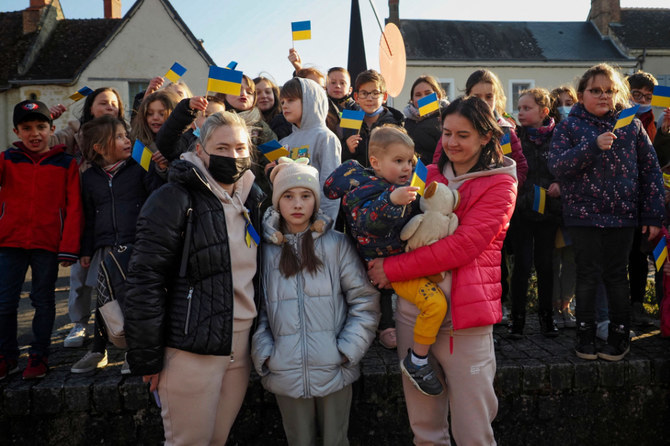
AMSTERDAM: More than 2,400 children from Ukraine aged between six and 17 years old have been taken to 13 facilities across Belarus since Russia’s full-scale invasion of Ukraine in early 2022, research published by Yale University said on Thursday.
Ukraine’s prosecutor general said in May that he was investigating the alleged role of Belarus in the forced transfer of more than 19,000 identified children from Russian-occupied territories since the conflict broke out, including to Russia.
The total number is estimated by some experts and organizations to be far higher.
The findings by the Humanitarian Research Lab at Yale School of Public Health, which receives US State Dept. funding, shared with Reuters are the most extensive to date about the alleged role of Belarus in the Russian relocation program for Ukrainian children.
Russia has said previously that it is offering humanitarian aid to those wishing to flee Ukraine voluntarily and rejects accusations of war crimes.
The press service of Russia’s Children’s Rights Commissioner, who oversees the relocation of children from occupied Ukraine, and Belarus’ foreign ministry did not immediately respond to requests for comment on the research.
Among the key findings detailed in the 39-page report were that children had been transported from at least 17 cities in Ukraine’s Donetsk, Luhansk, Kherson, and Zaporizhzhia regions in what Yale researchers described as an ongoing practice.
More than 2,000 children Yale identified were transported to the Dubrava children’s center in Belarus’ Minsk region between September 2022 and May 2023, it said, while 392 children were taken to 12 other facilities.
“Russia’s systematic effort to identify, collect, transport, and re-educate Ukraine’s children has been facilitated by Belarus,” the report said.
“Russia’s federal government and Belarus’ regime have been working together to coordinate and fund the movement of children from Russia-occupied Ukraine through Russia to Belarus.”
Transports to Belarus through Russia were “ultimately coordinated” between Russian President Vladimir Putin and Belarus leader Alexander Lukashenko, it added.
The International Criminal Court in The Hague issued an arrest warrant for Russia’s Putin in March. It accused him and Russia’s Children’s Rights Commissioner Maria Lvova-Belova of the war crime of illegally deporting hundreds of children from Ukraine.
Taking children under the age of 18 across a border without the consent of a parent or guardian is prohibited under international humanitarian law.
Ukraine’s war crimes prosecutors have said they are investigating the deportations as potential genocide.
The Genocide Convention — a treaty adopted by the UN General Assembly in the wake of the Nazi Holocaust — specifies five acts that could each constitute the crime, if committed with genocidal intent, including forcibly transferring children out of their group.
Ukraine’s foreign ministry and the office of the prosecutor general, which oversees war crimes investigations, did not immediately respond to requests for comment.
Once in Belarus, children have been subjected to military training and re-education and Lukashenko approved the use of state organizations to transport children from Ukraine to Belarus and finance their transportation, the Yale report said.
It is unclear how many of the children identified by Yale’s research remain in Belarus.

Thousands of Ukrainian children taken to Belarus — Yale research
Short Url
https://arab.news/gd53s
Thousands of Ukrainian children taken to Belarus — Yale research
- The total number is estimated by some experts and organizations to be far higher
- Russia has said previously that it is offering humanitarian aid to those wishing to flee Ukraine voluntarily and rejects accusations of war crimes
Afghan polio survivor’s sock factory provides hope by employing disabled workers
HERAT: In a tiny room in the center of Herat, Afghanistan’s westernmost city, Shahabuddin uses his hands to propel himself along the floor to a freshly-made pile of socks waiting to be sorted and packaged.
A double amputee since a roadside bomb took both his legs a decade ago, when Afghanistan was mired in conflict between US-led forces and Taliban insurgents, the 36-year-old father of four had struggled to find work. Unemployed for the last decade, he had been forced to rely on relatives for his family’s survival.
But a new sock production workshop in Herat employing only disabled workers has given him new hope.
“I became disabled due to the explosion. Both my legs were amputated,” Shahabuddin, who like many Afghans goes by only one name, said during a brief pause in his work in early December. “Now I work here in a sock factory, and I am very happy that I have been given a job here.”
The workshop is the brainchild of Mohammad Amiri, 35, a former grocery shop worker who started the business about a month ago. Amiri, himself disabled by childhood polio, wanted to create jobs and help provide income for other people with disabilities, particularly as many of them were injured during the conflict and have no other means of income.
He teamed up with another polio survivor to start the sock factory with a workforce of men disabled either through traumatic injuries or because of congenital issues or other reasons. They make four types of socks: long and short, for winter and summer.
“The factory, which is funded and supported by people with disabilities, began operations last month and currently employs around 50 people with disabilities,” Amiri said. “They are busy in the production, packaging and sale of socks in the city.”
A combination of decades of conflict, a weak health care system and struggling economy have contributed to high levels of disability in Afghanistan. Data from a 2019 Model Disability Survey conducted by The Asia Foundation nonprofit organization indicates that nearly 25 percent of adults live with a mild disability, while 40 percent have moderate and about 14 percent have severe disabilities.
“These figures compel us to act with greater urgency and commitment,” the UN Assistance Mission in Afghanistan said in a statement released on the International Day of Persons with Disabilities on Dec. 3, quoting the same figures. “Persons with disabilities must not be treated as an afterthought; they must be fully integrated into every stage of planning, decision-making, and service delivery.”
Meanwhile, Afghanistan is one of only two countries — along with neighboring Pakistan — where wild poliovirus remains endemic. The infectious disease can cause flu-like symptoms, but can also cause severe reactions, including paralysis, disability and death.
The Afghan Ministry of Martyrs and Disabled Affairs says 189,635 disabled people across the country are registered and receiving financial support from the government.
Amiri said his business faces serious competition from cheap imports of textiles, and expressed the hope that the government would stop imports from abroad. He has hopes of getting a contract to provide the Afghan security forces with socks, and wants to expand his workforce to 2,000 people.
His current employees include former refugees who have recently returned to Afghanistan after spending years abroad.
One such man is Mohammad Arif Jafari, 40, an economics graduate and polio survivor who lived in Iran for years. Returning to Afghanistan has been hard, he said.
“I suffered a lot due to unemployment. But fortunately, now I produce several types of socks,” he said while selling his wares from a stall on the streets of Herat. “I am happy that I am working here and earning an income.”
A double amputee since a roadside bomb took both his legs a decade ago, when Afghanistan was mired in conflict between US-led forces and Taliban insurgents, the 36-year-old father of four had struggled to find work. Unemployed for the last decade, he had been forced to rely on relatives for his family’s survival.
But a new sock production workshop in Herat employing only disabled workers has given him new hope.
“I became disabled due to the explosion. Both my legs were amputated,” Shahabuddin, who like many Afghans goes by only one name, said during a brief pause in his work in early December. “Now I work here in a sock factory, and I am very happy that I have been given a job here.”
The workshop is the brainchild of Mohammad Amiri, 35, a former grocery shop worker who started the business about a month ago. Amiri, himself disabled by childhood polio, wanted to create jobs and help provide income for other people with disabilities, particularly as many of them were injured during the conflict and have no other means of income.
He teamed up with another polio survivor to start the sock factory with a workforce of men disabled either through traumatic injuries or because of congenital issues or other reasons. They make four types of socks: long and short, for winter and summer.
“The factory, which is funded and supported by people with disabilities, began operations last month and currently employs around 50 people with disabilities,” Amiri said. “They are busy in the production, packaging and sale of socks in the city.”
A combination of decades of conflict, a weak health care system and struggling economy have contributed to high levels of disability in Afghanistan. Data from a 2019 Model Disability Survey conducted by The Asia Foundation nonprofit organization indicates that nearly 25 percent of adults live with a mild disability, while 40 percent have moderate and about 14 percent have severe disabilities.
“These figures compel us to act with greater urgency and commitment,” the UN Assistance Mission in Afghanistan said in a statement released on the International Day of Persons with Disabilities on Dec. 3, quoting the same figures. “Persons with disabilities must not be treated as an afterthought; they must be fully integrated into every stage of planning, decision-making, and service delivery.”
Meanwhile, Afghanistan is one of only two countries — along with neighboring Pakistan — where wild poliovirus remains endemic. The infectious disease can cause flu-like symptoms, but can also cause severe reactions, including paralysis, disability and death.
The Afghan Ministry of Martyrs and Disabled Affairs says 189,635 disabled people across the country are registered and receiving financial support from the government.
Amiri said his business faces serious competition from cheap imports of textiles, and expressed the hope that the government would stop imports from abroad. He has hopes of getting a contract to provide the Afghan security forces with socks, and wants to expand his workforce to 2,000 people.
His current employees include former refugees who have recently returned to Afghanistan after spending years abroad.
One such man is Mohammad Arif Jafari, 40, an economics graduate and polio survivor who lived in Iran for years. Returning to Afghanistan has been hard, he said.
“I suffered a lot due to unemployment. But fortunately, now I produce several types of socks,” he said while selling his wares from a stall on the streets of Herat. “I am happy that I am working here and earning an income.”
© 2025 SAUDI RESEARCH & PUBLISHING COMPANY, All Rights Reserved And subject to Terms of Use Agreement.


