

Bangladesh welcomes historic consensus on OIC-sponsored Rohingya resolution

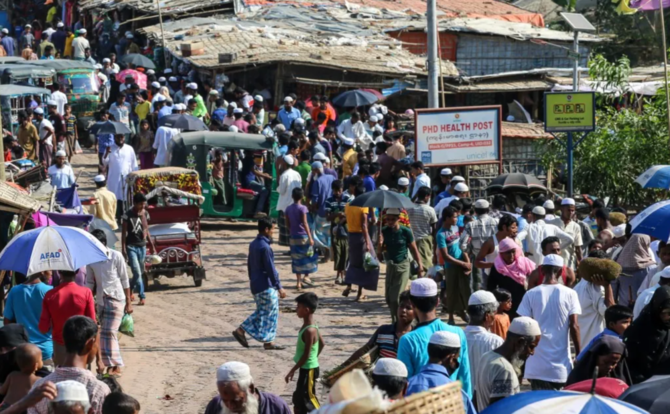
Rohingya gather at a market in Bangladesh’s Kutupalong refugee camp in Ukhia on May 15, 2020. (AFP)
Short Url
Updated 16 November 2023
Follow

Bangladesh welcomes historic consensus on OIC-sponsored Rohingya resolution

  • New UN resolution was tabled by OIC and EU, co-sponsored by 144 countries
  • It received the biggest international support since the beginning of Rohingya crisis

DHAKA: Bangladesh on Thursday welcomed a consensus on a UN resolution related to the repatriation to Myanmar of the 1.2 million Rohingya refugees it has sheltered for the past six years.

Hundreds of thousands of Rohingya Muslim refugees who fled a military crackdown in Myanmar in 2017 have sought shelter in neighboring Bangladesh.

They joined others who escaped persecution earlier and settled in squalid camps in Cox’s Bazar district, a coastal region in the country’s southeast that hosts the world’s largest refugee settlement.

The third committee of the UN General Assembly adopted the resolution on the situation of human rights of Rohingya Muslims and other minorities in Myanmar by consensus on Wednesday.

Tabled by the Organization of Islamic Cooperation and the EU, the resolution was co-sponsored by 114 countries, marking the biggest international support since the beginning of the Rohingya crisis.

“We welcome it. A solution to the Rohingya crisis is very important to us and we support the efforts. This time, 114 countries have co-sponsored the resolution initiated by the OIC. It’s a big thing,” Bangladeshi Foreign Minister Dr. Abdul Momen told Arab News.

The resolution urges Myanmar to create a conducive environment to facilitate the voluntary, safe and dignified return of the Rohingya to their homeland, and calls for swift implementation of the 2021 peace plan developed by members of the Association of Southeast Asian Nations to expedite the repatriation process.

The return of the Rohingya to Myanmar has been on the agenda for years, but a UN-backed repatriation process had yet to take off until now, despite pressure from Bangladesh amid dwindling financial support to host the large community.

Since March, repatriation has been negotiated between Bangladesh and Myanmar under a pilot scheme mediated by China, but Mizanur Rahman, Bangladesh’s refugee relief and repatriation commissioner in Cox’s Bazar, said that despite several visits and the compilation of data from an initial group of Rohingya willing to return, it remains unclear when the process will begin.

“Despite bilateral efforts being underway over the Rohingya repatriation, at the moment, I can’t say when it will begin. It totally depends on the overall situation in Myanmar,” he told Arab News.

“We want the Rohingya to be repatriated in a safe, dignified and voluntary way.”


Geoeconomic confrontation tops global risks in 2026: WEF report

Updated 14 January 2026
Follow

Geoeconomic confrontation tops global risks in 2026: WEF report

  • Also armed conflict, extreme climate, public polarization, AI
  • None ‘a foregone conclusion,’ says WEF’s MD Saadia Zahidi

DUBAI: Geoeconomic confrontation has emerged as the top global risk this year, followed by state-based armed conflict, according to a new World Economic Forum report.

The Global Risks Report 2026, released on Wednesday, found that both risks climbed eight places year-on-year, underscoring a sharp deterioration in the global outlook amid increased international competition.

The top five risks are geoeconomic confrontation (18 percent of respondents), state-based armed conflict (14 percent), extreme weather events (8 percent), societal polarization (7 percent) and misinformation and disinformation (7 percent).

The WEF’s Managing Director Saadia Zahidi said the report “offers an early warning system as the age of competition compounds global risks — from geoeconomic confrontation to unchecked technology to rising debt — and changes our collective capacity to address them.

“But none of these risks are a foregone conclusion.”

The report assesses risks across three timeframes: immediate (2026); short-to-medium term (next two years); and long term (next 10 years).

Economic risks show the largest overall increase in the two-year outlook, with both economic downturn and inflation jumping eight positions.

Misinformation and disinformation rank fifth this year but rise to second place in the two-year outlook and fourth over the 10-year horizon.

The report suggests this reflects growing anxiety around the rapid adoption of artificial intelligence, with adverse outcomes linked to AI surging from 30th place in the two-year timeframe to fifth in the 10-year outlook.

Uncertainty dominates the global risk outlook, according to the report.

Surveyed leaders and experts view both the short- and long-term outlook negatively, with 50 percent expecting a turbulent or stormy global environment over the next two years, rising to 57 percent over the next decade.

A further 40 percent and 32 percent, respectively, describe the outlook as unsettled across the two- and 10-year timeframes, while just 1 percent anticipate a calm global outlook in either period.

Environmental risks ease slightly in the short-term rankings. Extreme weather fell from second to fourth place and pollution from sixth to ninth. Meanwhile, critical changes to Earth systems and biodiversity loss dropped seven and five positions, respectively.

However, over the next decade, environmental threats re-emerge as the most severe, with extreme weather, biodiversity loss, and critical changes to Earth systems topping the global risk rankings.

Looking ahead over the next decade, around 75 percent of respondents anticipate a turbulent or stormy environmental outlook, making it the most pessimistic assessment across all risk categories.

Zahidi said that “the challenges highlighted in the report underscore both the scale of the potential perils we face and our shared responsibility to shape what comes next.”

Despite the gloomy outlook, Zahidi signaled a positive shift in global cooperation.

 “It is also clear that new forms of global cooperation are already unfolding even amid competition, and the global economy is demonstrating resilience in the face of uncertainty.”

Now in its 21st year, the Global Risks Report highlights a core message: global risks cannot be managed without cooperation.

As competition intensifies, rebuilding trust and new forms of collaboration will be critical, with the report stressing that today’s decisions will shape future outcomes.

The report was released ahead of WEF’s annual meeting, which will be held in Davos from Jan. 19 to 23.