

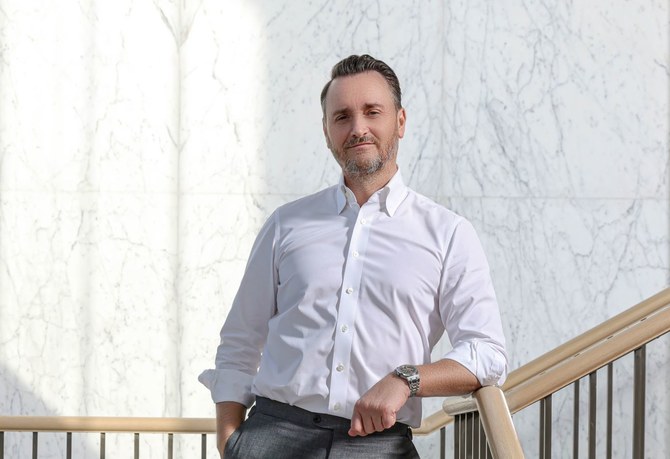

DUBAI: British celebrity chef Jason Atherton, founder-owner of multiple Michelin-starred restaurants, is no stranger to the Middle East. He recently opened his uber-exclusive Row on 45 restaurant at the Grosvenor House in Dubai, having launched City Social there earlier this year. Atherton is one of the most sought-after names in the food industry and calls himself “a total Dubai guy,” having met his wife in the city many years ago.
Given his love for the region, it’s no surprise that the chef also has an establishment in Saudi Arabia: Maraya Social in AlUla.
“It was in the middle of COVID, and we got asked by the Royal Commission of AlUla if we would like to put a restaurant in the middle of the desert on top of a mirrored building. And you go, ‘Well, sometimes in life, you just got to take a gamble.’ There was no point doing market research because there were no restaurants around there. So we took a gamble on whether anybody would even turn up in the middle of the desert. And they do! It’s amazing. It’s so busy. It’s crazy,” Atherton told Arab News.
Here, Atherton discusses tardy guests, his love of a Sunday roast, and his top tip for amateur chefs.
When you started out what was the most common mistake you made?
Rushing around too much trying to look busy. It’s a big mistake most young chefs make. Rather than being calm, calculated and efficient, young chefs tend to run around like a lunatic. A bit like a three-year-old boy — way too much energy and not knowing what to do with it.
What’s your top tip for amateur chefs?
One thing I’ve learned — and I’m 52 now — is that, no matter what discipline you’re taking up, when you’re starting out, keep it simple and stick to the basics. So, learn your disciplines properly, like pastry and sauce making. Everyone thinks that, if they scroll (through recipes and tutorials) for an hour, they’re going to be the next big sensation. But no one’s going to make you an amazing chef overnight, unfortunately. It just doesn’t happen.
What one ingredient can instantly improve any dish?
It’s more about the quality of the ingredients. So, if you’re in the supermarket, don’t just say, ‘OK, I need tomatoes,’ and pick the ones on the top. You need to really touch the tomato. When you press it at the bottom, has it got a little bit of give? Can you actually start to smell the fruit? The skin should move just a tiny bit, and if it doesn’t, then it’s not right.
When you go out to eat, do you find yourself critiquing the food? Or are you able to relax and enjoy it?
I have a very simple philosophy when I go out for dinner: I choose a restaurant based on the style of food I want to eat that particular evening and if I don’t enjoy it, I don’t go back. If I enjoy it, it goes on my list. And, you know, if I really enjoy it, then I take inspiration from it and make a few notes, take a few pictures. But I don’t critique it. It’s not for me to critique. I just think you’ll live a miserable existence if you go around judging yourself against everybody else.
What’s your go-to dish if you have to cook something quickly at home?
I’ve taught the children to make pasta, so we’ve always got pasta drying out or lying around somewhere. My four-year-old is going through a big pasta stage at the moment, so I tend to cook a lot of it at home.
What customer behavior most annoys you?
I find it really unreasonable when they’re late and then demand the service is quick. I had a private room of guests come in the other night for a business dinner and the lady was probably one of the rudest people I’ve come across for a long time. She was very rude to the staff. I just think it’s totally unnecessary. I mean, we’re all human beings. If you want the service to be quick, just say and we’ll do our best. But if you’ve turned up an hour-and-a-half late in the middle of the busiest part of the night… Also, there’s other people in the world just as important as you — you’re a business person, doesn’t mean you’ve cured cancer or you’re a brain surgeon. So, chill out, right?
What’s your favorite dish to cook and why?
I like cooking a Sunday roast and taking my time. No rush. I remember my mum making Sunday roast when I was a young kid and she’d have, like, 20 pans on the go, you know? I’ve brought it down to two roasting tins and mashed potatoes on the side, because I like mashed potatoes. I get two hot pans on the stove, sear my meat, stick that in the oven, get a little bit of a browning going on, stick my roast potatoes around it. Then I get the other pan hot, add garlic, thyme, rosemary, chop all of my vegetables in and make sure that they’re pretty much all the same size, stick ’em in the oven, I’m done. Just waiting for the meat to be cooked. While it’s resting, I take the tray out, put it back on the stove. Put in a little bit of vinegar, take all the sediment off the bottom, pour in the Oxo cubes — yes, I do Oxo cubes, scrape all the sediment off again, pass it, reduce it, and I’m done. I like that process. I’m not under pressure from a customer who’s wondering where their food is, I’m just happily cooking along and then the kids really enjoy Sunday lunch.
What are you like in the kitchen as a head chef?
The hardest thing as a leader is making sure that when you’re trying to teach somebody a better way of doing something just to make the product better, they can take it as feedback. Some people are really good at that, some people are not — some people have their defense mechanisms go up. So, you’ve got to understand how to break that barrier down. Over the years, I’ve got pretty good at it. I always explain that it’s for the greater good. And, at the same time, I always say that even a young chef who’s only been cooking for two years can teach me things, because they’ve been around the kitchens, right?


