

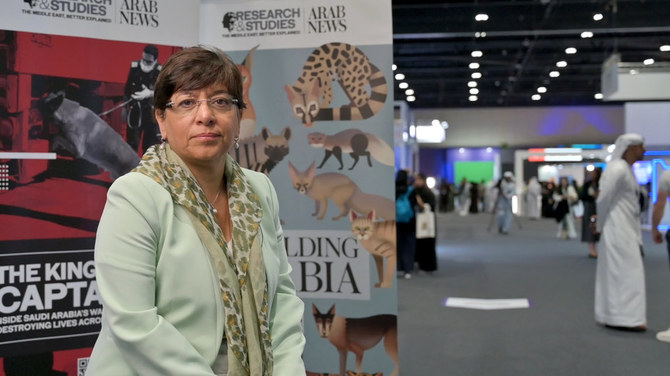
Speaking one language: CNN Arabic vice president highlights unifying power of the media

Caroline Faraj, vice president and editor-in-chief of CNN Arabic. (Supplied)
Short Url
Updated 17 November 2023
Follow

Speaking one language: CNN Arabic vice president highlights unifying power of the media

  • Caroline Faraj talks to Arab News about the evolution of the media landscape in the region and the increasingly important role of women and young people
  • She described the Global Media Congress in Abu Dhabi this week as ‘a very good opportunity for all media people to come from all over the world and … speak one language, which is media’

ABU DHABI: Caroline Faraj, vice president and editor-in-chief of CNN Arabic, advocated for a more open-minded approach within the media, and for the creative autonomy of the next generation of professionals, as she emphasized the unifying power of the industry.
In an interview with Arab News on the sidelines of the Global Media Congress in Abu Dhabi this week, she also highlighted the influential role of youth in shaping the modern media landscape, and the strides being taken by women in the industry.
“This is a very good opportunity for all media people to come from all over the world and gather here and speak one language, which is media,” she said of this week’s event in the Emirati capital.
It serves a crucial purpose in bringing together specialists to focus on truth and the common goals of the media, Faraj added, as she stressed the value of shared objectives irrespective of linguistic or organizational differences.
“Whether you speak the language of another network or entity or not, you have the same goal in front of you,” she said.


Welcoming the participation of youth, she said the event provides young people with a platform for expressing their ideas, as well as valuable opportunities for cross-generational learning.

Internationally recognized for her own contributions to the empowerment of women and youth, Faraj shared some insights into effective initiatives she has spearheaded.
Reflecting on CNN Arabic’s 20th anniversary last year, she highlighted the decision to celebrate the landmark in a meaningful way by focusing on equipping young Arab women with the tools to tell their stories. The “Her Story” project, for example, involved collaborations with nongovernmental organizations dedicated to helping Arab women and youth.
“We trained them how to tell their stories with the storytelling pillars, and we kept helping, supporting and advising them until they produced their stories,” Faraj explained.
While acknowledging the representation of women in the media industry in the Arab world has come a long way in recent years, she said there is still a lot of work to be done.
She contended that the adoption of an open-minded approach, and respect for the creative autonomy of the next generation, will be crucial for future leaders in the industry.
“In the Arab world, 70 percent of the population is under the age of 30,” Faraj said. “They are the ones who should be taking the decisions.”
Making mistakes is part of the journey, she said, adding: “They should learn from their mistakes but they should continue because that would definitely change the whole map of the media.”
The Global Media Congress began on Tuesday at the Abu Dhabi National Exhibition Center and concludes on Thursday.


Jailed French journalist files appeal in Algeria’s top court: lawyers

Updated 15 December 2025
Follow

Jailed French journalist files appeal in Algeria’s top court: lawyers

  • Gleizes was arrested in May 2024 after traveling to Tizi Ouzou in northeastern Algeria’s Kabylia region — home to the Amazigh Kabyle people — to write about the country’s most decorated football club, Jeunesse Sportive de Kabylie

ALGIERS: French journalist Christophe Gleizes, sentenced to seven years behind bars in Algeria on terror-related charges, has filed an appeal seeking a new trial with the country’s highest court, his lawyers said Sunday.
“Christophe Gleizes registered an appeal at (the court of) Cassation” on Sunday, the deadline for filing, his French lawyer Emmanuel Daoud told AFP in a message, declining to comment further.
Gleizes’ Algerian lawyer Amirouche Bakouri made a similar announcement on Facebook.
Earlier this month, an Algerian appeals court upheld the seven-year prison term for the sportswriter, who was first convicted of “glorifying terrorism” in June.
Gleizes was arrested in May 2024 after traveling to Tizi Ouzou in northeastern Algeria’s Kabylia region — home to the Amazigh Kabyle people — to write about the country’s most decorated football club, Jeunesse Sportive de Kabylie.
In 2021, he had met in Paris with the head of the Movement for the Self-Determination of Kabylie (MAK), a foreign-based group designated a terrorist organization by Algiers earlier that year.
At this month’s appeal hearing, Gleizes had said he did not know the MAK had been listed as a terrorist organization, and asked the court’s forgiveness for his “journalistic mistakes.”
The court’s decision to uphold his sentence was denounced by the rights group Reporters Without Borders (RSF), as well as the French government.
Gleizes’s jailing comes at a time of diplomatic friction between Paris and Algiers that began last year when France officially backed Moroccan sovereignty over the disputed Western Sahara region, where Algeria backs the pro-independence Polisario Front.
He is currently France’s only journalist imprisoned abroad, according to RSF, and French President Emmanuel Macron has vowed to work toward his release.

Mother makes plea

The mother of the jailed journalist Christophe Gleizes wrote a letter to Algeria’s president requesting he pardon her son from his seven-year sentence on terror-related charges.
“I respectfully ask you to consider granting Christophe a pardon, so that he may regain his freedom and his family,” Sylvie Godard wrote in the letter, which was dated December 10 and seen by AFP on Monday.
“Nowhere in any of his writings will you find any trace of statements hostile to Algeria and its people,” she wrote in her letter to President Abdelmadjid Tebboune.