RIYADH: The European Music Week in Riyadh is bringing audiences classical, pop, folk and jazz sounds to celebrate the “dynamism and richness of relations” between Saudi Arabia and the EU.
The EU delegation, in partnership with the embassies of EU member states and the Saudi Music Commission, inaugurated the event on Nov. 11.
Running until Nov. 20 at the Saudi Music Hub, the festival is hosting a rich selection of artists from Portugal, Denmark, Spain, Germany, France, Italy, Estonia, Greece and the Netherlands.
Christophe Fernand, ambassador of the EU, told Arab News: “Tonight is the launch of the European Music Week. It is a unique occasion; it is an event that did not exist before. This is a very important moment for Saudi Arabia and the EU. It reflects the dynamism and richness of the relations. The economic partnership must be strengthened by a cultural partnership.”
The ambassador added: “We live in a world where trade is increasingly important. It is fundamental that people learn to know each other, to better understand each other and this goes through culture in the general sense of the term. Tonight, it is the turn of music to bring together two cultures as rich and diverse as each other.
“Music today is an opportunity to have a good time together and also to know each other.”
Faisal Al-Gain, director general of the Saudi Music Hub, told Arab News: “This is an important event because our goal is to celebrate culture. It is, therefore, an incredible opportunity that allows us to celebrate musical art, and to promote new co-creation and new content.
“So, we could really embrace this art and look at best practices and how we can work together, whether it’s in the form of performances or from an educational perspective, to see how we can improve the quality of music.”
Since Nov. 11, the Saudi public and music enthusiasts at the festival have explored European music, including contemporary Portuguese sound, courtesy of the group Almanata, a collective made up of Portuguese friends living in Riyadh.
Louise Tuxen, a Danish singer and composer, showed her rich and emotive repertoire at the festival. Whether singing in Danish or English, her melodies explore themes of life, family, friendship, happiness, sadness and death.
Tuxen captivated the audience with her warm voice, offering a delightful musical journey through a small corner of Denmark.
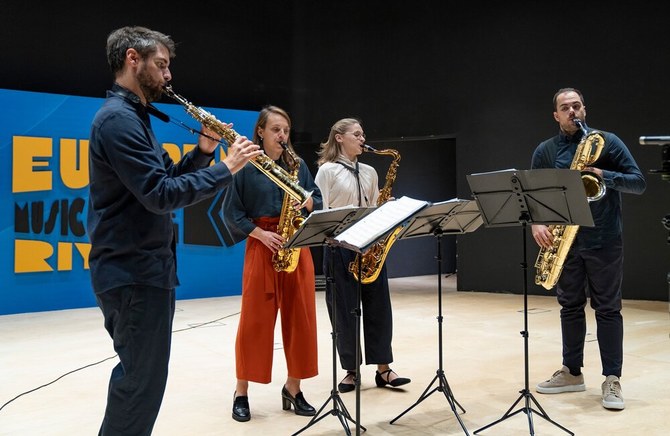
The Arcis Saxophone Quartet brought German sounds to the event through its four talented members: Claus Hierluksch, Ricarda Fuss, Anna-Marie Schafer and Jure Knez.
French-Maltese singer Cynthia Queenton blends charm and talent, and is widely recognized for her vocals through advertising jingles aired on French television.
Queenton blends “swing poppy jazz” with a “French touch.” Raised on the sounds of Ella Fitzgerald, Antonio Carlos Jobim, Cole Porter and Michel Legrand, she honed her craft at the Academie de musique et de danse Classique de Paris.
Audiences will also have the opportunity to attend concerts featuring artists from Italy, Estonia, Greece and the Netherlands.

From jazz to classical: European Music Week takes center stage in Riyadh
https://arab.news/ckmpn
From jazz to classical: European Music Week takes center stage in Riyadh
- The EU delegation, in partnership with the embassies of EU member states and the Saudi Music Commission, inaugurated the event on Nov. 11
- Envoy says festival is ‘very important moment’ for Saudi Arabia and the EU
Saudi Arabia has told Iran not to attack it, warns of possible retaliation, sources say
Saudi Arabia has told Tehran that while it favors a diplomatic settlement to Iran’s conflict with the United States, continued attacks on the kingdom and its energy sector could push Riyadh to respond in kind, four sources familiar with the matter told Reuters.
The message was conveyed before a speech on Saturday in which Iranian President Masoud Pezeshkian apologized to neighboring Gulf states for Tehran’s actions – an apparent attempt to defuse regional anger over Iranian strikes that hit civilian targets.
Two days earlier, Saudi Foreign Minister Prince Faisal bin Farhan spoke to Iranian Foreign Minister Abbas Araghchi and set out Riyadh’s position with clarity, the sources said.
Saudi Arabia is open to any form of mediation aimed at de‑escalation and a negotiated settlement, the sources quoted the minister as saying, underlining that neither Riyadh nor other Gulf states had let the US use their airspace or territory to launch airstrikes on Iran.
But Prince Faisal was also quoted by the sources as saying that if Iranian attacks persisted against Saudi territory or energy infrastructure, Saudi Arabia would be forced to permit US forces to use their bases there for military operations. Riyadh would retaliate if attacks on the kingdom’s critical energy facilities continued, he said.
The sources said the kingdom had remained in regular contact with Tehran through its ambassador since the US and Israeli military campaign against Iran began on February 28 following the collapse of talks on Iran’s nuclear program.
The Saudi and Iranian foreign ministries did not respond to requests for comment.
Drone and missile attacks on Gulf states
The United Arab Emirates, Kuwait, Qatar, Bahrain and Saudi Arabia have all come under heavy drone and missile fire from Iran over the past week.
Iran’s Supreme Leader, Ayatollah Ali Khamenei, was killed on the first day of the war. Tehran responded by hitting Israel and Gulf Arab states hosting US military installations, and Israel has attacked Lebanon’s Iran-backed Hezbollah armed group.
Araghchi said in an interview on Saturday that he remained in constant contact with his Saudi counterpart and other Saudi officials, adding that Riyadh had assured Tehran it was fully committed to not allowing its territory, waters or airspace to be used for attacks against Iran.
Pezeshkian said Iran’s temporary leadership council had approved suspending attacks on nearby countries – unless an attack on Iran came from those nations.
“I personally apologize to neighboring countries that were affected by Iran’s actions,” he said.
To what extent Pezeshkian’s remarks signal a change is unclear. There were further reports of strikes directed at Gulf states on Saturday.
Also, in a sign of possible divisions within Iran’s leadership, Khatam Al-Anbiya Central Headquarters – the unified combatant command of the Iranian armed forces – said in a statement afterwards that US and Israeli bases and interests across the region would remain targets.
The command said Iran’s armed forces respected the sovereignty and interests of neighboring states and had not taken action against them so far. But it said US and Israeli military bases and assets on land, at sea and in the air across the region would be treated as primary targets and face “powerful and heavy” strikes by Iran’s forces.
US President Donald Trump said in a social media post that Iran had “apologized and surrendered to its Middle East neighbors, and promised that it will not shoot at them anymore. This promise was only made because of the relentless US and Israeli attack.”
Two Iranian sources confirmed that a call had taken place in which Riyadh warned Tehran to halt attacks on Saudi Arabia and neighboring Gulf states. Iran, they said, reiterated its position that the strikes were not aimed at Gulf countries themselves but at US interests and military bases hosted on their territory.
One Iranian source said that Tehran had in response demanded that US bases in the region be closed and some Gulf states stop sharing intelligence with Washington that Iran believes is being used to carry out attacks against it.
Another Iranian source said some military commanders were pressing to continue the strikes, accusing the US of using bases in Gulf states and these countries’ airspace to conduct operations against Iran.
Iran had in recent years mended fences with its Gulf neighbors, including former regional archrival Saudi Arabia. The diplomatic campaign imploded in the blitz of drones and missiles launched by Iran’s Revolutionary Guards in the past week.