

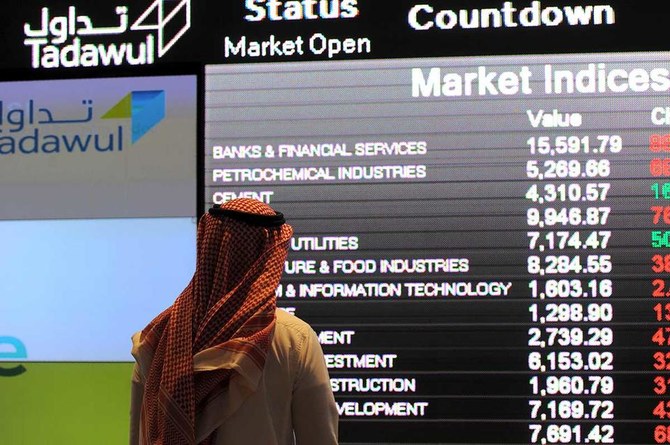
Saudi exchange sees foreign net inflows rebound with $3.7bn

According to Tadawul, foreign ownership increased in 111 companies listed on the Saudi exchange in the first two weeks of November. File
Short Url
Updated 15 November 2023
Follow

Saudi exchange sees foreign net inflows rebound with $3.7bn

RIYADH: International investors made a huge comeback into the Saudi Stock Exchange, or Tadawul, as they infused SR12.7 billion ($3.7 billion) in the first two weeks of November. 

According to Tadawul, foreign ownership increased in 111 companies listed on the Saudi exchange in the first two weeks of November. 

The rally came as a surprise as foreign investors sold shares worth SR26 billion in October, fearing market uncertainties due to the escalation of the Israel-Hamas war. 

Etihad Atheeb Communications was one of the biggest beneficiaries as foreign investors picked up 85,405 shares in November, increasing their stake to 3.26 percent from 2.9 percent in October.  

However, the spotlight was on the insurance sector as three companies saw some decent buying. 

In the last five days, foreign ownership in Al Sagr Cooperative Insurance Co., Malath Cooperative Insurance Co., and United Cooperative Assurance Co. jumped 0.36 percent, 0.76 percent and 0.21 percent, respectively.  

However, international investments decreased in 48 companies so far in November. 

For instance, the foreign ownership in Maharah Human Resources Co. decreased by 0.41 percent to 5.80 percent. 

Other companies that witnessed an outflow in the first two weeks of November were Al Mawarid Manpower Co. and Saudi Enaya Cooperative Insurance Co., which saw a decline of 0.33 percent and 0.22 percent, respectively. 

“Capital flight can be quite indiscriminate. It’s not necessarily 100 percent based on the fundamentals of each country. And so, obviously, there’s a perception that risks are increasing throughout the region. And we’re seeing a negative impact as a result of that,” said Torbjorn Soltvedt, principal analyst for the Middle East and North Africa with Verisk Maplecroft, told Reuters. 

Despite geopolitical tensions, Saudi Arabia’s main index, the Tadawul All Share Index, continued its upward trend on Nov.15. The index closed 165.79 points higher to 11,022.89, while the parallel market, Nomu, also edged up 332.52 points to 23,129.38. 

Earlier this month, Saudi Arabia’s Investment Ministry revealed that foreign direct investments to the Kingdom amounted to SR122 billion in 2022, thus placing the nation in the 10th rank among the G20 economies last year. 


Lebanese social entrepreneur Omar Itani recognized by Schwab Foundation

Updated 23 January 2026
Follow

Lebanese social entrepreneur Omar Itani recognized by Schwab Foundation

  • FabricAID co-founder among 21 global recipients recognized for social innovation

DAVOS: Lebanon’s Omar Itani is one of 21 recipients of the Social Entrepreneurs and Innovators of the Year Award by the Schwab Foundation for Social Entrepreneurship.

Itani is the co-founder of social enterprise FabricAID, which aims to “eradicate symptoms of poverty” by collecting and sanitizing secondhand clothing before placing items in stores in “extremely marginalized areas,” he told Arab News on the sidelines of the World Economic Forum in Davos, Switzerland.

With prices ranging from $0.25 to $4, the goal is for people to have a “dignified shopping experience” at affordable prices, he added.

FabricAID operates a network of clothing collection bins across key locations in Lebanon and Jordan, allowing people to donate pre-loved items. The garments are cleaned and sorted before being sold through the organization’s stores, while items that cannot be resold due to damage or heavy wear are repurposed for other uses, including corporate merchandise.

Since its launch, FabricAID has sold more than 1 million items, reached 200,000 beneficiaries and is preparing to expand into the Egyptian market.

Amid uncertainty in the Middle East, Itani advised young entrepreneurs to reframe challenges as opportunities.

“In Lebanon and the Arab world, we complain a lot,” he said. Understandably so, as “there are a lot of issues” in the region, resulting in people feeling frustrated and wanting to move away. But, he added, “a good portion of the challenges” facing the Middle East are “great economic and commercial opportunities.”

Over the past year, social innovators raised a combined $970 million in funding and secured a further $89 million in non-cash contributions, according to the Schwab Foundation’s recent report, “Built to Last: Social Innovation in Transition.”

This is particularly significant in an environment of geopolitical uncertainty and at a time when 82 percent report being affected by shrinking resources, triggering delays in program rollout (70 percent) and disruptions to scaling plans (72 percent).

Francois Bonnici, director of the Schwab Foundation for Social Entrepreneurship and a member of the World Economic Forum’s Executive Committee, said: “The next decade must move the models of social innovation decisively from the margins to the mainstream, transforming not only markets but mindsets.”

Award recipients take part in a structured three-year engagement with the Schwab Foundation, after which they join its global network as lifelong members. The program connects social entrepreneurs with international peers, collaborative initiatives, and capacity-building support aimed at strengthening and scaling their work.