

Turkiye’s Erdogan calls Israel ‘terror state’

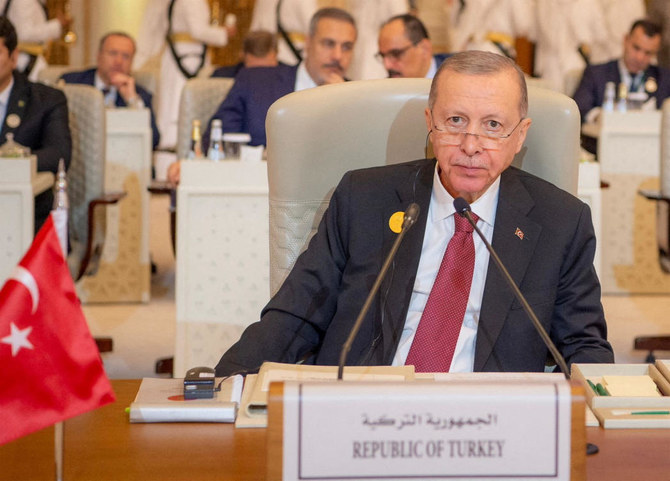
Turkish President Tayyip Erdogan also called on Israeli Prime Minister Benjamin Netanyahu to announce whether Israel had nuclear bombs or not. (SPA via Reuters)
Short Url
Updated 15 November 2023
Follow

Turkiye’s Erdogan calls Israel ‘terror state’

  • Reiterates his view that Palestinian militant group Hamas is not a terrorist organization

ANKARA: Turkish President Recep Tayyip Erdogan said on Wednesday Israel was a “terror state” committing war crimes and violating international law in Gaza, sharpening his repeated criticism of Israeli leaders and their backers in the West.

Speaking two days before a planned visit to Germany to meet Chancellor Olaf Scholz, Erdogan said Israel’s military campaign against Palestinian militant group Hamas included “the most treacherous attacks in human history” with “unlimited” support from the West.

He called for Israeli leaders to be tried for war crimes at the International Court of Justice in The Hague, and repeated his view — and Turkiye’s position — that Hamas is not a terrorist organization but a political party that won past elections.

Britain, the US, EU and some Arab states deem Hamas a terrorist group, unlike Turkiye. Ankara hosts some members of Hamas and supports a two-state solution to the Israeli-Palestinian conflict.

“With the savagery of bombing the civilians it forced out of their homes while they are relocating, it is literally employing state terrorism,” Erdogan said of Israel in parliament. “I am now saying, with my heart at ease, that Israel is a terror state.”

He said: “We will never shy away from voicing the truth that Hamas members protecting their lands, honor, and lives in the face of occupation policies are resistance fighters, just because some people are uncomfortable with it.”

Erdogan’s trip to Germany would be his first to a Western nation since Israel began bombarding Gaza on Oct. 7 in response to Hamas’s attacks. 

Germany has expressed strong solidarity with Israel, while urging a focus on limiting the impact of military operations on Gaza’s civilian population.

“The West, namely the US, is unfortunately still seeing this issue backwards,” Erdogan said.

He called on Prime Minister Benjamin Netanyahu to announce whether or not Israel had nuclear weapons, and added that Netanyahu would soon be a “goner” from his post.

He likened the conflict between Israel, a Jewish state, and the Palestinians to a war between the Christian and Muslim worlds, saying the fighting was “a matter of cross and crescent.”

Ankara would take steps to ensure Israeli settlers in occupied Palestinian territories are recognized as “terrorists,” he added.

Spanish Prime Minister Pedro Sanchez urged Israel to end the “indiscriminate killing of Palestinians” in Gaza, in his sharpest criticism of Israel since war against Hamas broke out over a month ago.

“We demand an immediate ceasefire on the part of Israel in Gaza and strict compliance with international humanitarian law, which today is clearly not respected,” he said during a debate in parliament ahead of a vote in confidence on Thursday in which he is poised to be re-appointed for another term.

“Let there be no doubt, we stand with Israel in rejecting and its response to the terrorist attack that this country suffered in October,” the socialist premier added before calling for the “immediate release” of the hostages kidnapped by Hamas.

“But with the same clarity we reject the indiscriminate killing of Palestinians in Gaza and the West Bank,” he said. Shortly after he spoke the leader of far-left party Podemos, acting social rights minister Ione Belarra, reiterated on social media her call for Spain to break diplomatic ties with Israel and impose economic sanctions on the country.

“We need much more than words in an investiture debate to halt the planned genocide that Israel in carrying out in Palestine,” she wrote on X.

Canadian Prime Minister Justin Trudeau said the killing “of women, of children, of babies” in the Israel-Hamas war must stop, sparking a strong rebuke from Israeli leader Benjamin Netanyahu.

“The world is watching, on TV, on social media, we are hearing the testimonies of doctors, family members, survivors, kids who have lost their parents,” Trudeau said at an event in British Columbia province.

“The world is witnessing this killing of women, of children, of babies. This has to stop.”

Netanyahu hit back at Trudeau’s criticism. “It is not Israel that is deliberately targeting civilians but Hamas that beheaded, burned and massacred civilians in the worst horrors perpetrated on Jews since the Holocaust,” Netanyahu posted on X.

Trudeau said Hamas “needs to stop using Palestinians as human shields” and that they “need to release all the hostages immediately and unconditionally.”

Referring to Gaza’s main hospital, which has in recent days become one of the focal points of the Israel-Hamas war, he said: “The human tragedy that is unfolding in Gaza is heart-wrenching, especially the suffering we see in and around the Al-Shifa Hospital.”

Trudeau urged the government of Israel to “exercise maximum restraint.”


Washington presses Syria to shift from Chinese telecom systems

Updated 59 min 6 sec ago
Follow

Washington presses Syria to shift from Chinese telecom systems

  • Syria is exploring the possibility of procuring Chinese technology
  • It was unclear whether the United States ⁠pledged financial or logistical support to Syria to do so

DAMASCUS: The United States has warned Syria against relying on Chinese technology in its telecommunications sector, arguing it conflicts with US interests and threatens US national security, according to three sources familiar with the matter.
The message was conveyed during an unreported meeting between a US State Department team and Syrian Communications Minister Abdulsalam Haykal in San Francisco on Tuesday. Washington has been coordinating closely with Damascus since 2024, when Syria’s now President Ahmed Al-Sharaa ousted longtime leader Bashar Assad, who had a strategic partnership with China.
Syria is exploring the possibility of procuring Chinese technology to support its telecommunications towers and the infrastructure of local Internet service providers, according to a Syrian businessman involved in the procurement talks.
“The US side asked for clarity on the ministry’s plans regarding Chinese telecom equipment,” said ⁠another source briefed on ⁠the talks.
But Syrian officials said infrastructure development projects were time-critical and that Damascus was seeking greater vendor diversity, the source added.
SYRIAN OFFICIALS CITE US EXPORT CONTROLS AS TELECOMS BARRIER
Syria is open to partnering with US firms but the matter was urgent and export controls and “over-compliance” remained an issue, according to person familiar with the meeting in San Francisco.
A US diplomat familiar with the discussions told Reuters that the US State Department “clearly urged Syrians to use American technology or technology from allied countries in the telecoms sector.”
It was unclear whether the United States ⁠pledged financial or logistical support to Syria to do so.
Responding to Reuters questions, a US State Department spokesperson said: “We urge countries to prioritize national security and privacy over lower-priced equipment and services in all critical infrastructure procurement. If it seems too good to be true, it probably is.”
The spokesperson added that Chinese intelligence and security services “can legally compel Chinese citizens and companies to share sensitive data or grant unauthorized access to their customers’ systems” and promises by Chinese companies to protect customers’ privacy were “entirely inconsistent with China’s own laws and well-established practices.”
China has repeatedly rejected allegations of it using technology for spying purposes.
The Syrian Ministry of telecommunications told Reuters any decisions related to equipment and infrastructure are made “in accordance with national technical and security standards, ensuring data protection and service continuity.”
The ministry said it is also prioritizing the diversification of partnerships and technology sources to ⁠serve the national interest.
Syria’s telecom ⁠infrastructure has relied heavily on Chinese technology due to US sanctions imposed on successive Assad governments over the civil war that grew from a crackdown on anti-government protests in 2011.
Huawei technology accounts for more than 50 percent of the infrastructure of Syriatel and MTN, the country’s only telecom operators, according to a senior source at one of the companies and documents reviewed by Reuters. Huawei did not immediately respond to a request for comment.
Syria is seeking to develop its private telecommunications sector, devastated by 14 years of war, by attracting foreign investment.
In early February, Saudi Arabia’s largest telecom operator, STC, announced it would invest $800 million to “strengthen telecommunications infrastructure and connect Syria regionally and internationally through a fiber-optic network extending over 4,500 kilometers.”
The ministry of telecommunications says that US restrictions “hinder the availability of many American technologies and services in the Syrian market,” emphasizing that it welcomes expanding cooperation with US companies when these restrictions are lifted.
Syria has inadequate telecommunications infrastructure, with network coverage weak outside city centers and connection speeds in many areas barely exceeding a few kilobits per second.