

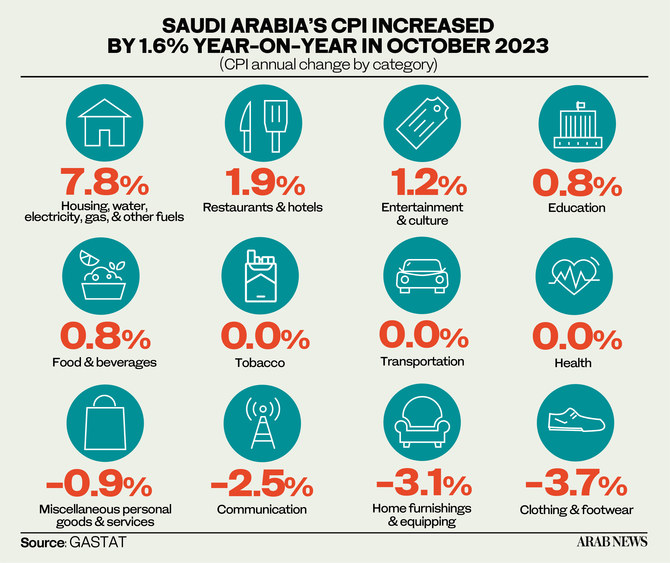

RIYADH: Saudi Arabia’s consumer price index fell to 1.6 percent in October from 1.7 percent in September, official data showed.
According to the General Authority for Statistics, inflation fell due to a 0.8 percent dip in personal goods and services expenses in October.
Prices for furnishings and household equipment also witnessed a monthly drop of 0.3 percent in October.
Clothing and footwear expenses also decreased by 0.3 percent during the same period.
On the other hand, food and beverage prices increased by 0.6 percent month on month in October, while expenses for education also rose by 0.9 percent.
Saudi Arabia’s resilience in controlling the inflation rate comes in line with the predictions made by the International Monetary Fund.
In June, the IMF had projected that the inflation rate in Saudi Arabia will average at 2.8 percent in 2023 amid global economic headwinds.
The Washington-based lendor had claimed in April that the possibilities of a rise in headline and core inflation in oil-exporting countries like Saudi Arabia are low.
“Headline and core inflation in many oil-exporting countries like Bahrain, Iraq, Kuwait, Oman, Qatar, and Saudi Arabia remain relatively lower than elsewhere — as subsidies and caps on certain products, the strengthening of the US dollar to which many of the countries peg their currencies, and limited share of food in the consumer price index basket have helped to offset imported inflationary pressures,” said the IMF.
Moreover, the overall inflation rate in Saudi Arabia increased by 1.6 percent in October compared to the year-ago period.
The annual rise in inflation was mainly attributed to higher housing rent prices, which recorded a significant increase of 9.3 percent.
“Prices for rents were the main driver of the inflation rate in October 2023 due to their high relative importance in the Saudi consumer basket with a weight of 21 percent,” said GASTAT in the report.
On an annual basis, food and beverage expenses increased by 0.8 percent, primarily driven by the rise in milk products and egg prices by 4.4 percent.
In contrast, furnishings, household equipment, and maintenance prices dipped by 3.1 percent in October 2023, compared to the same month of the previous year.
Meanwhile, in another report, GASTAT revealed that Saudi Arabia’s wholesale price index increased by 1 percent in October, compared to the year-ago period.
GASTAT attributed the rise in WPI to an increase in prices of dairy products which went up by 14.5 percent in the same period.
Compared to September 2023, the Kingdom’s WPI rose by 0.5 percent as a result of the increase in the prices of transportable goods which surged by 1.8 percent.


