ISLAMABAD: Pakistan, Afghanistan and Uzbekistan have set up a trade working group, the prime minister’s office in Islamabad said on Tuesday after the conclusion of the first trilateral meeting between the three nations.
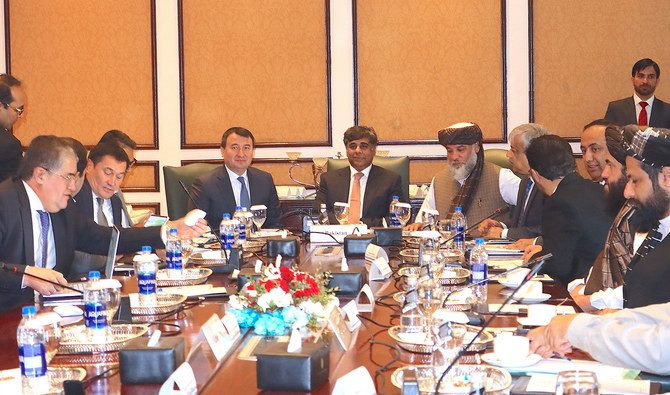
The tripartite meeting in Islamabad was co-chaired by the commerce ministers of Pakistan and Afghanistan, and the deputy prime minister of Uzbekistan. The three countries have been working on plans for trade transit and railway connections between South and Central Asia that would cross through Afghanistan.
“The three sides also established a trilateral working group to discuss customs, logistics, trade promotion, tariffs, TIR procedures, etc,” the PMO said in a statement after a meeting between Deputy Prime Minister of Uzbekistan, Dr. Jamshid Khodjaev Abdukhakomovich, and Caretaker Pakistani Prime Minister Anwaar-ul-Haq Kakar in Islamabad.
“Showing satisfaction at the outcome of the trilateral meeting, the Prime minister hoped that the trilateral mechanism would boost trade relations between the three countries.”
“Kakar expressed satisfaction at the pace of bilateral engagements between the two countries especially in the areas of trade, defense and connectivity,” the statement added. “The Prime Minister underlined the need to continue momentum of people-to-people exchanges.”
Kakar said easy visa procedures, improved banking channels and reciprocal warehousing facilities would further boost trade between the two countries and hoped the business communities of both nations could easily achieve the bilateral trade target of $ 1 billion “in a short time.”
“The meeting focused on boosting trade relations among the three nations,” a statement from the Pakistani commerce ministry said after talks concluded. “Discussions centered around reducing trade barriers, simplifying customs procedures, and promoting smoother cross-border trade.”
The officials also discussed regional connectivity and enhancing transportation networks and promoting infrastructure development to facilitate the movement of goods.
“By promoting economic interdependence and cooperation, we can build a foundation for sustainable development and prosperity in the region,” Pakistani commerce minister Dr. Gohar Ejaz was quoted by the statement as saying.
“By leveraging their strengths and resources, Pakistan, Afghanistan, and Uzbekistan can tap into new markets and expand their economies,” the minister added.


Pakistan, Afghanistan, Uzbekistan set up trade working group at first trilateral meeting
https://arab.news/yjk6q
Pakistan, Afghanistan, Uzbekistan set up trade working group at first trilateral meeting

- Three countries working on plans for trade transit, railway connections between South and Central Asia that would cross through Afghanistan
- Tripartite meeting in Islamabad co-chaired by commerce ministers of Pakistan and Afghanistan, deputy prime minister of Uzbekistan


Pakistani PM to attend Board of Peace summit as part of Islamic bloc effort — FO
- Board will hold its first meeting on Feb. 19 in Washington to discuss Gaza’s reconstruction
- Foreign office spokesman says no dates finalized for visit to Pakistan by Saudi Crown Prince
ISLAMABAD: Pakistan confirmed on Thursday that Prime Minister Shehbaz Sharif will attend the first meeting of President Donald Trump’s newly formed “Board of Peace” in Washington on Feb. 19, positioning Islamabad as part of a joint Islamic diplomatic initiative focused on Gaza.
A UN Security Council resolution, adopted in mid-November, authorized the board and countries working with it to establish an international stabilization force in Gaza, where a fragile ceasefire began in October under a Trump plan on which Israel and Palestinian militant group Hamas signed off.
Under Trump’s Gaza plan, the board was meant to supervise Gaza’s temporary governance. Trump thereafter said the board, with him as chair, would be expanded to tackle global conflicts. The board will hold its first meeting on Feb. 19 in Washington to discuss Gaza’s reconstruction.
Speaking at a weekly press briefing in Islamabad, Foreign Office spokesperson Tahir Andrabi confirmed Sharif’s participation.
“Yes, I can confirm that the prime minister will attend the Board of Peace meeting... He will be accompanied by the deputy prime minister,” Andrabi said, describing Pakistan’s participation as part of a broader collective engagement by Muslim-majority states.
“We have joined the Board of Peace in good faith… We are in it, not in isolation, not as one voice, but as a collective voice of eight Islamic Arab countries,” he said.
“Our collective voice is resonating in the Board of Peace, and we will continue to strive for the right and progress and prosperity of the people of Palestine. And also aimed at the long-term solution of the Palestine issue in order to create a state of Palestine in accordance with the pre-1967 border with Al-Quds Al-Sharif as its capital.”
Pakistan does not recognize Israel and has consistently supported a two-state solution based on pre-1967 borders, with East Jerusalem as the capital of a future Palestinian state.
Responding to reports about a possible visit to Pakistan by Saudi Crown Prince Mohammed bin Salman, Andrabi said no dates had been finalized.
“There was a reference to the visit in one of the joint statements [issued after two visits of Sharif to Saudi Arabia last year] that this visit will take place this year. But I am not aware of its timing as yet,” the FO spokesman said.
Andrabi also addressed Pakistan’s financial engagement with the United Arab Emirates, confirming that Abu Dhabi had rolled over $2 billion in deposits with Pakistan’s central bank.
“The tenure of the rollover is prerogative of the depositor. But what I can assure you is that through the positive role of the Deputy Prime Minister and Foreign Minister [Ishaq Dar], we can say that the rollover is assured,” he said.
Last month, Pakistan’s central bank confirmed the extension of the $2 billion deposit, which has helped support the country’s foreign exchange reserves as Islamabad implements reforms under an ongoing International Monetary Fund bailout program.
Andrabi added that Pakistan currently faces “no external finance gap.”


