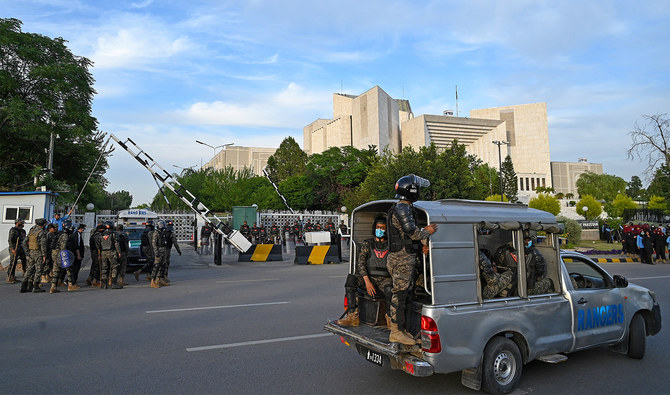

ISLAMABAD: Pakistan’s Senate passed a resolution on Monday urging the top court to review its decision to declare null and void the military trials of civilians arrested for the violent nationwide protests on May 9, saying that the judgment should not be implemented unless it is considered by a larger bench of the Supreme Court.
A five-member bench of the Supreme Court, headed by Justice Ijazul Ahsan, declared the trial of civilians by military courts null and void last month by a majority of 4-1. The Pakistan government and army said earlier this year that suspects accused of attacking army installations in countrywide protests on May 9, in the wake of the former prime minister Imran Khan’s brief arrest, would be tried in military courts.
The announcement faced widespread criticism from within Pakistan and rights organizations globally because of the secretive nature of military courts and their existence alongside a functioning civilian legal system. Pakistan’s Army Act of 1952 established military courts primarily to try members of the military or enemies of the state. Civilians can only be tried under a federal government order. Civilians accused of offenses such as “waging war” against the armed forces or law enforcement agencies, or attacking military installations or inciting “mutiny,” can be tried at military courts.
During a hearing on June 27, the federal government had assured the court that a formal trial had not yet commenced against 102 individuals held by military authorities in connection with the May 9 violent protests.
The resolution, tabled in the upper house of Pakistan’s parliament by Senator Dilawar Khan, said of the Supreme Court’s verdict that “prima facie an attempt has been made to rewrite the law by impinging upon the legislative authority of Parliament.”
“The Senate of Pakistan calls upon the apex court to reconsider its decision, urging alignment with the national security paradigm and sacrifices of the martyrs,” a copy of the resolution seen by Arab News, stated. “In order to address the concerns raised regarding the ramifications of the judgment on the security and stability of the nation.”
The resolution said the military trial of those accused of attacking military properties on May 9 under the Army Act “is an appropriate and proportional response in line with Pakistan’s existing constitutional framework and statutory regime.”
It said the Supreme Court’s judgment annuls sacrifices made by Pakistan’s armed forces, civilians and law enforcement agencies in combating “terrorism” as military courts have played a prominent role in addressing “terrorism” by ensuring those who committed acts of terror are brought to justice.
The resolution expressed dismay at the Supreme Court for not considering existing procedures that clarify that military courts’ sentences are not arbitrary and have to be conducted following due processes and formalities.
“The existence of an appeal process against Military Court orders, which involves appeal avenues with the Chief of Army Staff and the President, as well as the option to file writ petitions in High Courts that may eventually reach the Supreme Court, has been overlooked,” the resolution said.
On the protests of May 9, the resolution said it would be remembered as a “dark day” and condemned the “anti-state acts” that were committed against Pakistan’s armed forces.
“The culprits of 9th May, who blatantly attacked defense installations and disgracefully dismantled memorials of martyrs, deserve no empathy or leniency,” the resolution said. “Rather they should be tried in Military Courts and stringent punishments be given to make them an example for internal and external enemies to Pakistan by creating a deterrence and upholding the supremacy of State.”
The resolution noted that the bench led by Justice Ahsan was not in unanimity, as opposed to previous benches which upheld trials of civilians under the Army Act. “Hence the decision is legally flawed and should not be implemented unless it is considered by a larger bench,” it said.
According to Pakistan’s English-language newspaper Dawn, the resolution was passed in the presence of less than a dozen senators. Pakistan Peoples Party (PPP) Senator Raza Rabbani and Jamaat-e-Islami’s (JI) Mushtaq Ahmed voted against it.