



RIYADH: Palestinian President Mahmoud Abbas called on the US to “stop the Israeli aggression and end the occupation to protect our people” during the Joint Arab-Islamic Extraordinary Summit in Riyadh on Saturday.
Saudi Arabia hosted the summit, which brought together leaders from the Islamic and Arab worlds to discuss the worsening situation in Gaza.
In his opening remarks, Crown Prince Mohammed bin Salman said that “we are facing a humanitarian catastrophe that testifies to the failure of the (UN) Security Council and the international community to put an end to the flagrant Israeli violations of international laws and norms and international humanitarian law.”
The crown prince added that this poses a threat to international security and stability, and that all leaders must unite to take effective action to confront the situation.
During his speech, the crown prince renewed demands to “immediately cease military operations, provide humanitarian corridors for civilians, and enable international humanitarian organizations to perform their role.”
He also affirmed the Kingdom’s “condemnation and categorical rejection of the senseless war against our brothers in Palestine which has claimed the lives of thousands of unarmed civilians, including women, children and the elderly.”
Joint efforts by Saudi Arabia, the Arab League, and the Organization of Islamic Cooperation brought world leaders together in Riyadh for the summit.
Senior figures who took part included Arab League Secretary-General Ahmed Aboul Gheit, Turkish President Recep Tayyip Erdogan, OIC Secretary-General Hissein Brahim Taha, and Commissioner-General of the UN Relief and Works Agency for Palestine Refugees Philippe Lazzarini.
Also in attendance were Iranian President Ebrahim Raisi, Malaysian Prime Minister Anwar Ibrahim, Egypt President Abdel Fattah El-Sisi, UAE Vice President Mansour bin Zayed Al-Nahyan, Lebanese Prime Minister Najib Azmi Mikati, and Indonesian President Joko Widodo.
In his remarks, Taha said that the summit reaffirms absolute support for the Palestinian people. He highlighted the joint commitment to defending the Palestinian cause and the issue of Jerusalem, a key goal of the OIC.
Taha said that “everyone has witnessed the horrifying scenes and ethnic cleansing perpetrated by the Israeli occupation forces in Gaza,” and stressed the urgency of documenting and utilizing the available legal and international mechanisms to hold the occupying government accountable.
He also called for an immediate ceasefire and a halt to attacks on Gaza’s residents, the opening of safe passages for continuous aid delivery, and ensuring the safety of the Palestinian people.
Taha expressed his rejection of the forced displacement targeting the Palestinian people, and urged the “international community to take necessary actions against the measures undertaken by the occupying government of Israel.”
He called on the UN Security Council to “play its role, emphasizing the necessity for the Israeli occupation authorities to comply with human rights and implement all international norms.”
Aboul Gheit said that Israel’s assault on Gaza is not an isolated incident and expressed hope that it will be the last.
He said that since Israel began its occupation of the Gaza Strip, it has sought to eradicate or force the residents to leave. This was evident in statements by an Israeli minister suggesting the use of a nuclear bomb on Gaza, reflecting the deep-rooted Israeli animosity toward its inhabitants.
Aboul Gheit said that the Israeli assault has claimed the lives of more than 11,000 civilians, 70 percent of whom were women and children.
This “horrifying reality” showcases a campaign of ethnic cleansing, genocide, and systematic violence that is being carried out in full view of the world.

The Arab-Islamic Summit in Riyadh brought together leaders from Arab and Asian nations, who called for an immediate end to the war on Gaza. (SPA)
Despite international community and Security Council appeals to protect Palestinian civilians, all calls to restrict Israeli actions in response to the Oct. 7 operations have been unsuccessful, “as they unjustly justify their brutal actions as self-defense,” he said.
Aboul Gheit highlighted the urgent need for a comprehensive ceasefire, and said the international community must recognize that continued oppression by the Israeli military increases the risk of regional confrontation.
He reiterated the importance of halting and rejecting all forms of forced displacement in Gaza, the West Bank, and East Jerusalem, saying such actions constitute international crimes and blatant violations of international humanitarian law.
The Arab League secretary-general also called for an end to discussions about the separation of Gaza from the West Bank and East Jerusalem, saying that these areas are integral to establishing a Palestinian state based on the pre-1967 borders.
Aboul Gheit acknowledged that the road to restoring normalcy in Gaza will be long and challenging, but said member states remain committed to providing support and assistance to the people of Gaza in their struggle against aggression.
In his speech, Abbas said: “The US who has the most effect on Israel is responsible and liable that there is no political solution. We ask the US to stop the Israeli aggression, and to stop the occupation and to end it to protect our people.”
Addressing the Saudi crown prince, the head of the Arab League, and the OIC, the Palestinian president said: “We are all in a historic turning point, and we must all rise up to the occasion in our responsibilities to achieve peace and stability for everyone in our region.”
Abbas cited five requests for Palestine.
First, he asked the Security Council to abide by its responsibilities to halt the aggression immediately, and allow medical and food supplies, as well as electricity into Gaza. He also called on the Security Council to stop the forced displacement of people in Gaza and the West Bank.
Second, the president said that they “will not accept any military or security solutions after all of them have all failed utterly, and after the occupation has hindered the two-state solution and increased their settlements and have increased their attempts to commit genocide and flagrant violations of international laws and their desecration of Islamic and Christian holy sites.”
Third, Abbas emphasized that Gaza is part of the state of Palestine, adding that there must be a comprehensive political solution for all Palestinian lands, including the West Bank and Gaza.
He said that since 2007 the Palestinian Authority had spent more than $20 billion on Gaza, adding that this is the PA's responsibility to their people.
Fourth, he called on the Security Council to protect the Palestinian state and people, adding that “we need the protection of the international community, we need a plan — (a) viable political solution to achieve sovereignty for our state.”
Abbas said: “We call for the Arab Peace Initiative to be implemented and for there to be a Palestinian state with Quds as its capital and to follow the UN resolution 149,” and requested a timeline for this to be implemented.
Fifth, he said: “We call for international support to help the Palestinian state agencies to support its people with includes rebuilding Gaza and implementing your resolutions regarding supporting the budget of the government and to provide final stability to the state.”
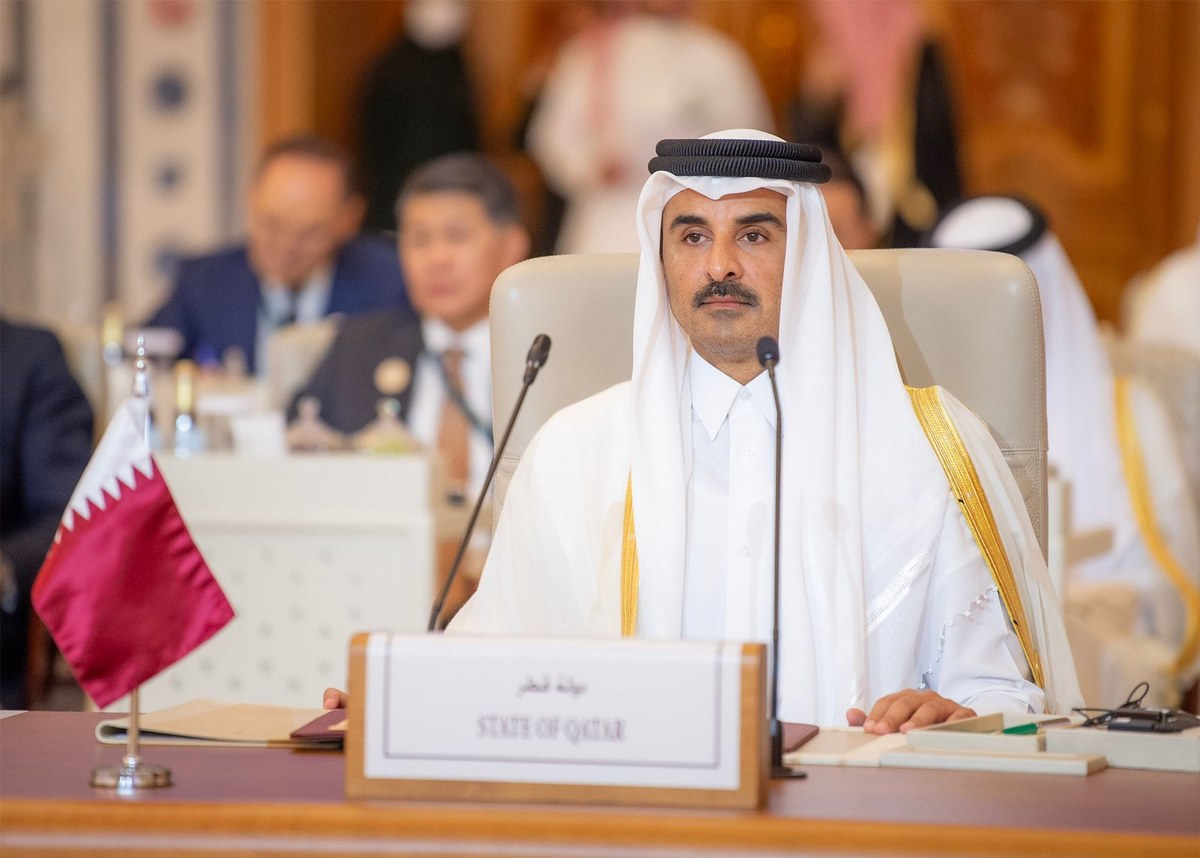
Qatar’s Emir Tamim bin Hamad Al-Thani stressed his country’s negotiation efforts to release the hostages held in Gaza. (SPA)
Abbas closed his remarks by thanking King Salman and the crown prince along with other leaders attending the summit.
Erdogan strongly condemned the Israeli occupation forces for their brutal targeting of hospitals, places of worship, schools, and refugee camps, as well as their indiscriminate killing of civilians and forced displacement in Gaza.
He said that those who remain silent in the face of such injustice are equal partners in these heinous acts.
The Turkish leader urged the US and Western nations to fulfill their responsibility in protecting human rights and not turn a blind eye to Israel’s actions.
“These painful and sad times reveal double standards, common sense failure, and inconsistency of humanitarian claims. Unfortunately, this revealing test resoundingly highlights these issues,” he said.
El-Sisi expressed the belief that every individual in the region deserves to live in peace and security, free from fear, intimidation, and the tragic loss of children. He called for a future of peace, where new generations can grow up without being surrounded by hatred and hostility.
Emomali Rahmon, the president of Tajikistan, demanded an immediate ceasefire, and urged all parties involved to come to the negotiating table.
He said that the crises, threats, and challenges that the Islamic world is witnessing demand unity, consensus, federation, and harmony more than ever before, adding that “today we are witnessing that these factors have led to serious destabilization in various regions of the Islamic world and have brought long-term negative economic and social consequences through the displacement of millions of people, mostly minors, as they were searching for a better and more secure life.”

Egypt’s President Abdel Fattah El-Sisi called on Saturday for an immediate sustainable ceasefire in Gaza. (SPA)
Sheikh Tamim bin Hamad Al-Thani, emir of Qatar, said that events in Gaza pose a danger at all levels, with a troubling precedent set even in terms of aggressive conflicts. He condemned the bombing of hospitals, initially denied and then justified by the existence of tunnels beneath medical facilities.
Sheikh Tamim said that during the ongoing war and the previous siege of Gaza, there has been a notable rise in voices from certain countries claiming to uphold international law and the global system.
These voices have been vocal in their condemnation of the indiscriminate killing of Palestinian civilians, including children and women, as well as the bombing of hospitals and shelters. The severity of the situation reached a point where the lifeless bodies of innocent individuals were left untouched, witnessing a heartbreaking disregard for human life.
He reiterated Qatar’s support for the Palestinian people and their just cause, as well as its commitment, along with its regional and international partners, to provide humanitarian aid despite Israeli obstruction.
Sheikh Tamim also called for the permanent opening of safe humanitarian crossings to allow aid to reach affected people without any obstacles or conditions.
He concluded his speech by saying that the only sustainable solution to the issue lies in establishing justice based on international legitimacy, the Arab Peace Initiative, and the principles advocated by the international community. This solution upholds the right of the Palestinian people to enjoy prosperity, security, and the right to determine their destiny in an independent state.


