

Saudi Arabia’s IPI climbs 0.8% in September driven by mining and quarrying
Saudi Arabia’s IPI climbs 0.8% in September driven by mining and quarrying /node/2405861/business-economy
Saudi Arabia’s IPI climbs 0.8% in September driven by mining and quarrying
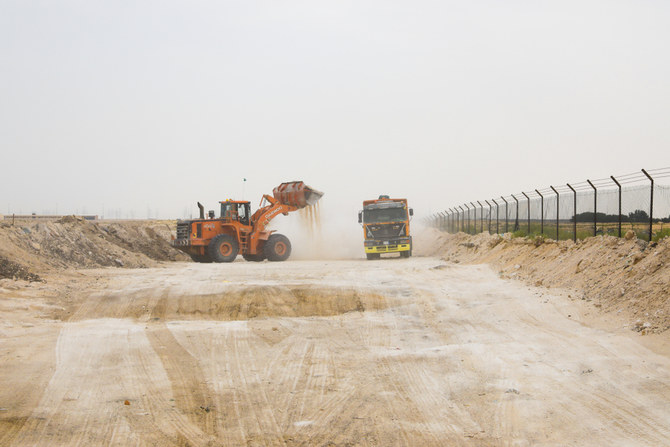
According to the data released by the General Authority for Statistics, mining and quarrying activities registered a monthly increase of 0.6 percent in September. Shutterstock
Saudi Arabia’s IPI climbs 0.8% in September driven by mining and quarrying
Updated 09 November 2023
Arab News
RIYADH: Saudi Arabia’s Industrial Production Index rose by 0.8 percent in September compared to August, primarily driven by a slight increase in mining and quarrying activities, official data showed.
According to the data released by the General Authority for Statistics, mining and quarrying activities registered a monthly increase of 0.6 percent in September.
The manufacturing sector and electricity and gas supplies industries increased by 1 percent each during the same period.
The report, however, added that the Kingdom’s IPI decreased by 11 percent in September compared to the same month last year.
“Although the activity of the manufacturing industry and the activity of electricity and gas supply continued to rise, the decline in the mining and quarrying activity led to the decrease in the general index, given its high weight in the index,” said GASTAT in the report.
GASTAT added that mining and quarrying activities decreased by 18.7 percent in September, compared to the same month of the previous year, as the Kingdom decreased its oil output, aligned with the decision of the Organization of the Petroleum Exporting Countries.
“Relative weights of the mining and quarrying, manufacturing, and electricity and gas supply sectors in the IPI are 74.5 percent, 22.6 percent, and 2.9 percent, respectively. Thus, the industrial production index in the mining and quarrying sector dominates the trend in the general IPI,” added GASTAT.
In April, Saudi Arabia decided to reduce oil output by 500,000 barrels per day to maintain market stability, which is now extended until the end of December 2024.
In July, the Kingdom also pledged an additional oil output cut of 1 million bpd. Earlier this month, the Ministry of Energy announced that this additional cut will be continued until the end of December.
In a statement issued, the Ministry of Energy added that the additional voluntary cut reinforces the precautionary efforts made by OPEC+ countries to support the stability of oil markets.
According to the GASTAT report, manufacturing activity in Saudi Arabia increased by 6.7 percent in September 2023, compared to the same month last year, while electricity and gas supplies surged by 26.5 percent during the same period.
Saudi Arabia’s Red Sea dolphins signal a thriving marine environment
Long-term monitoring aims to turn observations into data for conservation
Updated 30 January 2026
Nada Hameed
JEDDAH: The waters of the Red Sea along Saudi Arabia’s coast have become a vibrant natural stage, with pods of dolphins appearing near shorelines and along shipping lanes. These captivating sightings are emerging as a positive indicator for the health of the Red Sea’s marine ecosystem.
Saudi Arabia’s Red Sea waters are a thriving sanctuary for marine life, hosting 12 species of dolphins and small whales, according to the National Center for Wildlife.
Nearshore and reef-adjacent waters are frequently visited by the Indo-Pacific bottlenose dolphin (Tursiops aduncus) and the spinner dolphin (Stenella longirostris). Common bottlenose dolphins (Tursiops truncatus) are also present, but tend to favor deeper offshore waters.
Beyond these familiar faces, the Red Sea is home to a wider array of cetaceans that are less often documented. These include the Indo-Pacific humpback dolphin (Sousa plumbea), which inhabits shallow coastal areas, the pantropical spotted dolphin (Stenella attenuata), Risso’s dolphin (Grampus griseus), and larger relatives such as the false killer whale (Pseudorca crassidens), which may be more common than sightings suggest. Rare visitors like killer whales (Orcinus orca) and offshore species such as the rough-toothed dolphin (Steno bredanensis), striped dolphin (Stenella coeruleoalba), long-beaked common dolphin (Delphinus capensis), and short-finned pilot whale (Globicephala macrorhynchus) are known to appear sporadically but require documented evidence for confirmation.
DID YOU KNOW?
Pods of dolphins are regularly spotted near shorelines and shipping lanes along Saudi Arabia’s Red Sea coast.
Reef-enclosed lagoons and sheltered nearshore waters serve as resting and social hubs for dolphins.
Human activities, including fisheries, coastal development and vessel traffic, can disrupt dolphin behavior.
Field identification is made easier by distinct physical traits. Indo-Pacific bottlenose dolphins are smaller and more slender than their common bottlenose cousins, while spinner dolphins are streamlined with a pronounced beak. Risso’s dolphins are stockier with blunt heads, often marked with noticeable scars. Indo-Pacific humpback dolphins remain close to shallow, sometimes murky, shorelines, making them challenging to document without dedicated surveys.
Researchers at KAUST emphasized the importance of ongoing conservation to maintain the Red Sea’s ecological balance. Research scientist Jesse Cochran told Arab News: “For Saudi waters, the biggest challenge is that we still don’t have the kind of long-term, standardized monitoring needed to estimate population sizes or trends confidently. We have important observations and some targeted surveys, but the baseline is still developing.”
Another research scientist, Royale Hardenstine, highlighted the need for broader coordination: “What we need most right now is connectivity across efforts. There are good observations in specific project areas, but without a shared framework and a broader network, it’s hard to turn those observations into coast-wide inferences about residency, movements, or trends.”
Dolphins are frequently seen in reef-enclosed lagoons and sheltered nearshore waters, where they rest and socialize. These locations are often predictable, as reef structures reduce wave action and currents, creating calm conditions favorable to dolphin behavior.
Christy Judd, a Ph.D. student at KAUST, noted: “Some reef-bounded lagoons appear to be used repeatedly as resting areas. These places matter because they offer shelter and calm conditions, not because they’re automatically the highest biodiversity sites.”
While dolphins sometimes feed and socialize near coral reefs, Prof. Michael Berumen explained that their ecological range extends well beyond reef systems. Dolphin activity in the Red Sea spans a wide seascape that includes open waters, channels, continental shelf edges, and coastal zones.
He said that reefs shape resting areas and can concentrate prey. Experts, however, caution against linking dolphin presence directly to reef health.
Hardenstine elaborated: “Where dolphins and reefs overlap, it’s often because reef structures create sheltered lagoons and predictable resting areas.”
Dolphin group sizes in the Red Sea vary by species and activity. Bottlenose and spinner dolphins may form large aggregations exceeding 100 individuals during social interactions or when moving through food-rich waters.
In contrast, Indo-Pacific humpback dolphins are more often observed in small groups. Mixed-species associations also occur: Indo-Pacific humpback dolphins may interact with bottlenose dolphins, and pantropical spotted dolphins frequently accompany spinner dolphins.
From left: Dr. Michael Berumen, Christy Judd, Royale Hardenstine and Jesse Cochran. (KAUST)
Berumen described these social dynamics: “Dolphin societies are typically dynamic, with groups that form and re-form over time (often described as ‘fission-fusion’ social structure). Individuals associate for feeding, travel, resting, and social interactions, and alliances can form, particularly in some bottlenose populations.”
Judd added a field perspective: “Calves are usually integrated into the pod’s normal behavior, but groups with calves can be more cautious, especially around disturbance.”
Seasonal patterns in dolphin distribution remain unclear. Hardenstine noted: “In Saudi waters seasonal patterns, if they exist, are not yet well-resolved because sighting data are often influenced by survey effort, weather, and where people are looking.”
Dolphins respond to prey availability, water temperature, and oceanographic features such as currents and productive zones. Cochran cautioned: “We expect environment and prey to influence where dolphins are seen, but data limitations mean we should treat seasonal conclusions as provisional until long-term monitoring is in place.”
Human activities pose additional pressures. Dolphins face risks from fisheries, occasional bycatch, coastal development, tourism, vessel traffic, and underwater noise. While the Red Sea does not experience the intensive industrial fishing seen in other regions, interactions with fisheries can displace dolphins or disrupt the marine food web. Vessel traffic can disturb resting behavior and increase stress.
Berumen explained: “Vessels can affect dolphin behavior by causing avoidance of certain areas, interrupting resting behavior, altering movement patterns, and increasing stress, particularly in areas where dolphins rest in sheltered lagoons.”
Hardenstine added: “While data related to these impacts in the Red Sea are sparse, some anthropogenic pressures are increasing throughout the region. This is exactly when collaborative monitoring and scientifically informed mitigation become most valuable.”
KAUST researchers study dolphins as part of broader ecosystem and megafauna monitoring, combining reef surveys, opportunistic sightings, and targeted research. The university collaborates closely with the Saudi Arabia’s National Center for Wildlife to develop a national marine mammal stranding network, assisting with identification, sampling, and necropsies when needed. Collaborative efforts with NCW and OceanX have also supported aerial surveys documenting Red Sea megafauna.
Cochran emphasized the goal: “The most responsible next step is building long-term monitoring that is coordinated between stakeholders nationally, so that observations turn into defensible data that can identify trends and guide conservation actions or policy.”