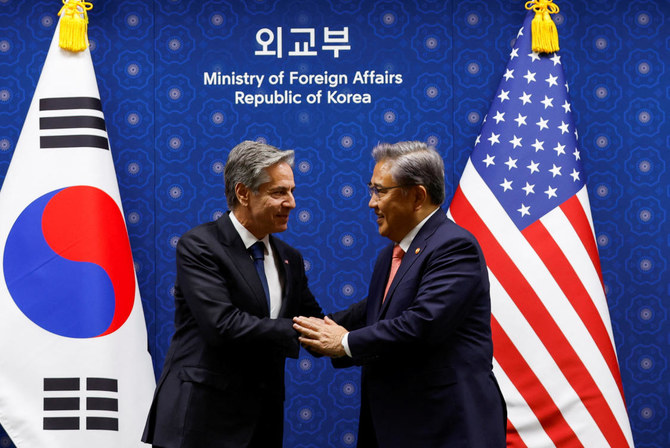
SEOUL, South Korea: Heightened tensions on the Korean Peninsula, suspected North Korean cooperation with Russia in its war on Ukraine and concerns about China’s growing aggressiveness are topping U .S. Secretary of State Antony Blinken’s agenda as he visits South Korea.
Blinken was in Seoul on Thursday for talks with South Korea’s leadership following a G7 foreign ministers meeting in Japan on Wednesday in which the group previewed much of what he will discuss.
The G7 “strongly condemned” North Korea’s ballistic missile tests as well as its alleged arms transfers to Russia, which are both in violation of UN Security Council resolutions against the North.
Even before Blinken’s arrival, North Korea’s official news agency, the Korean Central News Agency, condemned the visit as well as one by US Secretary of Defense Lloyd Austin, who travels to Seoul next week, describing them as “warmongers” bringing a “new war cloud” to Asia.
Tensions between the Koreas are at their highest point years as the pace of both Pyongyang’s weapons tests and South Korea’s combined military exercises with the United States have intensified in a tit-for-tat cycle.
Blinken began his talks in Seoul with a meeting with South Korean National Security Adviser Cho Tae-yong, where they discussed the growing threat posed by North Korea and its alleged provision of military equipment and munitions to Russia to help fuel Russian President Vladimir Putin’s war on Ukraine, State Department spokesperson Matthew Miller said. They also discussed the importance of US-South Korea cooperation to addressing global challenges, including “instability in the Middle East,” Miller said in a statement.
Blinken was also scheduled to meet South Korean President Yoon Suk Yeol and his Foreign Minister Park Jin.
In Japan, the G7 took specific aim at North Korea and its intensifying military relationship with Russia.
“We reiterate our call for the complete denuclearization of the Korean Peninsula and demand that North Korea abandon its nuclear weapons, existing nuclear programs, and any other WMD and ballistic missile programs in a complete, verifiable, and irreversible manner in accordance with all relevant UN Security Council resolutions,” the ministers said.
North Korea has been supplying artillery shells and other munitions to Russia in recent months to fuel its war efforts in Ukraine, US and South Korean officials have said, and they suspect that Kim could be seeking Russian technologies and other assistance in return to upgrade his own military. Both Pyongyang and Moscow have denied the accusations that North Korea has been providing Russia with munitions.
Unsurprisingly, the G7 rejected the denials.
“We strongly condemn arms transfers from North Korea to Russia, which directly violate relevant UNSCRs,” the ministers said. “We urge Russia and North Korea to immediately cease all such activities.”
On China, the G7 adopted a very similar line to that held by the US — that members are willing to work productively with Beijing as long as it respects international rules and regulations.
“We underscore that China has a responsibility to uphold the purposes and principles of the UN Charter in their entirety,” the ministers said. ” We remain seriously concerned about the situation in the East and South China Seas, strongly opposing any unilateral attempts to change the status quo by force or coercion,” the G7 said.
US President Joe Biden is expected to meet with Chinese leader Xi Jinping next week on the sideline of the Asia-Pacific Economic Forum summit in San Francisco.

Blinken arrives in Seoul for talks on North Korea and its military cooperation with Russia
https://arab.news/v7zhy
Blinken arrives in Seoul for talks on North Korea and its military cooperation with Russia
- Blinken was in Seoul for talks with South Korea’s leadership following a G7 foreign ministers meeting in Japan
- North Korea condemned the visit as well as one by US Secretary of Defense Lloyd Austin, who travels to Seoul next week
World welcomes 2026 with fireworks after year of turmoil
- Australia holds defiant celebrations after its worst mass shooting in nearly 30 years
- Hong Kong holds a subdued event after a deadly fire in tower blocks
PARIS, France: People around the globe toasted the end of 2025 on Wednesday, bidding farewell to one of the hottest years on record, packed with Trump tariffs, a Gaza truce and vain hopes for peace in Ukraine.
Russian President Vladimir Putin used his traditional New Year address to tell his compatriots their military “heroes” would deliver victory in Europe’s deadliest conflict since World War II, while his Ukrainian counterpart Volodymyr Zelensky said his country was “10 percent” away from a deal to end the fighting.
Earlier, New Year celebrations took on a somber tone in Sydney as revellers held a minute of silence for victims of the Bondi Beach shooting before nine tons of fireworks lit up the harbor city at the stroke of midnight.
Seeing in the New Year in Moscow, Natalia Spirina, a pensioner from the central city of Ulyanovsk, said that in 2026 she hoped for “our military operation to end as soon as possible, for the guys to come home and for peace and stability to finally be established in Russia.”
Over the border in Vyshgorod, Ukrainian beauty salon manager Daria Lushchyk said the war had made her work “hell” — but that her clients were still coming regardless.
“Nothing can stop our Ukrainian girls from coming in and getting themselves glam,” Lushchyk said.
Back in Sydney, heavily armed police patrolled among hundreds of thousands of people lining the shore barely two weeks after a father and son allegedly opened fire on a Jewish festival at Bondi Beach, killing 15 people in Australia’s deadliest mass shooting for almost 30 years.
Parties paused for a minute of silence an hour before midnight, with the famed Sydney Harbor Bridge bathed in white light to symbolize peace.
Pacific nations including Kiribati and New Zealand were the first to see in 2026, with Seoul and Tokyo following Sydney in celebrations that will stretch to glitzy New York via Scotland’s Hogmanay festival.
More than two million people are expected to pack Rio de Janeiro’s Copacabana Beach for what authorities have called the world’s biggest New Year’s Eve party.
In Hong Kong, a major New Year fireworks display planned for Victoria Harbor was canceled in homage to 161 people killed in a fire in November that engulfed several apartment blocks.
Truce and tariffs
This year has brought a mix of stress and excitement for many, war for others still — and offbeat trends, with Labubu dolls becoming a worldwide craze.
Thieves plundered the Louvre in a daring heist, and K-pop heartthrobs BTS made their long-awaited return.
The world lost pioneering zoologist Jane Goodall, the Vatican chose a new, American, pope and the assassination of right-wing activist Charlie Kirk laid bare America’s deep political divisions.
Donald Trump returned as US president in January, launching a tariff blitz that sent global markets into meltdown.
Trump used his Truth Social platform to lash out at his sliding approval ratings ahead of midterm elections to be held in November.
“Isn’t it nice to have a STRONG BORDER, No Inflation, a powerful Military, and great Economy??? Happy New Year!” he wrote.
After two years of war that left much of the Gaza Strip in ruins, US pressure helped land a fragile ceasefire between Israel and Hamas in October — though both sides have accused each other of flagrant violations.
“We bid farewell to 2025 with deep sorrow and grief,” said Gaza City resident Shireen Al-Kayali. “We lost a lot of people and our possessions. We lived a difficult and harsh life, displaced from one city to another, under bombardment and in terror.”
In contrast, there was optimism despite abiding internal challenges in Syria, where residents of the capital Damascus celebrated a full year since the fall of Bashar Assad.
“There is no fear, the people are happy, all of Syria is one and united, and God willing ... it will be a good year for the people and the wise leadership,” marketing manager Sahar Al-Said, 33, told AFP against a backdrop of ringing bells near Damascus’s Bab Touma neighborhood.
“I hope, God willing, that we will love each other. Loving each other is enough,” said Bashar Al-Qaderi, 28.
Sports, space and AI
In Dubai, thousands of revellers queued for up to nine hours for a spectacular fireworks and laser display at the Burj Khalifa, the world’s tallest building.
After a build-up featuring jet skis and floating pianos on an adjacent lake, a 10-minute burst of pyrotechnics and LED effects lit up the needle-shaped, 828-meter tall (2,717-feet) tower.
The coming 12 months promise to be full of sports, space and questions over artificial intelligence.
NASA’s Artemis II mission, backed by tech titan Elon Musk, will launch a crewed spacecraft to circle the moon during a 10-day flight, more than 50 years since the last Apollo lunar mission.
After years of unbridled enthusiasm, AI is facing scrutiny and nervous investors are questioning whether the boom might now resemble a market bubble.
Athletes will gather in Italy in February for the Milano Cortina Winter Olympics.
And for a few weeks in June and July, 48 nations will compete in the biggest football World Cup in history in the United States, Mexico and Canada.


