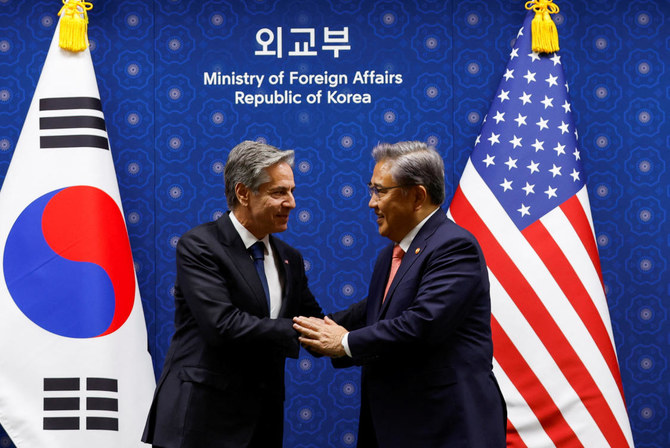
SEOUL, South Korea: Heightened tensions on the Korean Peninsula, suspected North Korean cooperation with Russia in its war on Ukraine and concerns about China’s growing aggressiveness are topping U .S. Secretary of State Antony Blinken’s agenda as he visits South Korea.
Blinken was in Seoul on Thursday for talks with South Korea’s leadership following a G7 foreign ministers meeting in Japan on Wednesday in which the group previewed much of what he will discuss.
The G7 “strongly condemned” North Korea’s ballistic missile tests as well as its alleged arms transfers to Russia, which are both in violation of UN Security Council resolutions against the North.
Even before Blinken’s arrival, North Korea’s official news agency, the Korean Central News Agency, condemned the visit as well as one by US Secretary of Defense Lloyd Austin, who travels to Seoul next week, describing them as “warmongers” bringing a “new war cloud” to Asia.
Tensions between the Koreas are at their highest point years as the pace of both Pyongyang’s weapons tests and South Korea’s combined military exercises with the United States have intensified in a tit-for-tat cycle.
Blinken began his talks in Seoul with a meeting with South Korean National Security Adviser Cho Tae-yong, where they discussed the growing threat posed by North Korea and its alleged provision of military equipment and munitions to Russia to help fuel Russian President Vladimir Putin’s war on Ukraine, State Department spokesperson Matthew Miller said. They also discussed the importance of US-South Korea cooperation to addressing global challenges, including “instability in the Middle East,” Miller said in a statement.
Blinken was also scheduled to meet South Korean President Yoon Suk Yeol and his Foreign Minister Park Jin.
In Japan, the G7 took specific aim at North Korea and its intensifying military relationship with Russia.
“We reiterate our call for the complete denuclearization of the Korean Peninsula and demand that North Korea abandon its nuclear weapons, existing nuclear programs, and any other WMD and ballistic missile programs in a complete, verifiable, and irreversible manner in accordance with all relevant UN Security Council resolutions,” the ministers said.
North Korea has been supplying artillery shells and other munitions to Russia in recent months to fuel its war efforts in Ukraine, US and South Korean officials have said, and they suspect that Kim could be seeking Russian technologies and other assistance in return to upgrade his own military. Both Pyongyang and Moscow have denied the accusations that North Korea has been providing Russia with munitions.
Unsurprisingly, the G7 rejected the denials.
“We strongly condemn arms transfers from North Korea to Russia, which directly violate relevant UNSCRs,” the ministers said. “We urge Russia and North Korea to immediately cease all such activities.”
On China, the G7 adopted a very similar line to that held by the US — that members are willing to work productively with Beijing as long as it respects international rules and regulations.
“We underscore that China has a responsibility to uphold the purposes and principles of the UN Charter in their entirety,” the ministers said. ” We remain seriously concerned about the situation in the East and South China Seas, strongly opposing any unilateral attempts to change the status quo by force or coercion,” the G7 said.
US President Joe Biden is expected to meet with Chinese leader Xi Jinping next week on the sideline of the Asia-Pacific Economic Forum summit in San Francisco.


![]()

Blinken arrives in Seoul for talks on North Korea and its military cooperation with Russia
Short Url
https://arab.news/v7zhy
Blinken arrives in Seoul for talks on North Korea and its military cooperation with Russia
- Blinken was in Seoul for talks with South Korea’s leadership following a G7 foreign ministers meeting in Japan
- North Korea condemned the visit as well as one by US Secretary of Defense Lloyd Austin, who travels to Seoul next week


Latest updates


© 2026 SAUDI RESEARCH & PUBLISHING COMPANY, All Rights Reserved And subject to Terms of Use Agreement.