


DUBAI: In line with the upcoming COP28 that will take place in Dubai this year from Nov. 30-Dec. 12 to find solutions to global climate change, this edition of Dubai Design Week is focusing on theme of sustainability and how designers and architects can create their work using materials and processes that are environmentally friendly.
An annual feature is Abwab, meaning “doors” in Arabic, which is dedicated to commissioning work from across the Middle East, North Africa and South Asia with the objective of promoting local and regional creative talent.
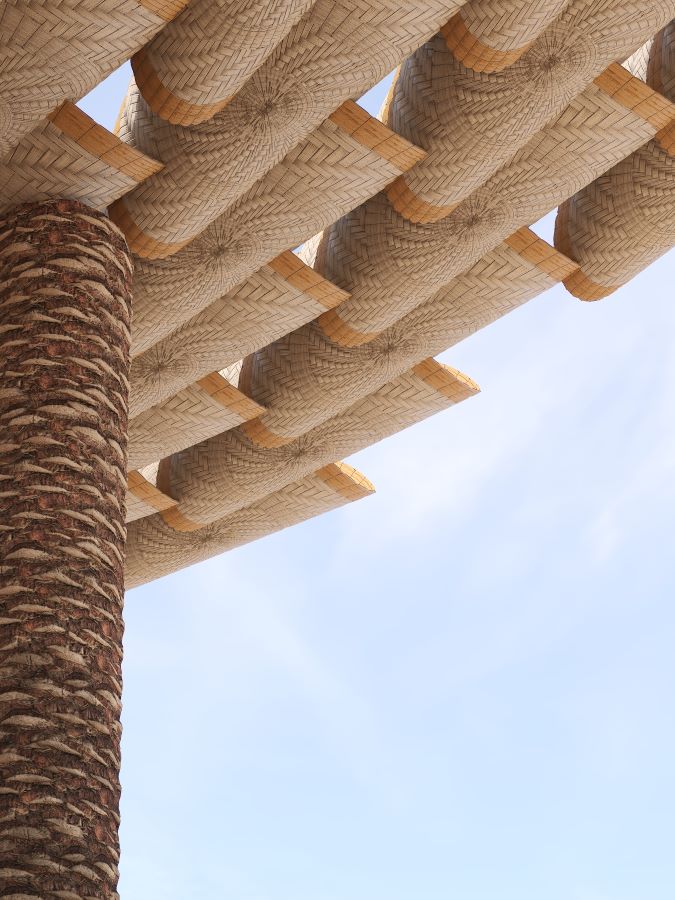
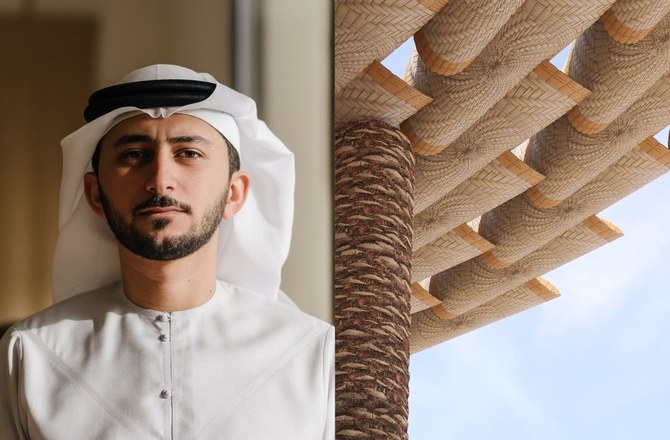
For this year’s Dubai Design Week, Emirati architect Abdalla Almulla created “The Palm,” a large-scale installation stationed outdoors that is made entirely from parts of the indigenous palm tree native to the United Arab Emirates. (Supplied)
For this year’s edition, Emirati architect Abdalla Almulla created “The Palm,” a large-scale installation stationed outdoors that is made entirely from parts of the indigenous palm tree native to the United Arab Emirates.
“My task for this year’s Abwab was to conceive and execute a concept that illustrates how sustainable resources can be utilized in architecture,” Almulla told Arab News.
“Guided by the concept of scarcity and staying true to the sustainability theme, I made the choice to leverage an existing natural resource, creatively repurposing it to extend its functionality beyond its original scope,” he said. “My objective was to highlight the remarkable versatility of the locally abundant palm tree, demonstrating its capacity to address diverse human needs.”
Born and raised in the UAE and based in Dubai, Almulla’s work has long been inspired by the natural desert landscape, plants and animals of his home country. He is the founder of design studio MULA known for its focus on innovative designs, its exploration of the unknown and incorporation of patterns and geometry. He has participated in numerous design exhibitions regionally and internationally, including Paris Design Week, Milan Design Week and London Design Biennale. He is also the recipient of the Institut du Monde Arabe’s inaugural Emerging Talent Design Award in 2023.
The installation features intricate floor patterns and a mesmerizing ceiling made from an array of palm-weaved mats and mirrors. “The Palm” additionally challenges his previous works by reimagining raw materials in new and multifunctional ways, according to the designer.
Additionally, Almulla’s use of geometric references, that echo motifs found in Islamic art, can be see embedded throughout the installation.


