

Pakistan ‘appalled’ at Israeli minister’s statement threatening nuclear force against Palestinians

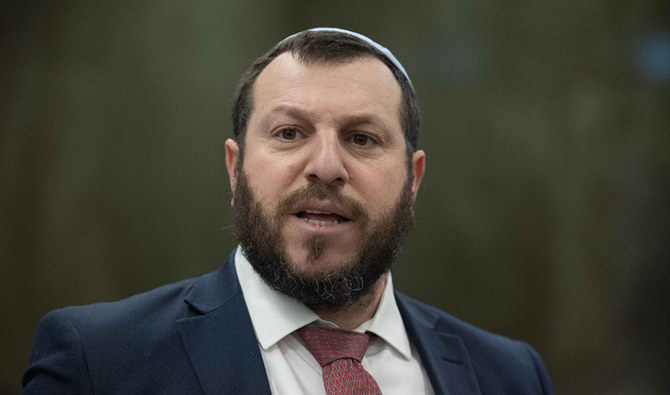
This photo, taken on January 29, 2023, shows Israel's Heritage Minister Amichai Eliyahu at the Prime Minister's Office in Jerusalem. (Photo courtesy: Flash90/File)
Short Url
Updated 06 November 2023
Follow

Pakistan ‘appalled’ at Israeli minister’s statement threatening nuclear force against Palestinians

  • Israel’s Heritage Minister Amihay Eliyahu said on Sunday dropping a nuclear bomb on Gaza was an ‘option’
  • Pakistan says statement ‘wake-up call’ for international community to threat Israel poses to regional peace

ISLAMABAD: Pakistan’s foreign office spokesperson said on Monday that Islamabad was “appalled” by an Israeli minister’s comments in which he suggested using nuclear force against Palestinians, saying it reflected the Jewish state’s intention to carry out a genocide in Gaza.

Israel’s Heritage Minister Amihay Eliyahu, asked during a radio interview on Sunday about a hypothetical nuclear option against Palestinians, said: “That’s one way.”

His comments drew sharp criticism from Middle Eastern nations Saudi Arabia, Yemen, Jordan, and Qatar. On Sunday, Israeli Prime Minister Benjamin Netanyahu announced Eliyahu had been suspended from cabinet meetings till “further notice.”

“We are appalled by the statement of an Israeli minister threatening nuclear force against Palestinians,” the spokesperson of Pakistan’s Ministry of Foreign Affairs (MoFA) wrote on social media platform X.

“This is a wake-up call for int’l community to the threat posed by Israeli aggression to regional peace, security & stability.”

The death toll from Israel’s bombardment on Gaza since Oct. 7 has risen to more than 9,700 people, including at least 4,800 children, according to Palestinian officials. Some officials have said one child has been killed every 10 seconds due to Israel’s military aggression.

Israel has expanded its air and ground attacks in the densely populated Gaza Strip, continuing its relentless airstrikes since a cross-border attack by Hamas on Oct. 7.

Apart from the huge number of casualties and displacement of thousands in Gaza, the UN has warned that an outbreak of diseases in the territory is imminent as Israel continues imposing a blockade on Gaza.

Water, fuel, medicine and relief items are running low in Gaza as Israel relentlessly pounds the territory with airstrikes.

Pakistan, which does not recognize Israel or has diplomatic relations with the country, has repeatedly called for a cease-fire and the establishment of an independent Palestinian state on the basis of the pre-1967 borders with Al Quds Al Sharif as its capital.


Pakistan’s president condemns Kabul blast, accuses Taliban of allowing militant ‘safe havens’

Updated 12 sec ago
Follow

Pakistan’s president condemns Kabul blast, accuses Taliban of allowing militant ‘safe havens’

  • President Zardari links attack on Chinese-run restaurant to Kabul’s failure to meet Doha commitments
  • He highlights the ‘failure’ of Afghanistan’s Taliban to establish a ‘broad-based and inclusive government’

KARACHI: President Asif Ali Zardari on Monday condemned a blast that ripped through a Chinese-run restaurant in Kabul, killing at least seven people, while criticizing Afghanistan’s Taliban administration for allowing “safe havens” to militant groups to export extremist violence in the region.

The explosion struck the restaurant in Kabul’s Shahr-e-Naw commercial district, an area considered one of the safest in the Afghan capital, killing one Chinese national and six Afghans and wounding several others, including a child, according to Afghan authorities.

The Afghan affiliate of Daesh militant group claimed responsibility, saying the attack was carried out by a suicide bomber.

“The Taliban regime in Afghanistan has failed to honor the commitments made under the Doha Peace Agreement, particularly the obligation to prevent the use of Afghan soil for the export of terrorism,” Zardari said in a statement circulated by his office.

“Pakistan has repeatedly stressed that no terrorist groups should be allowed safe havens in Afghanistan and that regional peace and security must be upheld,” he continued, adding that “it is not just Pakistan but other neighbors of Afghanistan, including Tajikistan, [that] have recently been affected by the terrorists operating out of Afghan soil.”

Pakistan has frequently accused Afghanistan of sheltering proscribed armed factions such as the Tehreek-e-Taliban Pakistan and the Balochistan Liberation Army, and of facilitating attacks on Pakistani civilians and security forces, allegations the Taliban deny.

The two countries witnessed major border skirmishes in October last year, followed by talks mediated by Qatar and Türkiye.

Pakistan subsequently closed its border and suspended bilateral and transit trade with Afghanistan, a move that led to a 17% drop in “cross-border attacks,” according to the Center for Research and Security Studies.

Late November also saw a series of deadly incidents along the Tajikistan–Afghanistan border, with militants on the Afghan side firing across the frontier into Tajikistan, killing five Chinese workers employed on Chinese–Tajik mining and construction projects.

In December, Tajik border forces clashed with armed individuals who crossed from Afghanistan, killing several assailants but losing a border guard in the fighting.

Zardari paid tribute to Chinese nationals working in Afghanistan “despite rising insecurity” and expressed solidarity with the victims and their families, while reiterating calls for political reform in Kabul.

“The failure to establish a broad based and inclusive government by the Taliban is contrary to the Doha Agreement,” he said in the statement.