

US rejects Arab demand for urgent Gaza truce at Jordan ministerial meeting

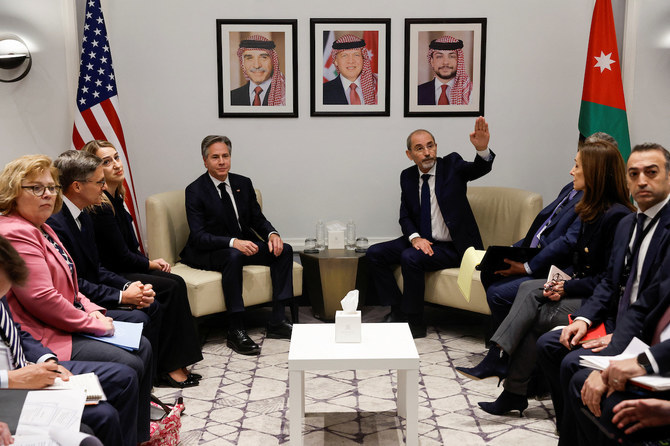
Blinken attends a meeting with Jordanian Deputy Prime Minister and Foreign Minister Ayman Safadi, during a day of meetings about the ongoing conflict between Israel and Hamas, in Amman, Nov. 4, 2023. (Reuters)
Short Url
Updated 05 November 2023
Follow

US rejects Arab demand for urgent Gaza truce at Jordan ministerial meeting

  • Antony Blinken says a ceasefire would leave Hamas in place and repeat what it did on October 7
  • Arab foreign ministers from Saudia Arabia and other countries convened before meeting Blinken

AMMAN: A demand by Jordan and Egypt for an immediate ceasefire in Gaza was rejected by US Secretary of State Antony Blinken at an Arab foreign ministers meeting in Amman on Saturday.

Blinken said that a truce would be counterproductive, and made clear the furthest he would go was support for a humanitarian pause to allow the delivery of aid and the evacuation of civilians from the besieged enclave.

“It is our view now that a ceasefire would simply leave Hamas in place, able to regroup and repeat what it did on Oct. 7,” Blinken told a news conference after the talks, referring to the militant group’s attack on southern Israel that triggered the latest Gaza conflict.

Foreign ministers of Jordan, Saudi Arabia, Egypt, UAE, Qatar, and a senior Palestinian official met with Blinken after holding a separate consultative meeting earlier and another with Jordan’s King Abdullah.

The meeting was attended by Jordanian Foreign Minister Ayman Safadi and his Saudi counterpart Prince Faisal bin Farhan, along with Abdullah bin Zayed Al-Nahyan from the UAE, Qatar’s Mohammed bin Abdulrahman bin Jassim Al-Thani, Egypt’s Sameh Shoukry, and Hussein Al-Sheikh from the Palestine Liberation Organization.

According to a Jordanian Foreign Ministry statement, the meeting reaffirmed Arab calls for an “immediate” ceasefire and “undisrupted” delivery of relief assistance as part of efforts to stop the war.

Speaking at a joint press conference with Shoukry and Blinken, Safadi said that “slaughter and war crimes need to stop, and also the immunity given to Israel before the international law.”

He called for “immediate” delivery of aid into Gaza and a halt to Israeli displacement of Palestinians, and also voiced alarm at the situation in the occupied West Bank, where “settlers are permitted to kill innocent Palestinians.”

Shoukry also raised concerns over the mounting civilian toll in Gaza, describing it as “collective punishment,” and saying that “the slaughter of civilians cannot be justified in (any) terms even as self-defense.”

The Egyptian foreign minister called for an “immediate ceasefire without any condition,” and said that Israel needs to end its violations of international humanitarian law.

He also highlighted “double standards” in dealing with the mounting civilian toll, saying: “Arab blood is no less worthy.”

Blinken reaffirmed Washington’s support for “humanitarian pauses” to ensure civilians receive assistance.

The senior US envoy said that he agreed with his Arab counterparts on the need for aid corridors, acknowledging that what has so far entered Gaza is “inadequate.”

Asked why Washington is failing to exert pressure to stop the killing of civilians, Blinken said that “Israel has the right to defend itself, but also to take means to ensure the protection of civilians and minimize harm to them.”

He claimed Hamas “embeds itself” within the civilian population, and is using civilian infrastructure as command centers and for ammunition storage.

“But Israel has an obligation to defend civilians. This is what I told the Israelis,” he said.

Washington’s top diplomat said that he is saddened to see bodies of children pulled from the rubble in Gaza. “I am a father and I have children and I know how it feels.”

Ending the press conference, Safadi said: “Self-defense? How would you explain this term to a father who is unable to protect his children and find shelter for them, not even in a refugee camp, a hospital or a UN organization?”

Before meeting Blinken, King Abdullah told the foreign ministers “to maintain Arab coordination and speak in one voice to the international community regarding the dangerous escalations in Gaza.”

He added: “Arab states have the responsibility of pushing the international community and world powers to stop the war on Gaza, allow the uninterrupted delivery of aid, and protect civilians.”

The king warned that continued fighting would lead to an “explosion in the region,” a statement said.

The Jordanian ruler also urged constant support for international relief organizations working in Gaza, especially UNRWA.

He reiterated that a political solution is needed to achieve just and comprehensive peace on the basis of a two-state solution.


Syrian foreign minister: National interest and the welfare of the people top priority

Updated 13 sec ago
Follow

Syrian foreign minister: National interest and the welfare of the people top priority

  • Hassan Al-Shaibani highlights reconstruction efforts, internal reforms during Munich discussion

MUNICH: The Syrian Arab Republic Foreign Minister Asaad Hassan Al-Shaibani spoke on the sidelines of the Munich Security Conference about the country’s ongoing recovery, internal reforms, and the impact of Israeli military actions.

“We are satisfied with the achievements we have made, but we continue striving to deliver the best for our people,” Al-Shaibani said.

“We will not tire or give up and will work day and night to build the Syria we aspire to, together with our citizens.”

In the Syrian Arab News Agency report the minister stressed that the Syrian state had not shirked its responsibility for what happened in Sweida and other areas, noting that “the national interest and the welfare of the people have always been our top priority.”

He emphasized that the diversity in Syria is a source of strength.

We live in a country exhausted by war and by the mismanagement inherited from the deposed regime.

Foreign Minister, Asaad Hassan Al-Shaibani

“We share national interests, including the unity and territorial integrity of the country, and we operate within the framework of the law,” he added.

Al-Shaibani highlighted progress in rebuilding state institutions and restoring trust between the government and the public.

“We live in a country exhausted by war and by the mismanagement inherited from the deposed regime,” he said. “Syrian society remains fragmented, both inside the country and abroad, and continues to face humanitarian and infrastructure challenges.”

He emphasized that efforts to unify the country include consolidating state control over weapons, a principle established after the revolution’s victory.

The minister also highlighted the role of Syrian citizens in the recovery process.

“What we rely on is our people, who possess determination and ambition,” he said, adding that “lifting sanctions is the key to reconstruction.”

He noted that there are still displacement camps in the country and that many refugees continue to live abroad.

Turning to external issues, he expressed concern over Israeli military activity.

“Since Dec. 8, 2024, Syria has faced more than 1,000 airstrikes, the occupation of new areas in southern Syria, and over 500 ground incursions,” he said, adding that the Syrian state has pursued a realistic approach toward Israel, prioritizing reconstruction and national recovery.

He noted, however, that the policy might not have been acceptable to Israel, which “continues to seek regional conflicts.”

Al-Shaibani emphasized that negotiations should result in Israel withdrawing from the areas it occupied after Dec. 8, respecting Syrian sovereignty and airspace.

Syria’s deputy interior minister met with Germany’s interior minister on the sidelines of the Munich Security Conference.

They discussed security developments and prospects for cooperation, according to a statement from the interior ministry.

Maj. Gen. Abdulkader Al-Tahhan held talks with German Interior Minister Alexander Dobrindt during the annual conference.

The Syrian Interior Ministry said the meeting included a review of current developments in Syria and their impact on security and humanitarian issues.

It added that both sides stressed the importance of coordination and information-sharing in support of regional and international stability.

The statement said the officials also discussed possible cooperation between the two interior ministries, including training, capacity-building and the exchange of expertise.