

Afghan PM appeals to Pakistan for dignified departure timeframe for nationals amid deportation drive

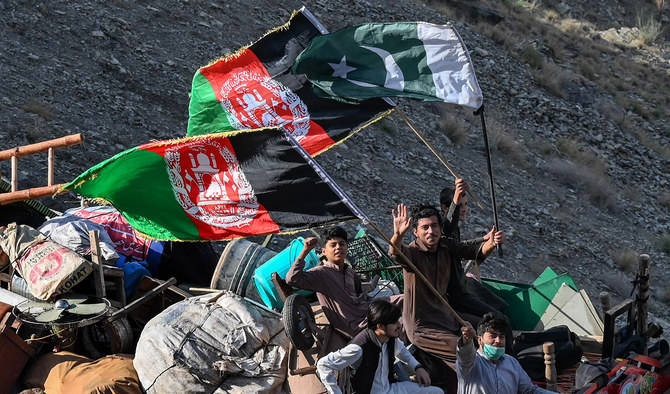
Afghan refugees wave flags of Afghanistan and Pakistan (R) as they travel with their belongings on a truck towards the Pakistan-Afghanistan Torkham border on November 3, 2023. (AFP)
Short Url
Updated 03 November 2023
Follow

Afghan PM appeals to Pakistan for dignified departure timeframe for nationals amid deportation drive

  • Mullah Akhund accuses Pakistan of stealing the properties of Afghan nationals, destroying their shops and houses
  • He asks Pakistan to ponder the long-term consequences of its actions that may strain future bilateral relationship

ISLAMABAD: Afghanistan’s Prime Minister Mullah Mohammad Hassan Akhund in a Pashtu video message on Friday appealed to Pakistan to halt the “undignified” expulsion of Afghan nationals, asking for sufficient time for them to settle affairs.
Earlier, Pakistan had initiated a crackdown on undocumented immigrants, predominantly Afghans, after giving them an ultimatum for voluntary departure by November 1.
With approximately 1.7 million Afghans residing illegally, the government’s four-week notice last month has culminated in forced expulsions.
Prior to this, Afghans, including refugees, reported police harassment and distress sales of belongings, with buyers exploiting their urgency to depart, paying less than the worth of their items.
“We ask them [the government of Pakistan] to not expel Afghans in an undignified manner, to not harass Afghans, and to give them sufficient time so they can return in a dignified manner,” the Afghan prime minister said in a message which was widely reported by media outlets in his country.
“If their [Pakistan’s] reason is to expel undocumented migrants only, then why are they humiliating refugees, stealing their property, and destroying their houses,” he asked.

He accused the Pakistani authorities of allowing their “forces to loot the property of refugees, destroy their houses and shops, and seize their cars and motorbikes.”
Pakistani authorities maintain their deportation drive is not designed to target any specific community, though they have highlighted Afghan links to recent suicide bombings in the country.
Afghanistan’s prime minister implored Pakistan to show neighborly consideration and ponder the long-term consequences, cautioning that current actions could strain future bilateral ties.
He said if Pakistani authorities had any issues with his administration, they should try to resolve them through negotiations.


Rotary grant backs WHO effort to vaccinate 27 million Pakistani children against polio

Updated 8 sec ago
Follow

Rotary grant backs WHO effort to vaccinate 27 million Pakistani children against polio

  • Funding targets high-risk districts as Pakistan remains one of two countries with endemic virus
  • Officials warn that persistent transmission in Pakistan’s high-risk areas continues to pose global threat

ISLAMABAD: Rotary International has provided a $9.9 million grant to the World Health Organization (WHO) in Pakistan to support the vaccination of 27 million children against polio in high-risk districts, WHO said on Wednesday, reinforcing nationwide eradication efforts in one of the last two countries where the disease remains endemic.

The funding will support WHO’s operational role within the Pakistan-led Polio Eradication Initiative, which conducts multiple door-to-door and subnational immunization campaigns each year, reaching more than 45 million children across the country.

Polio eradication remains a critical public-health priority for Pakistan, which, along with Afghanistan, is among the only two countries worldwide where wild poliovirus type 1 continues to circulate. While Pakistan has made substantial progress over the past three decades, health officials warn that persistent transmission in high-risk areas continues to pose a global threat.

Since the launch of Pakistan’s eradication program in the mid-1990s, polio cases have fallen by 99.8 percent, from about 20,000 cases in 1994 to 31 cases reported in 2025, according to official data. Globally, cases have declined by 99.9 percent since 1988 under the Global Polio Eradication Initiative (GPEI).

“Rotary’s support is the best example of how a partnership can protect millions of lives. WHO extends its deepest appreciation to Rotary for its continuing support as a founding partner of the Global Polio Eradication Initiative. Rotary’s long-standing commitment is crucial in our journey toward a polio-free world,” Dr. Luo Dapeng, WHO representative in Pakistan, said in a statement. 

The grant to WHO Pakistan forms part of a broader $14.9 million contribution by Rotary toward polio eradication efforts in the country. The funding will support immunization campaigns in high-risk districts of Balochistan, Sindh, Khyber Pakhtunkhwa and Punjab, covering operational costs such as frontline health worker incentives, training, transportation, vaccine carriers and campaign logistics.

To date, Rotary has contributed $3 billion globally toward polio eradication, including nearly $500 million in Pakistan, alongside advocacy efforts and volunteer support. Health authorities say the latest funding will help sustain momentum as Pakistan works to interrupt final chains of transmission.

Rotary is a founding partner of the GPEI, a public-private alliance led by national governments and supported by WHO, Rotary International, the US Centers for Disease Control and Prevention, UNICEF, the Bill & Melinda Gates Foundation and Gavi, the Vaccine Alliance.

Health officials say sustained financing and political commitment remain essential as global travel and migration continue to expose polio-free countries to potential re-importation.

“Science indicates that ending polio in Pakistan and worldwide is within reach if we sustain the ongoing partnership and eradication efforts,” Dr. Luo said.

“However, the detection of wild poliovirus type 1 in Germany last November is a strong reminder that the cost of inaction would be far greater than the cost of action, since no country and no child will be safe until the virus is fully eradicated everywhere.”