QUETTA/PESHAWAR: Pakistan suffered the loss of 21 individuals, predominantly military personnel, following three separate militant assaults on police and security forces conveys in the western provinces of Khyber Pakhtunkhwa and Balochistan on Friday, as confirmed by senior government functionaries and official statements.
The country has experienced an uptick in militant attacks since the year’s beginning, with a concentration of these violent incidents occurring in the two provinces along the Afghan border.
Despite the conclusion of nearly two decades of conflict following the withdrawal of international forces in August 2021, Afghanistan remains mired in crisis.
Pakistani officials have repeatedly asserted that the militants targeting their country operate from the neighboring state, urging the Taliban government in Kabul to prevent their territory from being used as a staging ground for such attacks.
“On 3 November 2023, 2 vehicles of security forces moving from Pasni to Ormara in [Balochistan’s] Gwadar District, were ambushed by the terrorists,” the army’s media wing, ISPR, said in a statement. “14 x soldiers embraced shahadat [martyrdom] in the unfortunate incident.”
Balochistan, where Pakistan and China are jointly undertaking infrastructure development and regional connectivity projects, has long been a battleground for a low-level insurgency.
Baloch nationalists argue they are fighting against the unfair extraction of the province’s resources by the federal government, an accusation Islamabad denies.
Baloch separatist groups have also expressed opposition to Pakistan’s decision to build a strategic port in Gwadar, where the recent attack took place, to gain economic advantage in the region and tap Central Asian markets.
Speaking to Arab News, the deputy commissioner of Gwadar, Major (r) Aurangzaib Badini, said the attack took place at 3pm near Pasni.
He informed the convoy was “ambushed by terrorists with an IED [improvised explosive device] blast and gunfire attacks.”
Pakistan’s caretaker interior minister Sarfraz Bugti condemned the incident in a statement circulated by his office.
“The new wave of terrorism is a matter of concern,” he said, adding that Pakistan would continue to fight until the end of militant violence.
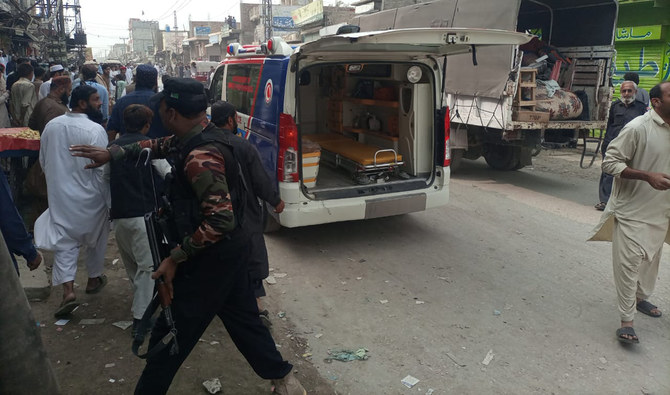
Earlier in the day, police and security forces also came under two separate attacks in Dera Ismail Khan district of northwestern Khyber Pakhtunkhwa province, resulting in seven fatalities.
The area’s Regional Police Officer, Nasir Hussain Satti, told Arab News one of the blasts was set off by a bomb planted on a motorbike, which exploded near a police van in a congested neighborhood of the city.
“The powerful blast left six civilians dead and another 22 people, including two policemen, wounded,” he informed. “It was a planted device with initial investigations suggesting the use of eight to 10 kilograms of explosives.”
Footage released by Rescue 1122 officials shortly after the incident captured a chaotic scene, with ambulances transporting the injured to hospitals.
Mujtaba Ahmad, a property shop owner near the blast site, described the explosion as powerful enough to rattle the entire marketplace.
He informed most shops were closed for Friday prayers with many people inside mosques at the time of the blast, a factor that likely prevented further casualties and damage.
“Initially, when the explosion occurred, people didn’t know what had happened but they started running,” he continued. “When the cloud of dust settled after the blast, we saw people in blood and damaged motorcycles.”
The second blast, according to the police officer, took place in Takwarra, a small settlement on the outskirts of Dera Ismail Khan, targeting a security convoy which left soldier dead and another wounded.
Khyber Pakhtunkhwa’s caretaker information minister Feroze Jamal Shah told Arab News the militant attacks during the day had led to precious loss of life, saying medical centers across the district were put on high alert after the explosions.
Expressing grief over the two incidents, he said the government would not bow to militants and continue to fight them.
“The blasts martyred several people and wounded 23,” he added. “We condemn both acts of terrorism in the strongest words. I have directed the district administration to provide best medical care to the wounded.”


![]()

Militant attacks in western Pakistan leave 21, including 15 security personnel, dead
Short Url
https://arab.news/zsjdd
Militant attacks in western Pakistan leave 21, including 15 security personnel, dead
- Militants ambushed two vehicles of security forces moving in Balochistan’s Gwadar district, killing 14 soldiers
- Seven people also lost their lives and 23 injured in dual attacks on security convoys in Dera Ismail Khan district
Latest updates


Recommended


© 2026 SAUDI RESEARCH & PUBLISHING COMPANY, All Rights Reserved And subject to Terms of Use Agreement.