Dhahran’s inspiring Tanween exhibition explores power of scale

1 / 2
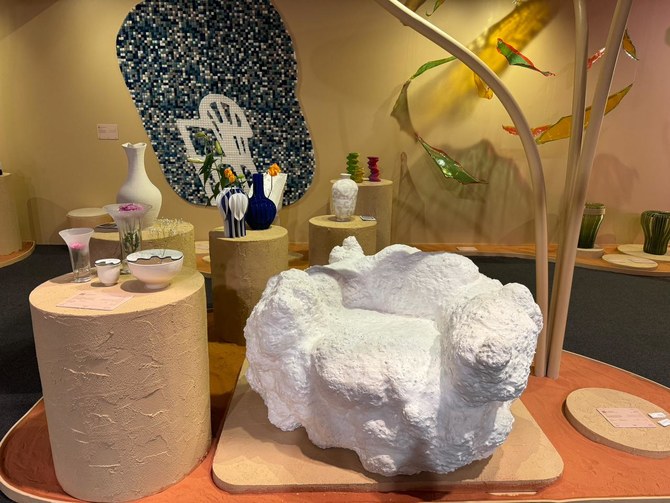
The Routes to Roots exhibition at Tanween displays a collection of forward-looking projects from Isola’s global design community. (AN Dhai Al-Mutairi)
2 / 2
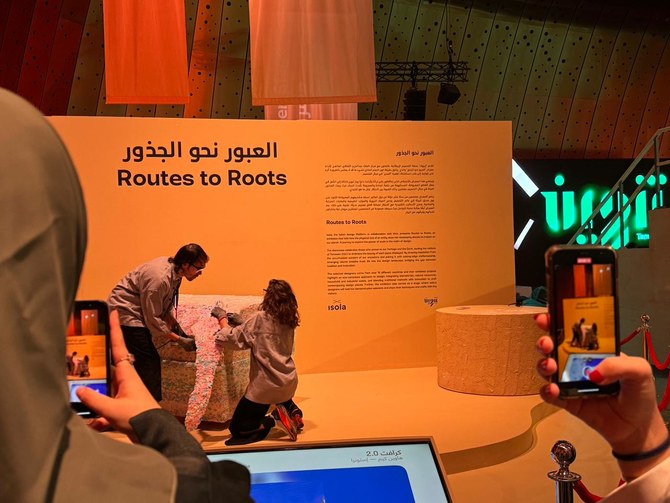
The designers of Iammi studio demonstrated in a live performances how to handcraft cloud seatings. (AN Dhai Al-Mutairi)
Short Url
Updated 03 November 2023
Follow

Dhahran’s inspiring Tanween exhibition explores power of scale

DHAHRAN: The Routes to Roots exhibition at Tanween, Ithra’s famed creativity conference, is hosting leading designers from around the world in a bid to promote a sustainable future.

Under the theme “Scale,” Tanween is being held by Ithra at its Dhahran headquarters from Nov 1-4.

The Routes to Roots exhibition, which is held in partnership with Milan-based Isola, is the first curated digital platform dedicated to international emerging designers and independent design studios, with a focus on innovation, sustainability and biomaterials.

The event at Tanween displays a collection of forward-looking projects from Isola’s global design community.

The selected designers come from more than 16 countries, and their exhibited projects highlight an eco-conscious approach to design, integrating biomaterials, natural resources, household and industrial waste, and blending traditional methods with innovation to craft contemporary design pieces.

“As a design student myself, I dreamed about traveling the world to see contemporary art and design pieces, and to have the work of brilliant designers exhibited here in my hometown makes it emotional and happy,” said Noor Al-Hamed, a visitor at the exhibition.

She added: “Dhahran, as most Saudi art students believe, is becoming a global hub for young creative designers, with Ithra enabling young designers to showcase their innovation at Tanween.”

The exhibition includes art projects by emerging talents from Japan, Portugal, France, Italy, India, Estonia, South Korea, the US and more.
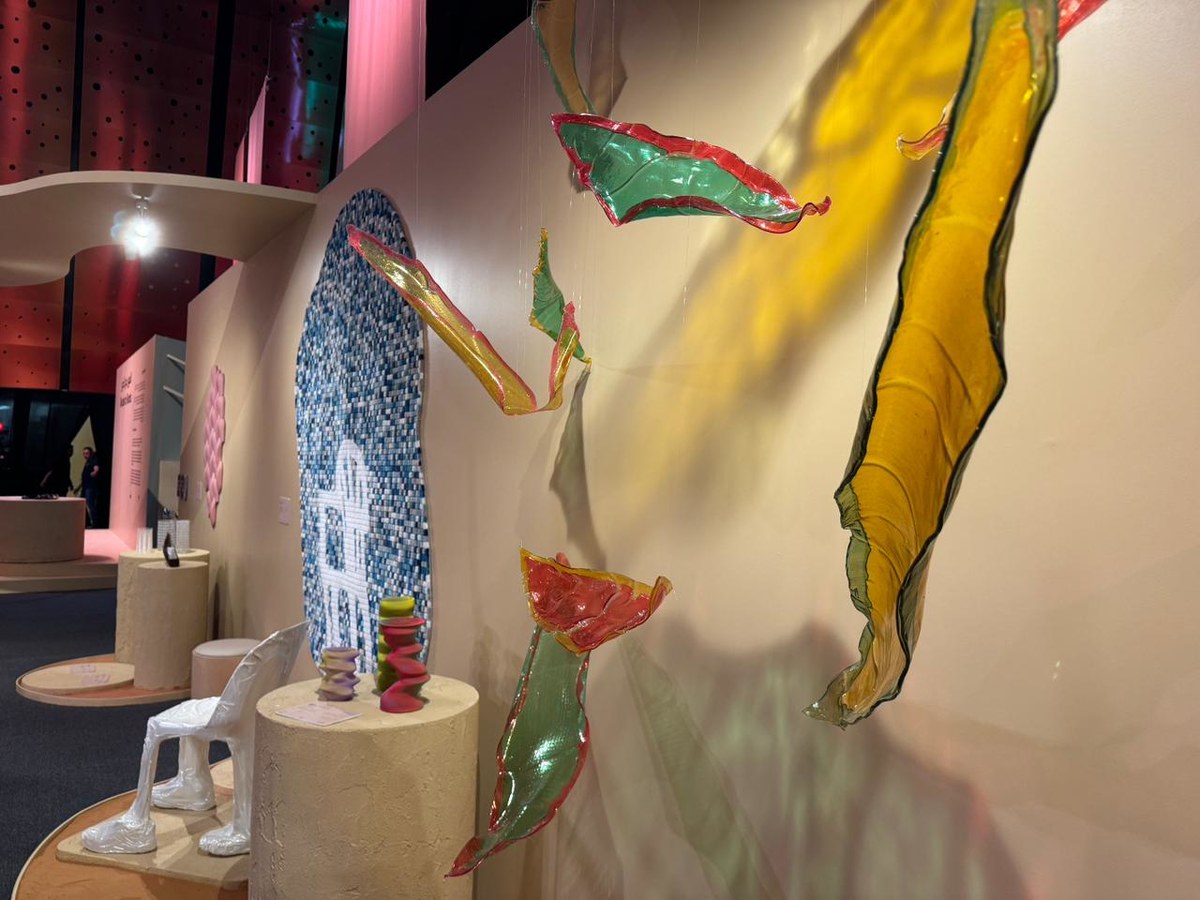


The Routes to Roots exhibition is one of the four exhibitions held at Ithra as part Tanween. (AN Dhai Al-Mutairi)

It also enables designers to hold live performances and share their techniques and crafts with visitors at Tanween.

On the second day of the exhibition, Portuguese designer Nicolau dos Santos and French-Italian art director Stephanie Blanchard, the designers of Iammi studio, held a live demo to teach visitors how to handcraft cloud seatings, an exhibited design that captured the attention of many at Tanween.

The cloud seatings were made by moulding entire blocks of Ecofoam sourced by Italian startup Re-mat, which gives new life to discarded mattresses.

Once completed, the seating is coated with water-based elastic varnish to make it durable, washable and biodegradable.

“In using this coating, we are increasing the longevity of the cloud seating, and still committing to an environmentally safe approach,” said dos Santos.

The Routes to Roots exhibition is one of four exhibitions held at Ithra as part of Tanween.

Since 2018, the event has brought together innovators and creatives with leading experts, encouraging knowledge exchange and redefining creativity in a changing world.


Experimental farm in Al-Lith looks into future of Saudi Arabian agriculture

Updated 01 February 2026
Follow

Experimental farm in Al-Lith looks into future of Saudi Arabian agriculture

  • Research initiative reflects strategic transformation

JEDDAH: An experimental farm in Saudi Arabia’s Al-Lith Governorate is one of the research initiatives reflecting the strategic transformation taking place in the Kingdom’s agricultural sector.

The farm uses highly efficient, sustainable production models that combine scientific research with commercial application, contributing to strengthening the country’s food security system and the sustainability of water resources.

Located in the Ghumaiqa Center on an area of about 10 hectares, the cutting-edge farm is a testing platform for modern agricultural technologies that tackle the challenge of water scarcity.

The farm includes developed open fields and modern greenhouses, supported by smart irrigation encompassing drip and sprinkler irrigation alongside surface and subsurface technologies.

All the systems operate via smart controls that enable the monitoring of water consumption and ensure improved efficiency, thereby achieving a balance between agricultural production and water conservation.

The farm also uses treated and diluted low-salinity seawater.

It aims to diversify agricultural water sources, reduce reliance on freshwater, and open new horizons for agriculture in coastal and semi-arid environments.

The project represents a promising investment opportunity in the field of smart agriculture, enabling the development of commercially scalable production models, particularly for high-value vegetables and fruits, while reducing operational costs associated with water and energy, enhancing the economic feasibility of future agricultural projects.

In addition, the project contributes to transferring and localizing agricultural expertise, supporting local food supply chains, and creating an attractive environment for agricultural investment.

This aligns with Sustainable Development Goals and enhances the efficiency of the private sector in adopting innovative agricultural solutions.

Yahya bin Abdulrahman Al-Mahabi, the director of the Ministry of Environment, Water and Agriculture office in Al-Lith Governorate, told the Saudi Press Agency that the project represented the future of agriculture in the Kingdom.

He explained that the vision was based on investing in technology, enhancing the return on water per unit, and integrating scientific research with investment opportunities.

Al-Mahabi spoke of the experimental farm as a modern, scalable and replicable model applicable in several regions of the Kingdom, particularly in coastal environments.

Al-Mahabi highlighted the Ministry of Environment, Water and Agriculture’s commitment to supporting distinctive projects that contributed to achieving food security while developing rural areas and enhancing agricultural production efficiency, in line with the objectives of the Kingdom’s Vision 2030.