

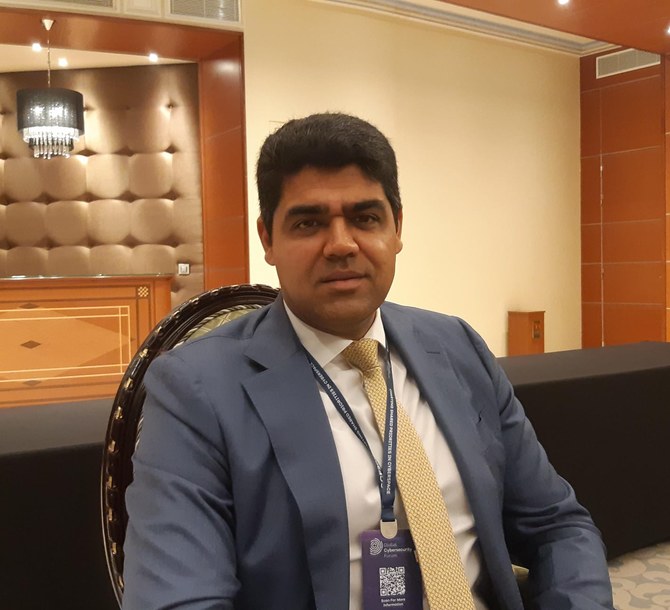

RIYADH: Saudi Arabia’s government and private sectors are advancing in cybersecurity, with the leadership strongly emphasizing the importance of electronic information protection, according to a top official from the World Economic Forum.
Speaking to Arab News on the sidelines of the Global Cybersecurity Forum, Akshay Joshi, head of the industry and partnerships at the Center for Cybersecurity at the WEF, highlighted Saudi efforts in cybersecurity and its role in the global landscape.
“There is a well-established national cybersecurity authority. On top of that, you have leading organizations such as Saudi Aramco, SITE, NEOM and Saudi Telecommunications Co. — all of which are partnering with us,” said Joshi, who was elated to see the GCF in its third iteration.
He added: “One aspect is to be a leader in cybersecurity and prioritize it for your own country. The second is to try and take leadership in terms of bringing other players on board this problem as well.”
Talking about the significance of focusing on cybersecurity amid increasing online threats amid technological developments such as artificial intelligence, Joshi said that cybersecurity today is so vital that it intersects all aspects of life.
“We have seen that technologies are developing at an unprecedented pace, and AI is a good example of that. Until last year, we were talking about AI. We weren’t talking about generative AI, as it may be. And that’s the new thing that took us by storm as of last year,” he said.
He added that the top questions in people’s minds, ever since, have been about security, privacy and the ethics of the underlying AI systems.
According to Joshi, the advent of technological innovations has been so rapid that in 2018, blockchain and cryptocurrencies were the buzzwords. Videoconferencing took the mantel during the COVID-19 pandemic, and then came the metaverse and the possibilities it could offer and now generative AI.
Foreseeing the future, Joshi said that quantum computing is one thing that the world is essentially waiting for, but that has heightened security-related considerations.
“So, if we look at all of these transformations, cybersecurity is a top concern. Therefore, there is no digital transformation without cybersecurity being deep and green,” he added.
Elaborating on the role of public-private partnerships in addressing cybersecurity challenges, he said that the commerical realm has a lot of expertise because companies are defending their infrastructure daily.
“Private sector businesses are sitting on a lot of information overall. If we think about the public sector, particularly law enforcement, the mandate to prosecute cybercriminals squarely lies with them,” said the WEF executive
Naturally, it is a partnership in the making because if the expertise on how these attack vectors are emerging lies is available, then law enforcement will have the mandate to prosecute.
“This is ripe for public-private partnership. If we think about critical infrastructure, which is a different element, a lot of the providers of critical infrastructure in many countries or operators might be the private sector,” added Joshi.
He also pointed out the need to stop looking at cybersecurity in isolation and consider it a global problem.
“Cyberspace is very unique. It transcends borders. The risks facing one particular country, from a cybersecurity perspective, are the exact risks that other countries can also face. Therefore, we need to move beyond just national approaches and think about global public-private cooperation if we are to solve this issue,” Joshi said.
There is also a need for a structural alignment among various industry stakeholders and governments that assesses the ground situation as a business imperative.
“Within critical infrastructure organizations, it is important to view cybersecurity not as a technical problem but as a business imperative. There needs to be adequate risk mitigation measures and a resilience plan overall,” said Joshi.
There is also a dire need for cybersecurity professionals worldwide, as many organizations need help finding and retaining skilled individuals to protect their digital assets.
According to Joshi, it is one of the key priorities, as he cited a report that estimated that the talent shortfall last year was roughly 3.5 million cybersecurity professionals.
“I think there is a massive shortage. This report basically highlights the talent shortfall at one point in time. Now, if you’re thinking about generative AI that came into the mix, we have a new tech landscape,” he said, summing up the need for organizations to keep their guards up.


