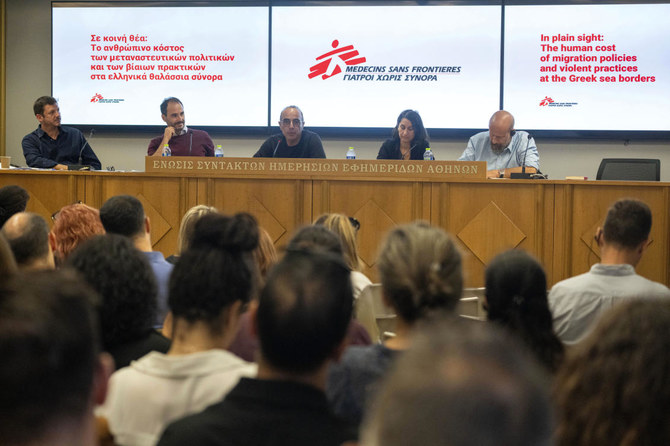
ATHENS: Greece has “normalized” abusive pushbacks of migrants under a broader EU policy that ignores violence against people in need, the international charity Doctors Without Borders (MSF) said on Thursday.
Tens of thousands of migrants, mostly from Syria, Afghanistan and Pakistan, have entered Greece in recent years from the sea and land borders with Turkiye.
Greece has stepped up patrols in the Aegean Sea with the help of the European Border Surveillance Agency, Frontex.
“MSF teams have borne witness to how normalized pushbacks have become, and to the stark absence of protection for people who seek safety in Greece,” MSF said in a report.
“Despite extensive and credible evidence, Greek authorities, the EU and its member states have failed to hold to account the perpetrators of these violations,” it added.
In June, a dilapidated and overloaded former trawler capsized and sank off Pylos in the Peloponnese, drowning 82 people, while hundreds were reported missing.
Forty of the survivors have filed a group lawsuit against Greek authorities for failing to take appropriate action before the boat sank.
MSF said the current situation at Europe’s borders “is the result of EU policies that condone and enable continued violence against individuals in need.”
Despite extensive documentation and reporting of violent pushbacks at both land and sea “there is a striking and longstanding lack of accountability at Greek and Europe,” it said.
The charity says it has provided emergency medical assistance to nearly 8,000 individuals over the past two years, including over 1,500 children.
Most patients treated by the group said they had survived multiple pushbacks while many “were trapped in cycles of violence on arrival,” MSF said.
The organization said it had recorded testimonies of “violence, physical assault, strip searches and intrusive body searches on children, women and men” by uniformed officers and unidentified masked individuals.
The Greek migration ministry has been contacted by AFP for comment.
Between August 2021 and July 2023, MSF said its teams on the Aegean islands of Samos and Lesbos treated 467 survivors of sexual violence and 88 patients who had survived female genital mutilation in their country of origin.
Many of these women and girls were also suspected survivors of trafficking, while some were pregnant or had given birth after being raped.
The group also acknowledged reports of pushbacks on land, with people detained, forcibly placed on life rafts and left to drift back to Turkish waters.
On several occasions, MSF said its teams rushing to provide assistance to people in distress on Greek islands were delayed for checks by local law enforcement.
On five occasions, they were actively blocked from reaching the scene.
Greece and Turkiye in December are expected to discuss a renewal of a 2016 EU deal restricting migration.
Greece’s migration ministry this week said arrivals began increasing in mid-2022, peaking in September before declining in October.
In the first nine months of the year, migrant arrivals in Greece spiked to over 29,700 people, compared to 11,000 in the same period in 2022, the ministry said.


![]()

Abusive pushbacks of migrants ‘normalized’ in Greece: MSF
Short Url
https://arab.news/r6h6b
Abusive pushbacks of migrants ‘normalized’ in Greece: MSF
- Tens of thousands of migrants, mostly from Syria, Afghanistan and Pakistan, have entered Greece in recent years
- “MSF teams have borne witness to how normalized pushbacks have become, and to the stark absence of protection for people who seek safety in Greece,” MSF said in a report


Latest updates


© 2026 SAUDI RESEARCH & PUBLISHING COMPANY, All Rights Reserved And subject to Terms of Use Agreement.