Pakistan needs $340 billion to meet climate, development challenges between 2023-2030 

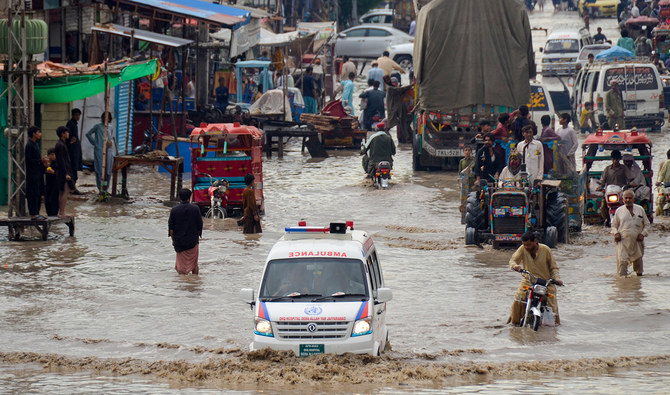
Commuters wade through a flooded street after heavy monsoon rains in Jaffarabad district of Balochistan province on July 27, 2023. (AFP/File)
Short Url
Updated 02 November 2023
Follow

Pakistan needs $340 billion to meet climate, development challenges between 2023-2030 

  • Currently, only $39 billion in public finance and $9 billion through public-private partnerships is expected for climate mitigation and adaptation efforts 
  • Pakistan is fifth most climate-vulnerable country, international donors in January committed over $9 billion to help Pakistan recover from 2022 floods

ISLAMABAD: Caretaker Finance Minister Dr. Shamshad Akhtar said on Wednesday Pakistan needed $340 billion to meet climate and development challenges until 2023, saying the South Asia nation was facing a trade-off between raising development finance and funds to combat climate change.

In August 2022, torrential monsoon rains triggered the most devastating floods in Pakistan’s history, killing around 1,700 people. Over 33 million people were affected by the floodwaters — a staggering number close to the population of Canada. Millions of homes, tens of thousands of schools as well as thousands of kilometers of roads and railways still need to be rebuilt.

Pakistan produces less than one percent of the world’s carbon footprint but, according to the Global Climate Risk Index, is currently the fifth most climate-vulnerable country in the world, having lost nearly ten thousand lives and suffering economic losses worth $3.8 billion due to climate change throughout the years 1999 to 2018.

Changing seasonal weather patterns, rising temperatures, variability of monsoons and melting of glaciers in the north — compounded with recurrent extreme weather events and natural disasters — are just some of the effects of climate change that Pakistan has been forced to contend with in recent years.

Speaking at the second Pakistan Climate Conference organized by the Overseas Investors Chamber of Commerce and Industry (OICCI), the finance minister said Pakistan needed $340 billion to address climate and development challenges between 2023 and 2030. The amount is equivalent to 10 percent of the cumulative GDP during the same period.

“I think we need to be conscious that getting money is a big issue that we face in addressing the climate agenda,” she said, highlighting that seeking money for climate finance undercut other development finance requirements.

The best recourse for Pakistan would be to use its “best of the best firms” to attract institutional investors’ financing for bridging gaps.

The total cost of implementing Pakistan’s nationally determined contribution (NDC), which is a self-defined national climate pledge under the Paris Agreement reflecting what Islamabad will do to help meet the global climate goals, is projected to be nearly $200 billion by 2030.

Currently, only $39 billion in public finance and $9 billion through public-private partnerships is expected for both climate mitigation and adaptation efforts over the coming decade, the finance minister added.

Pakistan has carried out a number of green finance initiatives such as the dollar-denominated green Eurobonds annou­nced by the Water and Power Development Authority (Wapda), Akhar said, adding that the government was planning to float “some of government securities” and different instruments, including Islamic finance and green finance issues, through the PSX.

“If we can remain on course, which is always a challenge given what’s going on within Pakistan, we should be able to bring at least one issue of Sukuk,” she said, adding that the issue will have a “green element” to it.

International donors in January committed over $9 billion to help Pakistan recover from the 2022 floods last year, exceeding its external financing goals and paving the way for a new model on raising funds to fight climate disasters in poorer countries.

Officials from some 40 countries as well as private donors and international financial institutions gathered at a meeting in Geneva as Islamabad sought funds to cover around half of a recovery bill amounting to $16.3 billion.



Pakistan, Türkiye military chiefs discuss defense cooperation amid Middle East tensions

Updated 6 sec ago
Follow

Pakistan, Türkiye military chiefs discuss defense cooperation amid Middle East tensions

  • Field Marshal Asim Munir reaffirms Pakistan’s commitment to deepening military-to-military ties with Türkiye
  • Turkish officials said this month they were in talks to join the Pakistan-Saudi defense alliance formed last year

ISLAMABAD: Pakistan’s top military commander, Field Marshal Asim Munir, met the Chief of the Turkish General Staff, General Selcuk Bayraktaroglu, on Friday to discuss deepening defense cooperation, as regional security concerns intensify amid the ongoing tensions in the Middle East.

The meeting comes against the backdrop of widening geopolitical uncertainty following the Gaza war, which has heightened the risk of broader regional escalation involving Iran and the United States, and as Ankara explores closer defense coordination with partners beyond NATO.

Earlier this month, Turkish Foreign Minister Hakan Fidan said Türkiye was in talks to join a defense alliance established between Pakistan and Saudi Arabia last September, signaling a possible expansion of security cooperation among key regional players.

The Turkish general called on Pakistan’s chief of defense forces at the General Headquarters in Rawalpindi, according to the military’s media wing, Inter-Services Public Relations (ISPR).

“During the meeting, besides dilating upon matters of mutual interest, prevailing regional and global security landscape, and prospects for strengthening bilateral defense and military cooperation were also discussed,” the ISPR said in a statement.

It added that both sides “expressed satisfaction on current trajectory of Pakistan-Türkiye relations while underscoring the requirement of maintaining close coordination and enhancing defense collaboration.”

Munir welcomed the support of the Turkish Armed Forces and reaffirmed Pakistan’s commitment to strengthening military-to-military ties, according to the statement.

It said that Bayraktaroglu praised the professionalism of Pakistan’s armed forces and expressed Türkiye’s intent to deepen defense cooperation through training, joint exercises and capacity-building initiatives.

Pakistan and Türkiye maintain close diplomatic, economic and defense relations, with military cooperation forming a major pillar of their partnership.

Last month, a high-level delegation of Turkish aerospace and defense manufacturers visited Pakistan to explore joint ventures, co-production and technology-sharing opportunities. In August 2025, the navies of both countries conducted their first bilateral amphibious exercise to strengthen maritime coordination.

Turkish defense firms have played a key role in modernizing Pakistan’s Agosta 90B-class submarines and have supplied Islamabad with advanced military hardware, including drones.

The two countries also regularly conduct joint military drills. Their most recent exercise, Ataturk-XIII in February 2025, brought together special forces units for combat training aimed at improving their ability to operate effectively together in the field.