UN peacekeepers wounded in blast while pulling out from insurgency-wracked Mali

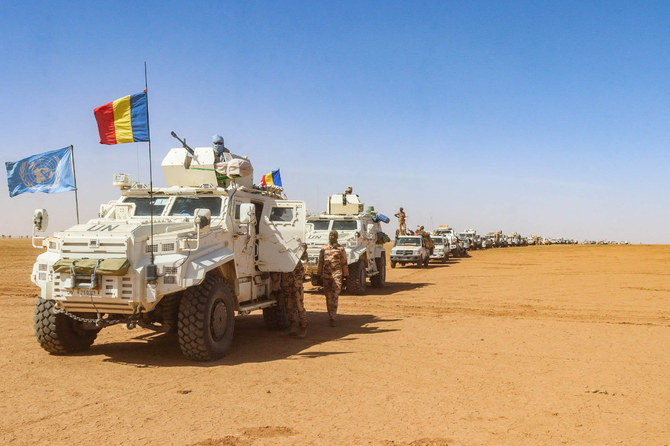
Chadian soldiers with the United Nations peacekeeping force in Mali drive in convoys toward the city of Gao, after withdrawing from their bases in Tessalit and Aguelok in the North of Mali on Oct. 25, 2023. (MINUSMA handout photo/via AFP)
Short Url
Updated 02 November 2023
Follow

UN peacekeepers wounded in blast while pulling out from insurgency-wracked Mali

  • A vehicle carrying troops hit an explosive device as the peacekeepers left their camp in Kidal, says UN spokesman
  • The UN force, called Minusma, pulled out of Mali upon the demand of the country's military junta

UNITED NATIONS: Several peacekeepers from the UN mission in Mali, currently in the process of withdrawing from the country, were “seriously injured” on Wednesday when their convoy fell victim to an improvised explosive device, a UN spokesman said.
On Tuesday, peacekeepers from the mission, known as Minusma, left their camp in Kidal in a long convoy of dozens of vehicles bound for Gao, a major northern city some 350 kilometers (220 miles) away.
“Today, we were just informed that the convoy hit an improvised explosive device,” Stephane Dujarric, spokesman for the UN Secretary-General, told reporters at the United Nations in New York.
Preliminary information indicates that “several peacekeepers were seriously injured,” he added. Minusma later said on its X (formerly Twitter) account that eight peacekeepers had been wounded, all of whom were evacuated to Gao.
“Today’s attack follows two similar incidents yesterday in which two peacekeepers experienced minor injuries” and were treated on site, Dujarric said.
The convoy was the last to leave Kidal for the Minusma base in Gao, “under extremely difficult security conditions.”
The convoy was thus “forced to depart without any air support due to a lack of flight authorization by the Malian authorities, which of course has increased the threat to the safety of our peacekeepers as they travel hundreds of kilometers in very unsafe territories,” Dujarric said, calling again for Bamako’s “full cooperation” in the Minusma withdrawal.
In June, the Malian junta demanded that the peacekeepers leave “without delay,” forcing the UN Security Council to launch an unprecedented hasty withdrawal, due to be completed by the end of the year. UN forces had to destroy equipment left behind and risk their lives on the road out, campaigners said on October 27, 2023. 
Minusma, constrained by the deteriorating security situation between all the armed actors vying for control of the terrain — including separatists, jihadists, and the regular army — has accelerated its withdrawal, much to the irritation of the junta. 
It left its positions in Kidal without waiting for the army to arrive, allowing the separatist rebellion, which is predominantly Tuareg, to take control of the area and beat the Malian army in the race for territory between the central state and the armed groups in the north.


EU, India successfully conclude major trade deal: New Delhi

Updated 3 sec ago
Follow

EU, India successfully conclude major trade deal: New Delhi

  • Indian government officials say the pact, which was two decades in the making, will be unveiled Tuesday
  • European Commission President Ursula von der Leyen and European Council president Antonio Costa appear as guests of honor at India’s Republic Day parade
NEW DELHI: India and the European Union have finalized a massive free trade deal, Indian government officials said on Monday, about two decades after negotiations were first launched.
Facing challenges from China and the United States, Brussels and New Delhi have sought closer ties, producing a pact that is to be unveiled in the Indian capital on Tuesday.
Feted Monday as guests of honor at India’s Republic Day parade, European Commission President Ursula von der Leyen and European Council president Antonio Costa are to meet Indian Prime Minister Narendra Modi for a summit.
“Official level negotiations are being concluded and both sides are all set to announce the successful conclusion” of talks at the Tuesday summit, Indian commerce secretary Rajesh Agrawal told AFP.
The EU has eyed India — the world’s most populous nation — as an important market for the future, while New Delhi sees the European bloc as an important source of much-needed technology and investment to rapidly upscale its infrastructure and create millions of new jobs.

’Mother of all deals’

Bilateral trade in goods reached 120 billion euros ($139 billion) in 2024, an increase of nearly 90 percent over the past decade, according to EU figures, with a further 60 billion euros ($69 billion) in trade in services.
India’s Commerce Minister Piyush Goyal has described the new pact as “the mother of all deals.”
“Final negotiations have been focused and fruitful, and we are now very optimistic that we will land this historic trade deal,” an EU official said Monday speaking on condition of anonymity.
Under the agreement, India is expected to ease market access for key European products, including cars and wine, in return for easier exports of textiles and pharmaceuticals, among other things.
“The EU stands to gain the highest level of access ever granted to a trade partner in the traditionally protected Indian market,” von der Leyen said on Sunday, adding that she expected exports to India to double.
“We will gain a significant competitive advantage in key industrial and agri-good sectors.”
Talks went down to the wire on Monday, focusing on a few sticking points, including the impact of the EU’s carbon border tax on steel, according to sources familiar with the discussions.
The accord comes as both Brussels and New Delhi have sought to open up new markets in the face of US tariffs and Chinese export controls.
India and the EU were also expected to conclude an accord to facilitate movement for seasonal workers, students, researchers and highly skilled professionals, and a security and defense pact.
“India and Europe have made a clear choice. The choice of strategic partnership, dialogue and openness,” von der Leyen wrote on social media. “We are showing a fractured world that another way is possible.”
New Delhi, which has relied on Moscow for key military hardware for decades, has tried to cut its dependence on Russia in recent years by diversifying imports and pushing its own domestic manufacturing base.
Europe is doing the same with regard to the United States.