

Israel bombed ‘safe’ zones in southern Gaza: BBC analysis

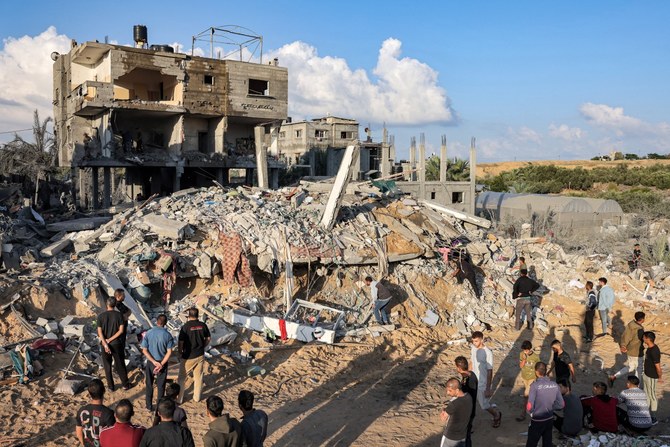
Israel bombed Nejmeh Square in central Rafah three days after instructing Gazans to take shelter in the area. (AFP/File)
Short Url
Updated 01 November 2023
Follow

Israel bombed ‘safe’ zones in southern Gaza: BBC analysis

  • IDF warnings provided maps with 'vague' destinations, claiming evacuation orders were for 'safety' of citizens
  • BBC could not find evidence of subsequent different instructions

LONDON: Israel bombed areas in Gaza to which the Israel Defense Forces had previously ordered Palestinian civilians to evacuate, an analysis carried out by BBC Verify found.

Upon receiving warnings from the Israeli forces of plans to bomb northern Gaza after the military campaign began on Oct. 7, hundreds of thousands of Gazans fled to the south, which came under relentless Israeli bombardment.

On Oct. 13, the UN voiced concerns that nowhere in Gaza was safe for civilians.

In a report published on Tuesday, BBC Verify, in collaboration with BBC Arabic, identified and analyzed four instances of airstrikes on the Gaza Strip. These included the bombing of Khan Younis on Oct. 10 and 19, Rafah on Oct. 11, and camps in central Gaza on Oct. 17, 18, and 25.

The warnings issued to Gazan neighborhoods provided maps pointing to “vague” destinations for residents to move to, according to the report. Three of the analyzed strikes “hit within, or close to, those areas” a few days after the evacuation orders.

The BBC verified the location of the Khan Younis strike of Oct. 10 using visual clues, such as the minaret of the Grand Mosque, in addition to photos of destroyed buildings and people picking through rubble.

The network’s assessment unit also employed “reverse image search” to make sure the photos were not taken during a previous attack.

On the morning of Oct. 8, the IDF warned through X (formerly Twitter) that the residents of Abasan Al-Kabira and Abasan Al-Saghira neighborhoods in Khan Younis should move to the “city center” for their safety. After around two days, the IDF struck central Khan Younis.

The same warning also instructed the residents of Rafah to take shelter in Rafah city center for their “safety.” On Oct. 11, Israeli fighter jets bombed Nejmeh Square in central Rafah. The BBC verified this by studying a video of the aftermath as well as photos taken before the strike.

Another attack on Khan Younis targeted Gamal Abdel Nasser Street on Oct. 19, less than three days after the IDF warned people in Gaza City to move to Khan Younis, claiming it was for their “safety” and that of their loved ones.

Airstrikes on three refugee camps in the Strip also came after the IDF’s warning on Oct. 8 instructed people in the eastern and southern Maghazi area to move to camps in central Gaza.

The BBC verified that there were no camps in the location specified on the tweet’s map but identified three nearby ones: Al-Nuseirat, Al-Bureij, and Deir Al-Balah. All three camps were bombed on Oct. 17 and 18.

On Oct. 25, Al-Nuseirat camp suffered another strike that killed the son of Al Jazeera’s chief Gaza correspondent Wael al-Dahdouh, who moved with his family from the north following Israel’s warning.

The BBC said in the report it could not rule out the possibility that there were subsequent different instructions, “but the BBC has not found any evidence of this.”

The BBC asked the IDF if it had targeted the provided locations on these specific dates and if any advance warnings were issued before the attacks, but the IDF said it “cannot provide any further information regarding these specific locations.”

It added that it had “called on civilians in Gaza to move south for their safety,” and that it “will continue striking terrorist targets in all parts of Gaza.”


Foreign media group slams Israel for refusing to lift Gaza press ban

Updated 07 January 2026
Follow

Foreign media group slams Israel for refusing to lift Gaza press ban

  • Foreign Press Association expresses 'profound disappointment' with Israeli government’s response to a Supreme Court appeal
  • Israel has barred foreign journalists from independently entering the devastated territory since the war started

JERUSALEM: An international media association on Tuesday criticized the Israeli government for maintaining its ban on unrestricted media access to Gaza, calling the move disappointing.
The government had told the Supreme Court in a submission late Sunday that the ban should remain in place, citing security risks in the Gaza Strip.
The submission was in response to a petition filed by the Foreign Press Association (FPA) — which represents hundreds of journalists in Israel and Palestinian territories — seeking immediate and unrestricted access for foreign journalists to the Gaza Strip.
“The Foreign Press Association expresses its profound disappointment with the Israeli government’s latest response to our appeal for full and free access to the Gaza Strip,” the association said on Tuesday.
“Instead of presenting a plan for allowing journalists into Gaza independently and letting us work alongside our brave Palestinian colleagues, the government has decided once again to lock us out” despite the ceasefire in the territory, it added.
Since the outbreak of the Gaza war in October 2023, triggered by an attack on Israel by the Palestinian militant group Hamas, the government has barred foreign journalists from independently entering the devastated territory.
Instead, Israel has allowed only a limited number of reporters to enter Gaza on a case-by-case basis, embedded with its military inside the blockaded Palestinian territory.
The FPA filed its petition in 2024, after which the court granted the government several extensions to submit its response.
Last month, however, the court set January 4 as a final deadline for the government to present a plan for allowing media access to Gaza.
In its submission, the government maintained that the ban should remain in place.
“This is for security reasons, based on the position of the defense establishment, which maintains that a security risk associated with such entry still exists,” the government submission said.
The government also said that the search for the remains of the last hostage held in Gaza was ongoing, suggesting that allowing journalists in at this stage could hinder the operation.
The remains of Ran Gvili, whose body was taken to Gaza after he was killed during Hamas’s 2023 attack, have still not been recovered despite the ceasefire.
The FPA said it planned to submit a “robust response” to the court, and expressed hope the “judges will put an end to this charade.”
“The FPA is confident that the court will provide justice in light of the continuous infringement of the fundamental principles of freedom of speech, the public’s right to know and free press,” the association added.
The Supreme Court is expected to issue a ruling on the matter, though it is unclear when a decision will be handed down.
An AFP journalist sits on the board of the FPA.