Saudi entrepreneurs forge new partnerships on 8,000-km India train journey

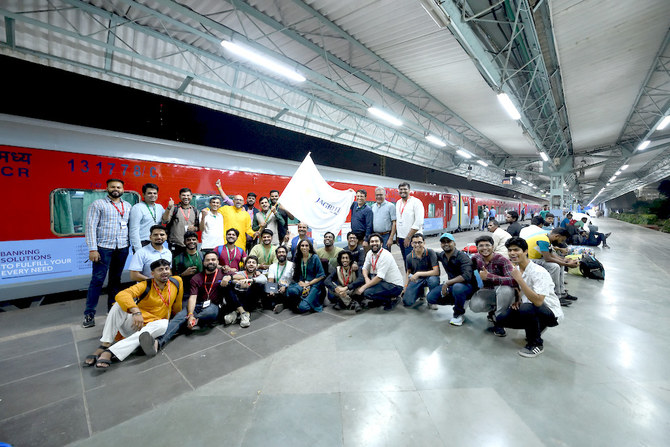
Entrepreneurs from G20 countries start their Jagriti Startup20 train journey across India in Mumbai on Oct. 28, 2023. (Jagriti Yatra)
Short Url
Updated 01 November 2023
Follow

Saudi entrepreneurs forge new partnerships on 8,000-km India train journey

  • 60 delegates from G20 countries participate in Jagriti Startup20 train journey across India
  • Co-organizer of the journey from the Saudi side is startup incubator HealthGena

NEW DELHI: Saudi entrepreneurs have started their 8,000-km train journey across India to brainstorm with other innovators from G20 countries and forge new collaborations with Indian startups.

The journey, Jagriti Startup G20 Yatra 2023, comprises 60 delegates from G20 countries and Indian participants who took part in the Startup20 engagement group under this year’s Indian presidency of the world’s biggest economies.

The round trip that started in Mumbai on Saturday will take them to 11 Indian cities before it ends on Nov. 10.

The co-organizer of the journey is Saudi startup incubator HealthGena, whose project manager, Alaa Hanifah, said it was a “unique opportunity” to strengthen his relations with Indian entrepreneurs and look for potential business ventures, partnerships, and investment opportunities in India’s technology, sustainable development, and e-commerce industries.

“The experience has been incredibly enriching so far. The nicest thing that happened was when a group of entrepreneurs spontaneously organized a pitch session onboard, showcasing their startups and receiving valuable feedback from peers,” he told Arab News on board the train.

“My expectations from this journey are to gain insights into different business models, learn from the experiences of other entrepreneurs, and potentially discover new opportunities for partnerships or investments.”

Five of the participants arrived from Saudi Arabia for the program that falls under the umbrella of the Startup20 engagement group.

For Abdulmajeed Al-Yaseen, strategy and business operation director at Salasa, a shipping and logistics company based in Riyadh, it was an important experience of interacting with people of different cultural backgrounds and learning about their lives during the journey they set out on together.

“It’s been great and challenging at the same time,” he told Arab News, adding that it was also a “great chance” to connect with Indian entrepreneurs for potential collaborations.

“Technology and AI are the major sectors that I’m interested in, but I came here with an open mind to any potential opportunity,” he said.

Jagriti Yatra, a non-profit organizing the journey from the Indian side, signed a cooperation agreement with HealthGena during the G20 Young Entrepreneurs Alliance Summit in New Delhi in July.

“This will help in promoting Indian-Saudi entrepreneurship culture and amalgamation of entrepreneurs from both places,” said Rahul Kumar, the organization’s media head.

“The Indian participants who are interacting with the Saudi participants are definitely keen on being part of some entrepreneurship. Indians are also very excited to be part of the entrepreneurship (ecosystem) in Saudi Arabia.”

During the 14-day journey, young entrepreneurs are not only establishing connections and expanding their networks but also taking part in workshops and lectures.

The journey has been organized by Jagriti Yatra for the past 15 years, but it is the first time that it has seen so many foreigners.

“People are selected based on their journey of entrepreneurship, their willingness to learn about entrepreneurship,” Kumar said.

“This year, it is happening in association with Startup20. We have (made sure) to have participation from all the G20 nations.”


Geoeconomic confrontation tops global risks in 2026: WEF report

Updated 20 min 53 sec ago
Follow

Geoeconomic confrontation tops global risks in 2026: WEF report

  • Also armed conflict, extreme climate, public polarization, AI
  • None ‘a foregone conclusion,’ says WEF’s MD Saadia Zahidi

DUBAI: Geoeconomic confrontation has emerged as the top global risk this year, followed by state-based armed conflict, according to a new World Economic Forum report.

The Global Risks Report 2026, released on Wednesday, found that both risks climbed eight places year-on-year, underscoring a sharp deterioration in the global outlook amid increased international competition.

The top five risks are geoeconomic confrontation (18 percent of respondents), state-based armed conflict (14 percent), extreme weather events (8 percent), societal polarization (7 percent) and misinformation and disinformation (7 percent).

The WEF’s Managing Director Saadia Zahidi said the report “offers an early warning system as the age of competition compounds global risks — from geoeconomic confrontation to unchecked technology to rising debt — and changes our collective capacity to address them.

“But none of these risks are a foregone conclusion.”

The report assesses risks across three timeframes: immediate (2026); short-to-medium term (next two years); and long term (next 10 years).

Economic risks show the largest overall increase in the two-year outlook, with both economic downturn and inflation jumping eight positions.

Misinformation and disinformation rank fifth this year but rise to second place in the two-year outlook and fourth over the 10-year horizon.

The report suggests this reflects growing anxiety around the rapid adoption of artificial intelligence, with adverse outcomes linked to AI surging from 30th place in the two-year timeframe to fifth in the 10-year outlook.

Uncertainty dominates the global risk outlook, according to the report.

Surveyed leaders and experts view both the short- and long-term outlook negatively, with 50 percent expecting a turbulent or stormy global environment over the next two years, rising to 57 percent over the next decade.

A further 40 percent and 32 percent, respectively, describe the outlook as unsettled across the two- and 10-year timeframes, while just 1 percent anticipate a calm global outlook in either period.

Environmental risks ease slightly in the short-term rankings. Extreme weather fell from second to fourth place and pollution from sixth to ninth. Meanwhile, critical changes to Earth systems and biodiversity loss dropped seven and five positions, respectively.

However, over the next decade, environmental threats re-emerge as the most severe, with extreme weather, biodiversity loss, and critical changes to Earth systems topping the global risk rankings.

Looking ahead over the next decade, around 75 percent of respondents anticipate a turbulent or stormy environmental outlook, making it the most pessimistic assessment across all risk categories.

Zahidi said that “the challenges highlighted in the report underscore both the scale of the potential perils we face and our shared responsibility to shape what comes next.”

Despite the gloomy outlook, Zahidi signaled a positive shift in global cooperation.

 “It is also clear that new forms of global cooperation are already unfolding even amid competition, and the global economy is demonstrating resilience in the face of uncertainty.”

Now in its 21st year, the Global Risks Report highlights a core message: global risks cannot be managed without cooperation.

As competition intensifies, rebuilding trust and new forms of collaboration will be critical, with the report stressing that today’s decisions will shape future outcomes.

The report was released ahead of WEF’s annual meeting, which will be held in Davos from Jan. 19 to 23.