

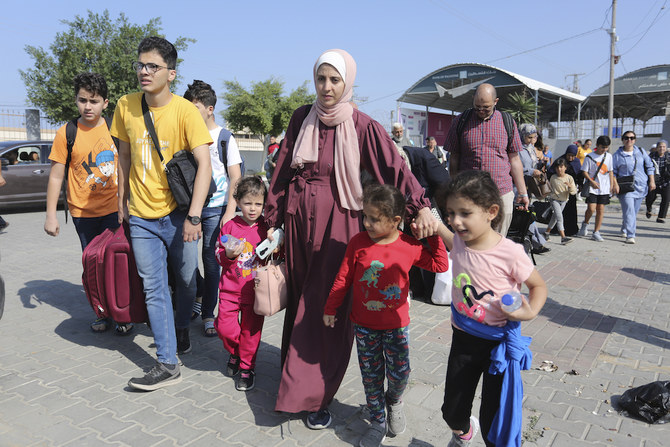

RAFAH, Palestinian Territories: Injured residents and foreigners escaped Gaza to Egypt Wednesday, the first evacuations from the war-torn Palestinian territory pounded by Israeli warplanes in retaliation for an unprecedented Hamas attack.
The brief glimmer of hope sparked by the temporary opening of the Rafah border crossing was quickly snuffed out as a fresh strike pulverised buildings in Gaza’s biggest refugee camp for a second consecutive day, killing dozens according to the Palestinian health ministry.
Prime Minister Benjamin Netanyahu vowed to “continue until victory” over Hamas, whose brutal October 7 attack sparked the latest conflict, the deadliest in decades of unrest between the two sides.
AFP reporters at Gaza’s southern border saw ambulances whisking away the wounded to Egyptian field hospitals, including one young boy with heavy bandaging around his stomach.
Whole families, struggling to carry their worldly possessions, rushed through the heavily fortified crossing toward Egypt, which was expected to admit at least 400 foreign passport holders and 90 of the most seriously wounded and sick.
Jordanian citizen Saleh Hussein said she received word in the middle of the night that she was on the list for evacuation.
“We’ve faced many problems in Gaza, the least of which were the shortage of water and the power outage,” she told AFP. “There were bigger problems such as the bombardment. We were afraid. Many families were martyred.”
A first group of mostly women and children arrived in Egypt, an official told AFP on condition of anonymity, as TV images showed parents with pushchairs and elderly people clambering off a bus.
“It’s enough. We’ve endured enough humiliation,” said Gaza resident Rafik Al-Hilou, accompanying relatives including children aged one and four hoping to cross into Egypt.
“We lack the most basic human needs. No Internet, no phones, no means of communication, not even water. For the past four days, we haven’t been able to feed this child a piece of bread. What are you waiting for?”

Ambulances with Gaza residents wounded in the Israeli bombardment arrive at Rafah border crossing to Egypt on Nov. 1, 2023. (AP)
he Jabalia camp suffered a second strike in as many days Wednesday, with AFPTV images showing major damage and rescuers clawing through rubble to extract blood-stained casualties.
Dozens were killed and wounded, according to the Hamas-run health ministry, which came a day after Israeli jets hit the camp, killing at least 47 people, according to an AFP count.
“This is just the latest atrocity to befall the people of Gaza where the fighting has entered an even more terrifying phase, with increasingly dreadful humanitarian consequences,” said Martin Griffiths, UN humanitarian chief.
Israel said Tuesday’s raid was a successful hit on top Hamas commander Ibrahim Biari, but the large death toll drew a chorus of international condemnation in the region and as far afield as Bolivia, which severed diplomatic ties in protest.
Jordan recalled its ambassador to Israel “to condemn the Israeli war that is killing innocent people in Gaza.”
Hamas said seven hostages, including three foreign passport holders, had died in Tuesday’s bombing, a claim impossible to verify.
The group’s leader Ismail Haniyeh accused Israel of committing “barbaric massacres against unarmed civilians,” saying it was covering its own “defeats.”
Israel has relentlessly pounded Gaza in retribution for the worst attack in the country’s history, when Hamas gunmen stormed across the border, killing 1,400 people, mostly civilians, according to Israeli officials.
AFP reporters saw more tanks pour over the border into northern Gaza, as Israel stepped up its ground incursion launched late last week. Its bombing campaign has killed 8,796 people, according to the Hamas-run health ministry.
Images provided by the military showed Israeli troops picking through bombed-out houses searching for militants or some of the 240 hostages seized by Hamas.
Israel said 15 soldiers died in ground fighting in Gaza on Tuesday, taking to 330 the number of troops killed since October 7.
AFP images showed tearful Israeli women in uniform hugging each other for comfort at the funeral of one of the troops killed.

Palestinians with dual citizenship wait at the Rafah border crossing with Egypt, in the hope of getting permission to leave Gaza, amid the ongoing conflict between Israel and Hamas. (Reuters)
“Our soldiers have fallen in the most just of wars, the war for our home,” said Netanyahu, steeling the nation for “a difficult war... a long war.”
The situation in Gaza remained desperate, with food, fuel and medicine for the 2.4 million residents all running short, according to aid groups.
Palestinian residents told AFP they had evacuated from northern Gaza, as demanded by Israel, but were still under threat.
“We’ve been told people are evacuating from Gaza City toward the central area of the Strip beyond the valley, so we headed there,” Amen Al-Aqluk told AFP. “After 20 days, we were bombarded. Three of our kids lost their lives and we all got injured.
“There is no hope in the Gaza Strip. It is not safe anymore here. When the border opens, everybody will leave and emigrate. We encounter death everyday, 24 hours a day.”
With fears mounting the violence could spiral into a regional war, US President Joe Biden called for “urgent mechanisms” to dial down tensions and said top diplomat Antony Blinken would embark on another Middle East tour from Friday.
Turkiye and Iran called for a regional conference to prevent a conflagration, as Israel faces a daily barrage of aerial attacks from Hamas and other Iran-backed groups around the Middle East, including Yemen’s Houthi rebels.
In the north, Israel has traded near-daily fire with Lebanon’s Iran-backed Hezbollah movement.
And the families of hostages kidnapped by Hamas have endured an unbearable wait for news of relatives thought to be held in the labyrinth of tunnels deep below Gaza.
Ayelet Sella, whose seven cousins were kidnapped from one of the kibbutz communities raided by Hamas gunmen, said she could find “no rest” until her loved ones are returned.
“We have no more tears, our eyes are dry, we are empty three weeks on,” said Sella, speaking to AFP at the Great Synagogue in Paris. “I only ask for one thing, that they come back.”


