

Russia tightens security in Muslim-majority south after weekend airport riot

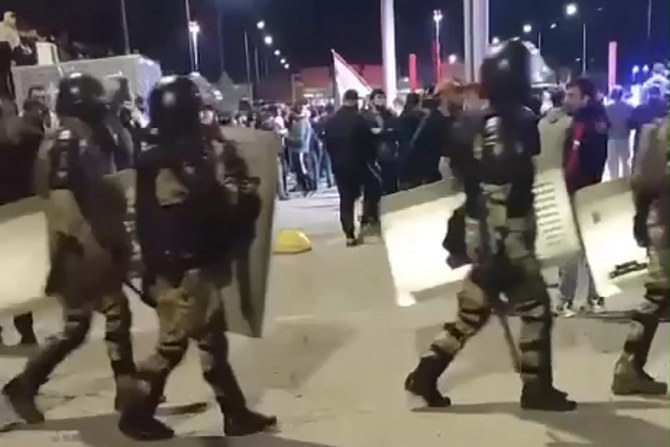
Law enforcement personnel march past as protestors (background) gather at an airport in Makhachkala. (File/AFP)
Short Url
Updated 31 October 2023
Follow

Russia tightens security in Muslim-majority south after weekend airport riot

  • The unrest followed several other anti-Semitic incidents in recent days in North Caucasus in response to Israel’s war against Palestinian Hamas militants in Gaza
  • Israel has urged Moscow to protect Israelis and Jews in Russian jurisdictions

MOSCOW: Russia tightened security in its Muslim-majority North Caucasus region on Tuesday after a weekend anti-Semitic riot there, and the Kremlin-backed leader of Chechnya ordered that rioters be shot dead if they fail to heed warnings.
President Vladimir Putin held an emergency meeting with top security officials on Monday evening after rioters in the southern region of Dagestan stormed an airport on Sunday to “catch” Jewish passengers arriving on a flight from Tel Aviv.
The unrest followed several other anti-Semitic incidents in recent days in North Caucasus in response to Israel’s war against Palestinian Hamas militants in Gaza. Israel has urged Moscow to protect Israelis and Jews in Russian jurisdictions.
The airport riot, which some Jewish leaders likened to Tsarist-era pogroms, left at least 20 people injured and resulted in over 80 detentions. It also seemed to catch authorities off-guard — it was hours before security forces regained control of the airport in Makachkala.
The Kremlin said Putin, who has accused the West and Ukraine of stirring up the trouble via social media — an allegation the US and Kyiv have rejected — used Monday’s meeting to discuss strengthening measures to counter external interference.
It did not disclose what those measures were, but Ramzan Kadyrov, the Kremlin-backed head of Chechnya, was reported to have issued an order to shoot and kill anyone trying to riot in his Muslim-majority republic, which borders Dagestan.
“If we have even one person who goes out for unauthorized riots, detain and imprison him. Or fire three warning shots in the air and after that if the person does not obey the law make the fourth shot in the forehead. No more will come out (after that). This is my order,” Russia’s state RIA news agency cited Kadyrov as telling security officials.
Rabbi Alexander Boroda, the president of Russia’s Federation of Jewish Communities, called on the Kremlin on Monday to ensure that police found and punished all those who took part in the Dagestan riot “in the strictest possible manner.”
Putin did not condemn the rioters or their actions in his public statement on Monday evening, dedicating much of it to criticizing the West instead.

’INVESTIGATIVE ACTION’
But Dmitry Peskov, his spokesman, said on Tuesday that it was obvious that the authorities were responding appropriately and investigating what had happened.
“Of course, the relevant authorities will, firstly, take investigative action. This has already been announced,” Peskov told reporters.
“And after that, of course, the situation will be analyzed to see what is necessary in order to minimize the risk or completely rule out such illegal incidents in future.”
Sergei Melikov, the governor of Dagestan, has vowed no leniency for the rioters. Dagestan is one of Russia’s poorest regions and has long suffered from high unemployment levels with a large number of young men out of work.
Like some other majority-Muslim regions, Moscow has long given it more autonomy than other Russian regions. In September 2022 when Moscow sought to mobilize men to fight in Ukraine, clashes between protesters and police broke out.
On Monday, the Telegram messaging app banned a local channel which had on Sunday urged people to go to the airport in Makachkala, Dagestan’s capital, to catch Jews. Peskov said Putin and top security officials had discussed how malicious information designed to stir up trouble could be countered.
“The focus will be on strengthening measures to counter external interference, including external information manipulation capable of inflaming the situation in our country by exploiting the theme of the same events in the Middle East,” he said.
In another anti-Semitic incident in the past few days, a Jewish center under construction in Nalchik, capital of the nearby Russian republic of Kabardino-Balkaria, was set on fire, emergency officials said.
The unrest in Dagestan, where Russian security forces once fought and defeated an Islamist insurgency, is a headache for Putin, who is waging a war in Ukraine and is keen to maintain stability at home ahead of an expected presidential election next year.
Russia, which wants an immediate cease-fire in Gaza and backs a two-state solution to the Israeli-Palestinian conflict, has tried to maintain contact with all sides but has angered Israeli authorities by inviting a Hamas delegation to Moscow. Israel’s foreign ministry summoned the Russian ambassador on Sunday.


Homeless Muslims in southern Philippines observe Ramadan as month of trial

Updated 4 sec ago
Follow

Homeless Muslims in southern Philippines observe Ramadan as month of trial

  • Thousands lost their homes when parts of Bongao in Tawi-Tawi were burnt to ashes
  • Many trying to fully observe the fasting month say they are grateful to be alive

Manila: As Annalexis Abdulla Dabbang was looking forward to observing the month of Ramadan with her family, just days before it began they lost everything when an enormous fire tore through whole neighborhoods of their city in the southernmost province of the Philippines.

Bongao is the capital of Tawi-Tawi, an island province, forming part of the country’s Muslim minority heartland in the Bangsamoro region. The city experienced its worst fire in years in early February, when flames swept through the coastal community, leaving more than 5,000 people homeless.

“We were swimming for our lives. We had to swim to escape from the fire ... We swam in darkness, and (even) the sea was already hot because of the fire,” Dabbang, a 27-year-old teacher, told Arab News.

“Everything we owned was gone in just a few hours — our home, our memories, the things we worked hard for, everything turned to ashes.”

Trying to save their 2-year-old daughter and themselves, she and her husband left everything behind — as did hundreds of other families that together with them have since taken shelter at the Mindanao State University gymnasium — one of the evacuation centers.

Unable to secure a tent, Dabbang’s family has been sleeping on the bleachers, sharing a single mat as their bed. When Ramadan arrived a few days after they moved to the makeshift shelter, they welcomed it in a different, more solemn way. There is no family privacy for suhoor, no room or means to welcome guests for iftar.

“Ramadan feels different now. It’s painful but at the same time more real. When we lost our home, we began to understand what sacrifice really means. When you sleep in an evacuation center, you understand hunger, discomfort in a deeper way,” Dabbang said.

“We don’t prepare special dishes. We prepare our hearts.”

While she and thousands of others have lost everything they have ever owned, she has not lost her faith.

“Our dreams may have turned to ashes, but our prayers are still alive,” she said.

“This Ramadan my prayers are more emotional than ever. I pray for strength, not just for myself, but for my family and for every neighbor who also lost their family home. I pray for healing from the trauma of fire. I pray that Allah will replace what we lost with something better. I pray for the chance to rebuild not just our house, but our sense of security.”

Juraij Dayan Hussin, a volunteer helping the Bongao fire victims, observed that many of them were traumatized and the need to cleanse the heart and mind during Ramadan was what kept many of them going, because they are “thankful that even though they lost their property, they are still alive.”

But the religious observance related to the fasting month is not easy in a cramped shelter.

“It’s hard for Muslims to perform their prayers when they do not have their proper attire because they usually have specific clothes for prayer,” he said. “Sanitation in the area is also an issue ... when you fast and when you pray, cleanliness is essential.”

For Abdulkail Jani, who is staying at a basketball court with his brother and more than 70 other families, this Ramadan will be spent apart from their parents, whom they managed to move to relatives.

“The month of Ramadan this year is a month of trial ... there will be a huge change from how we observed Ramadan in the past, but we will adjust to it and try to comfort ourselves and our family. The most important thing is that we can perform the fasting,” he told Arab News.

“Despite our situation now, despite everything, as long as we’re alive, we will observe Ramadan. We’ll try to observe it well, without missing anything.”