

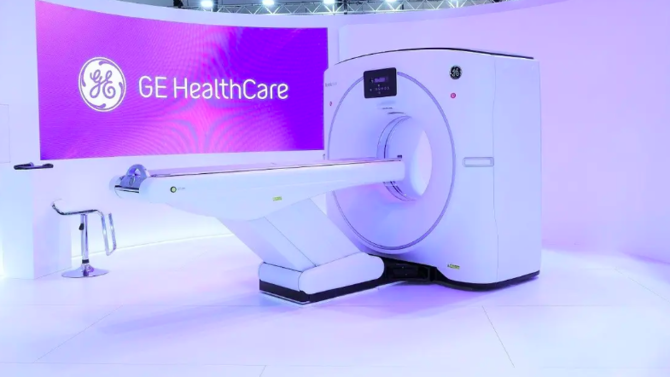
GE HealthCare to relocate regional headquarters to Riyadh

The firm has outlined its commitment to the Kingdom’s healthcare sector. Supplied.
Short Url
Updated 31 October 2023
Follow

GE HealthCare to relocate regional headquarters to Riyadh

RIYADH: GE HealthCare has announced its new regional headquarters in Riyadh amid Saudi Arabia’s push to attract international businesses to relocate their base to the Kingdom.

The announcement was made during the Global Health Exhibition in the Saudi capital, where the medical tech firm outlined its commitment to the Kingdom’s healthcare sector.

This comes on the heels of other major players joining the relocation trend. Jones Lang LaSalle, a global real estate services firm, and the consulting giant Deloitte had already declared their intent to shift their regional headquarters to Saudi Arabia earlier this month.  

First announced in February 2021, the initiative mandates that international firms seeking government contracts in the Kingdom must establish their regional headquarters in Riyadh by no later than Jan. 1, 2024.

The goal is twofold, aiming to stimulate local job creation in line with economic diversification plans and to stay competitive in the face of growing regional competition.

The health sector transformation program within the Kingdom’s Vision 2030 doctrine focuses on improving access to healthcare, modernizing facilities and equipment, and enhancing the role of private sector investment. 

“If you go back a few years, by memory, we will realize the effectiveness of using digital healthcare. During the pandemic, Saudi was ranked second in managing the pandemic. Digital health or e-health contributed heavily,” Saudi Health Minister Fahad Al-Jalajel said earlier this month.

“Nowadays in Saudi, any individual can access quality healthcare regardless of their physical location. This is actually done by leveraging digital health,” he added.

As the Kingdom aims to digitalize 70 percent of patient activities by 2030, health tech sector growth has become imperative to meet these goals.

The company’s innovative approaches, spanning from precision care, reimagined patient treatment and advanced imaging, will address the evolving healthcare demands in the Kingdom and the broader region.

Saudia Arabia aims to restructure the sector by enhancing its capabilities as an effective, integrated, value-based ecosystem focused on the patient’s well-being.

The Kingdom has committed to investing in the health technology sector, with the 2023 budget allocating over SR180 billion ($50.3 billion) to healthcare and social development, reflecting the government’s commitment to this initiative.

Much of this budget is focused on digital health to enhance accessibility, efficiency, and transparency within the sector.


Saudi tourism employment surpasses 1m as hospitality sector expands 

Updated 08 January 2026
Follow

Saudi tourism employment surpasses 1m as hospitality sector expands 

RIYADH: Saudi Arabia’s tourism workforce surpassed 1 million in the third quarter of 2025, underscoring the sector’s rapid expansion as the Kingdom continues to develop its hospitality infrastructure and visitor economy. 

According to the latest Tourism Establishments Statistics report released by the General Authority for Statistics, the total number of employees in tourism activities reached approximately 1,009,691 in the third quarter of 2025, marking a 6.4 percent increase compared to the same period in 2024, when employment stood at 948,629. 

The growth in employment comes alongside a significant rise in the number of licensed tourism hospitality facilities, which increased by 40.6 percent year on year to reach 5,622 in the third quarter. Of these, serviced apartments and other hospitality facilities accounted for 52.6 percent, while hotels represented 47.4 percent. 

The robust growth reflected in the latest tourism statistics aligns directly with the goals of Vision 2030, as the Kingdom aims to double tourism’s gross domestic product contribution to 10 percent. The sector is also seeking to create 1.6 million jobs, and attract 150 million visitors annually by 2030.

The report showed that non-Saudi employees made up the majority of the tourism workforce, numbering 764,520 and accounting for 75.7 percent of the total. Saudi nationals employed in the sector reached 245,171, representing 24.3 percent of all tourism workers. 

In terms of gender distribution, male employees dominated the sector with 875,658 workers, while female employees totaled 134,033, making up just 13.3 percent of the workforce. 

Hotel performance showed positive momentum, with the average room occupancy rate rising to 49.1 percent during the quarter, an increase of 2.9 percentage points from 46.1 percent in the same period a year earlier. 

In contrast, serviced apartments and other hospitality facilities experienced a slight dip in occupancy, recording 57.4 percent compared to 58 percent in the same quarter of 2024. 

The average daily room rate in hotels decreased by 3.6 percent to SR341 ($90.9), down from SR354 in the third quarter of 2024. Meanwhile, serviced apartments and similar facilities saw their average daily rate rise by 4.1 percent to SR208, up from SR200 a year earlier. 

The average length of stay in hotels was 4.1 nights, down 1 percent from 4.2 nights in the third quarter of 2024. For serviced apartments and other hospitality facilities, the average stay was 2.1 nights, reflecting a marginal decrease of 0.2 percent year-on-year. 

The statistics draw on administrative records, surveys and secondary data to capture activity across the Kingdom’s tourism sector, GASTAT said.