- The UAE will host COP28 from Nov 30 to Dec 12, with the conference expected to attract 70,000 world leaders, diplomats and experts
- Diplomats urge for cross-sectoral responses, technology-driven governance to build Pakistan’s resilience against climate catastrophes
ISLAMABAD: Officials, diplomats and climate experts have urged Pakistan to seize a substantial share of a new fund to recover from “loss and damage” caused by climate change during the upcoming United Nations Conference of the Parties (COP28) in the United Arab Emirates (UAE), emphasizing the importance of collective, cross-sectoral responses and technology-driven governance to address extreme climate events and build resilience against disasters.
The UAE will be the second Arab state to host the climate conference after Egypt hosted COP27 last year. The Gulf country will host COP28 from Nov 30 till Dec 12, with the conference expected to attract around 70,000 people, including heads of states, government officials, international industry leaders, private sector representatives, academics and experts.
Pakistan has been at the forefront of efforts for compensation from wealthy countries for poor nations impacted the most by climate change. At COP27, the South Asian country led a group of 134 states to push for the establishment of the loss and damage fund to compensate the nations affected by climate disasters.
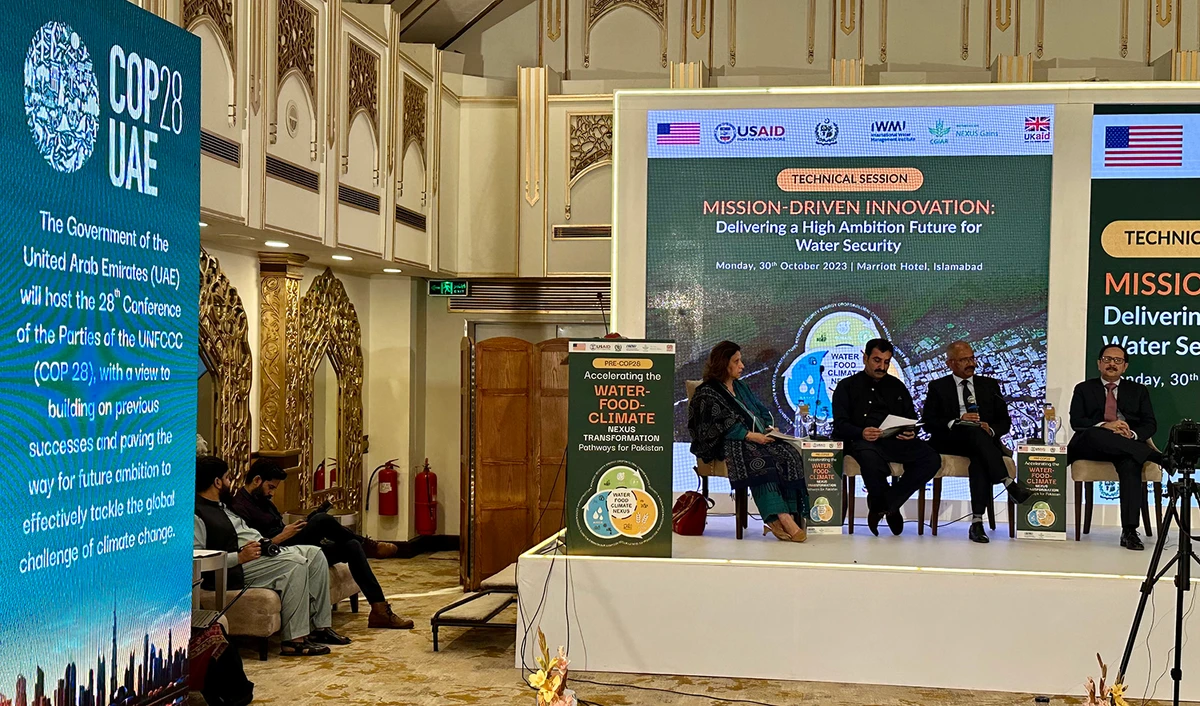
The International Water Management Institute (IWMI), a global research-for-development organization with offices in Pakistan and 14 other countries, on Monday organized a day-long ‘PRE-COP28 conference’ in Islamabad, where the speakers shared their views about the conservation of water, food and ecosystems in Pakistan, and ways to make the South Asian country climate-resilient.
“During the COP28, Pakistan should keep this at number one on its agenda to get a higher share of the loss of damage fund as the country has a good case of 2022 floods in hand, where it lost over $33 billion,” Ahmed Kamal, chairman of Pakistan’s Federal Flood Commission, told Arab News.
Pakistan last year witnessed one of the worst monsoon rains and floods that submerged a third of the South Asian country at one point. The deluges killed more than 1,700 Pakistanis, affected 33 million and caused more than $30 billion losses.
In the aftermath of the harsh monsoon last year, Kamal said, Pakistan had made significant progress and implemented both well-conceived projects and plans that were grounded in integrated flood risk management and disaster risk management, rather than having a reactive approach.
“We should use the platform of COP28 in Dubai to attract funds for the long-term sustainability of these projects,” he said.
Pakistan’s caretaker minister for food security, Dr. Kausar Abdullah Malik, said the time had come for the world to utilize all resources to deal with climate change.
“At COP28, the world should ensure all resources and effective measures must be used to deal with the looming climate crisis,” he said.
Dr. Mark Smith, the IWMI director-general, said the voice of Pakistan was very prominent during COP27 in Egypt and the same enthusiasm was needed this year in Dubai as well.
“We hope that this conference will contribute to setting a pathway forward for Pakistan on critical issues such as intensifying climate change, water scarcity and food insecurity,” Smith told Arab News.
He said the IWMI would be supporting the Pakistani climate change ministry in the COP28 position paper, advising Pakistan’s climate negotiation team on water issues and sharing outputs for broader impact during the conference in Dubai.
“At COP28, Pakistan has to make sure that the institutions are aligned and have in place the right frameworks and policies to prioritize the right actions and to see those implemented so that investment can flow into them and make a difference quickly and fast and in the right places,” Smith added.
Speaking on the occasion, British High Commissioner to Pakistan Jane Marriott said the latest report of the UN’s Intergovernmental Panel on Climate Change (IPCC) highlighted an urgent need for climate resilience solutions, including in Pakistan, which was known to be among the topmost climate-vulnerable countries and the 32nd least prepared when none of this was its fault.
Extreme climate events such as the 2022 floods have deteriorated food and water security in Pakistan and affected the lives and livelihoods of 33 million people, according to the British envoy.
“Such extreme events highlight the need for collective, intersectoral responses and smart technology-driven governance,” she said.
“As a way forward during COP28, new approaches need to be designed and delivered and Pakistan needs fresh and integrated approaches to address the urgent issue of nutrition, water governance, gender equality, and poverty reduction to protect vulnerable segments of society and to help Pakistan on a road to low-carbon economic recovery.”
Henny De Vries, the ambassador of The Netherlands to Pakistan, praised the South Asian country for “translating its climate commitment into national policies.”
“The [Pakistani] Ministry of Climate Change established an institutional framework to implement initiatives and we can identify how the international community in Pakistan can work toward a climate-resilient Pakistan,” the Dutch ambassador said.