Macron makes legacy bid with French language museum

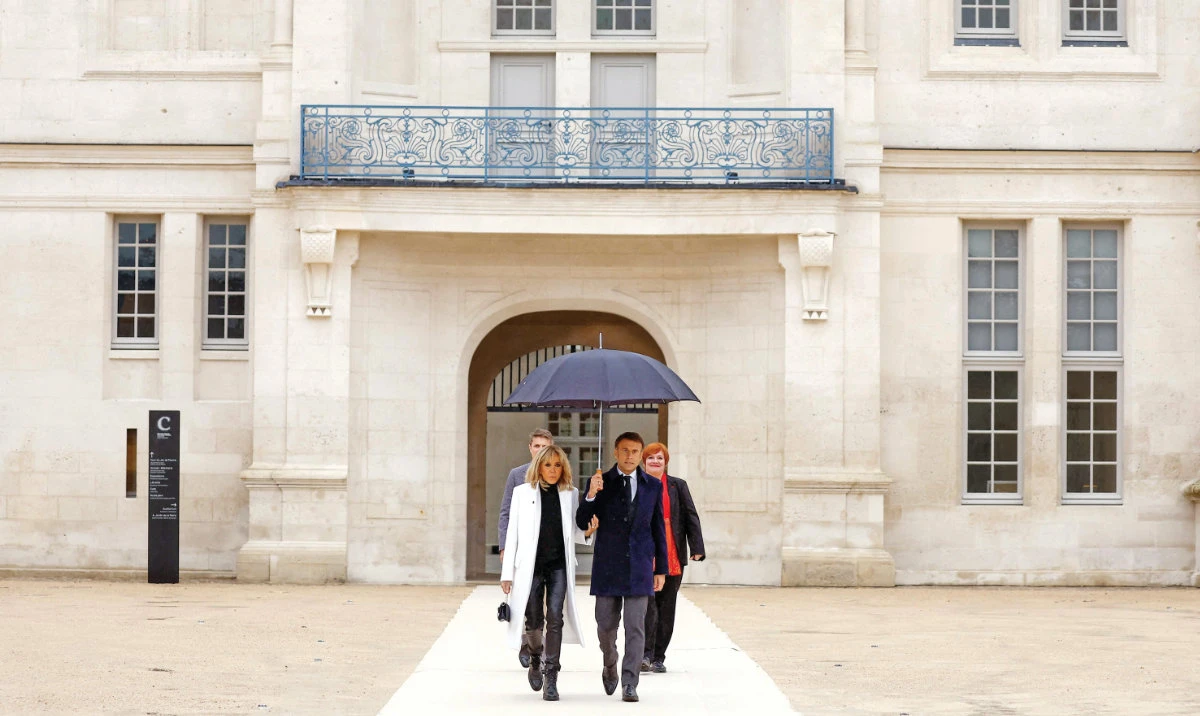
French President Emmanuel Macron and his wife Brigitte Macron walk during the inauguration of a cultural project at the castle of Villers-Cotterets, on Monday. (AFP)
Short Url
Updated 30 October 2023
Follow

Macron makes legacy bid with French language museum

  • The chateau will host the 19th summit of the francophone world next year, to which some 88 leaders are invited

VILLERS-COTTERÊTS: French President Emmanuel Macron looked to cement his legacy, and take on political opponents, with the inauguration on Monday of a monument to the French language deep in far-right heartland.

Modern French presidents love a cultural “grand projet” — an imposing monument to “scratch” their name on history, as ex-leader Francois Mitterrand put it in the 1980s. Mitterrand was an avid and controversial legacy-builder, transforming the Louvre museum with a glass pyramid, and erecting the vast Opera Bastille and National Library. Other examples include the modern art museum built by Georges Pompidou in central Paris, and Quai Branly global culture museum of Jacques Chirac on the banks of the River Seine.

The practice fell out of fashion this century, but has been revived by Macron, who was already eyeing up a crumbling chateau in the small town of Villers-Cotterets while still a presidential candidate in 2017.

He has overseen the renovation of the Renaissance castle, completed in 1539 under King Francois I, and its transformation into the Cite Internationale de la Langue Francaise, an international center for the French language.

It hopes to attract 200,000 visitors a year to its large library (replete with AI-supported suggestion engine), interactive exhibits, games and cultural events.

“All those who, around the world, work, create, think, write, play and sing in French should feel at home at Villers-Cotterets,” said the Elysee Palace in a statement.

Culture Minister Rima Abdul Malak told AFP it will be “the beating heart of the Francophone world.”

Perhaps fittingly, the website seems determinedly uninterested in the quality of its English translations, describing the castle as a “high place of the French history and architecture.”

As the home town of Alexandre Dumas, Villers-Cotterets is a fitting choice. The author of “The Three Musketeers” and “The Count of Monte Cristo” even took swordsmanship classes in the chateau.

But there is politics at play, too.

The small town of 10,000, around 80 kilometers from Paris, lies deep in France’s northeast, where factory closures and high unemployment have made the region a stronghold of the far right. The new institution aims “to show that the region’s recovery does not rely on withdrawing into itself, but by greater openness,” an adviser to Macron said, asking not to be named. It underlines that France is not the most populous francophone country — that prize goes to the Democratic Republic of Congo with its 100 million citizens. The chateau will host the 19th summit of the francophone world next year, to which some 88 leaders are invited.

The French language is “the greatest asset of the nation ... and the foundation of who we are intellectually and our relations with the world,” the Elysee said.


C. Africa’s displaced youth bet on vote for brighter future

Updated 2 sec ago
Follow

C. Africa’s displaced youth bet on vote for brighter future

BIRAO: Amani Abdramane bustled around her donkey in the makeshift camp where she lives in the Central African Republic.
In this northern part of the country, on the edge of the Sahel, the sun is scorching and sand is swallowing the last traces of vegetation.
The 18-year-old adjusted a pink scarf covering her head and shoulders and pondered what she wanted from Sunday’s general election that will choose local and regional officials, members of parliament and a new president.
“I hope the person I vote for brings peace,” she said of the seven candidates vying to become head of state.
They include President Faustin-Archange Touadera, who is seeking a third consecutive term.
Displaced by decades of conflict, young people like Abdramane who live in camps around the town of Birao in the far northeast, see the elections as a chance for a better future.
Abdramane fled ethnic violence in El-Sisi, her home village seven kilometers (four miles) from Birao, in 2015 with her mother and eight siblings.
Her father had been killed a few months earlier.
“I just want my brothers, sisters and me to be able to go to school,” she said.

- First-time voters -

Abdramane had just completed her second year of school, aged eight, when her family had to flee.
She has not returned to lessons since.
Now the teenager and other young people are counting on the elections to bring them peace, education and opportunities beyond life as displaced persons.
The last polls were in 2020 but lack of security meant even those old enough to vote at the time were unable to do so.
There is a crowd outside the community radio station in the Korsi neighborhood of Birao, which serves as a distribution center for voter registration cards.
Marina Hajjram, also 18, will be voting for the first time.
“I’m so happy,” she told AFP, clutching her voter card.
Behind her in the queue, 25-year-old Issa Abdoul agreed the elections were essential “to continue the reconstruction of our country.”
Korsi is home to thousands of internally displaced persons, as well as many refugees from neighboring Sudan.
Across CAR, there were 416,000 internally displaced persons as of November, the vast majority of whom are under 25 and will be voting for the first time this weekend.

- A brighter future -

For them, the mere act of obtaining a voter registration card is a challenge.
First they must produce an identity document. But many lost everything when they fled, including ID papers for those who had them.
Three quarters of people in the CAR are under 35, according to a 2018 report by the United Nations Population Fund.
And peace is one of the things these young people most want.
Although the situation has improved in much of the country, particularly in cities, violence persists in the northeast on the border between the two Sudans.
This is mainly due to incursions by Sudanese armed forces, who are waging war in a region already plagued by abuses blamed on rebel groups.
Issene Abdoulkasim, 23, only made it to the third year of primary school.
Now he wants to become a tailor so he can afford to study again.
“I dream of studying so I can become a member of parliament. Because as an MP I’ll be able to bring peace and development,” he said.
“I want to put an end to conflicts, tensions and everything that is destroying our country.”