

Hamas says ‘heavy fighting’ in Gaza as Israel steps up ground war

1 / 2
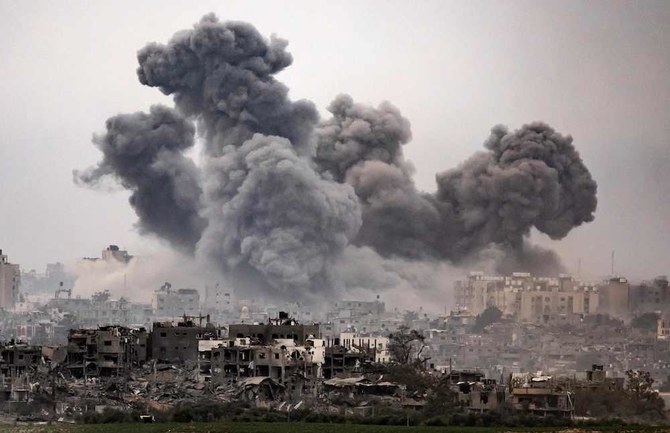
Black smoke ascends from the Gaza Strip amid heavy bombardment of the Israeli army on the Palestinian enclave. (AFP)
2 / 2
Israeli troops gather near the border with Gaza before entering the Palestinian strip on October 29, 2023, amid ongoing battles between Israel and the Palestinian Hamas movement. (AFP)
Short Url
Updated 30 October 2023
Follow

Hamas says ‘heavy fighting’ in Gaza as Israel steps up ground war

  • There is deep and growing international concern about the toll of Israel’s campaign on Gaza’s two-plus million residents

GAZA STRIP, Palestinian Territories: Hamas said it was engaged in “heavy fighting” with Israeli troops inside northern Gaza Sunday, as besieged residents were again warned to flee southward.

After weeks of ferocious airstrikes, Israel has declared a new “stage” in a war that Prime Minister Benjamin Netanyahu warned would be “long and difficult.”

The Israeli army said Monday that its forces killed “dozens” of militants in clashes through the night in Gaza as it presses its military response to the October 7 Hamas attacks.

The army said “troops killed dozens of terrorists who barricaded themselves in buildings and tunnels and attempted to attack the troops,” and that a fighter jet had targeted a building “with over 20 Hamas terrorist operatives inside.”

Late Sunday Israel’s military released footage that purported to show a significant number of tanks, infantry and artillery operating in Palestinian territory.

The military claimed to have struck more than “450 terror targets, including operational command centers, observation posts, and anti-tank missile launch posts.”

Hamas said its Ezzedine Al-Qassam Brigades were already “engaged in heavy fighting... with the invading occupation forces.”

With a fierce door-to-door urban war expected, Israeli army spokesman Daniel Hagari told Palestinian civilians to go south “to a safer area.”

It is now 23 days since Hamas gunmen launched a wave of bloody cross-border raids against homes, communities, farms and security posts inside Israel.

An estimated 1,400 people, mostly civilians, were killed and 239 people were taken hostage, according to the latest Israeli tallies.

Israel has vowed to free the hostages, track down those responsible and “eradicate” Hamas, a Palestinian Islamist movement that has governed Gaza since 2007.

But there is deep and growing international concern about the toll of Israel’s campaign on Gaza’s two-plus million residents.

The territory is under siege, with people unable to leave and only a limited amount of humanitarian aid allowed in.

Meanwhile, Israel has carried out one of the most intense bombing campaigns in recent memory.

The Hamas-run health ministry in Gaza says more than 8,000 people, mainly civilians and half of them children have already been killed.

Inside Gaza’s maze of streets, rubble and hulled-out buildings, there is a growing sense of panic, fear and desperation.

Ibrahim Shandoughli, a 53-year-old from Jabaliya in northern Gaza, asked why he would head south when that area is also being bombed.

“Where do you want us to evacuate to? All the areas are dangerous,” he said.

Etidal Al-Masri was among those who fled after Israel told residents in the north to leave.

But she still struggles to find even the basics amid shortages of food, water and medicine.

Gazans “must now queue for bread, toilets and even for sleep,” she said.

On Sunday, the desperation appeared to boil over.

The United Nations reported that “thousands of people” had ransacked several of its warehouses looking for tinned food, flour, oil and hygiene supplies.

Only a trickle of aid has been allowed to cross the border from Egypt.

The UN said 33 trucks carrying water, food, and medical supplies had entered Gaza on October 29.

It is one of the largest deliveries to date, but still far short of the 100-a-day aid groups say is needed.

International Criminal Court lead prosecutor Karim Khan told Israel on Sunday that preventing access to humanitarian aid could be a “crime.”

“Impeding relief supplies as provided by the Geneva conventions may constitute a crime within the court jurisdiction,” Khan told reporters in Cairo.

He said he wanted “to underline clearly to Israel that there must be discernible efforts without further delay to make sure civilians” in the Hamas-run Palestinian territory “receive basic food, medicines.”

In a phone call with Netanyahu on Sunday, US President Joe Biden also underscored the need to “immediately and significantly” increase the flow of aid.

And while the White House has welcomed the gradual return of cell phone and Internet services that had been cut for days, it had a sharp warning for Israel’s leaders.

The “burden” lies with Israel to distinguish between militants and innocent civilians in Gaza, US National Security Adviser Jake Sullivan told CNN.

This as the United Nations said all hospitals in the north of Gaza had received evacuation orders, despite sheltering thousands of patients and more than 117,000 people who had become internally displaced because of the bombardment.

The Palestinian Red Crescent Society reported repeated strikes around Al-Quds hospital in central Gaza.

Mohamed Al-Talmas, who has taken shelter in Gaza’s biggest hospital Al-Shifa, said “the ground shook” with intense Israeli raids.

Washington has also expressed deep concern about the war spilling over, as Israel’s enemies — and in particular an Iran-allied “axis of resistance” — step up actions across the Middle East.

Iran’s President Ebrahim Raisi has warned Israel’s “crimes have crossed the red lines, which may force everyone to take action.”

Since Hamas’s attack on October 7, Iran-backed groups have launched attacks from Lebanon, Yemen, Iraq and Syria.

Skirmishes have intensified on the Israeli-Lebanese border with Iran-backed Hamas ally Hezbollah.

On Sunday militants in south Lebanon fired rockets toward Israel, which has responded with strikes.

The Israel Defense Forces also said they had “struck military infrastructure in Syrian territory” in response to launches “toward Israeli territory.”

Inside Israel, where shocked residents still face daily rocket attacks, much of the focus is on the hostages abducted by Hamas.

Hamas has released four prisoners and offered to release more as part of a swap for Palestinians detained in Israel.

It has also claimed “almost 50” hostages were killed by Israeli strikes — a claim that was impossible to verify but has caused anguish to those praying for their loved ones to return.

“We demanded that no action be taken that endangers the fate of our family members,” said Meirav Leshem Gonen, the mother of hostage Romi Gonen.

Israel’s Defense Minister Yoav Gallant accused Hamas of playing “psychological games.”

“Hamas is cynically using those who are dear to us — they understand the pain and the pressure,” he said.


Trump warns of ‘bad things’ if Iran doesn’t make a deal, as second US carrier nears Mideast

Updated 40 min 9 sec ago
Follow

Trump warns of ‘bad things’ if Iran doesn’t make a deal, as second US carrier nears Mideast

  • Footage released by Iran showed members of the paramilitary Revolutionary Guard’s naval special forces board a vessel in the exercise

DUBAI: Iran held annual military drills with Russia on Thursday as a second American aircraft carrier drew closer to the Middle East, with both the United States and Iran signaling they are prepared for war if talks on Tehran’s nuclear program fizzle out.
President Donald Trump said Thursday he believes 10 to 15 days is “enough time” for Iran to reach a deal. But the talks have been deadlocked for years, and Iran has refused to discuss wider US and Israeli demands that it scale back its missile program and sever ties to armed groups. Indirect talks held in recent weeks made little visible progress, and one or both sides could be buying time for final war preparations.
Iran’s theocracy is more vulnerable than ever following 12 days of Israeli and US strikes on its nuclear sites and military last year, as well as mass protests in January that were violently suppressed.
In a letter to the UN Security Council on Thursday, Amir Saeid Iravani, the Iranian ambassador to the UN, said that while Iran does not seek “tension or war and will not initiate a war,” any US aggression will be responded to “decisively and proportionately.”
“In such circumstances, all bases, facilities, and assets of the hostile force in the region would constitute legitimate targets in the context of Iran’s defensive response,” Iravani said.
Earlier this week, Iran conducted a drill that involved live-fire in the Strait of Hormuz, the narrow opening of the Arabian Gulf through which a fifth of the world’s traded oil passes.
Tensions are also rising inside Iran, as mourners hold ceremonies honoring slain protesters 40 days after their killing by security forces. Some gatherings have seen anti-government chants despite threats from authorities.
Trump again threatens Iran

The movements of additional American warships and airplanes, with the USS Gerald R. Ford aircraft carrier near the mouth of the Mediterranean Sea, don’t guarantee a US strike on Iran — but they bolster Trump’s ability to carry out one should he choose to do so.

He has so far held off on striking Iran after setting red lines over the killing of peaceful protesters and mass executions, while reengaging in nuclear talks that were disrupted by the war in June.

Iran has agreed to draw up a written proposal to address US concerns raised during this week’s indirect nuclear talks in Geneva, according to a senior US official who was not authorized to comment publicly and spoke on the condition of anonymity.

The official said top national security officials gathered Wednesday to discuss Iran, and were briefed that the “full forces” needed to carry out potential military action are expected to be in place by mid-March.

The official did not provide a timeline for when Iran is expected to deliver its written response.

“It’s proven to be, over the years, not easy to make a meaningful deal with Iran, and we have to make a meaningful deal. Otherwise, bad things happen,” Trump said Thursday.

With the US military presence in the region mounting, one senior regional government official said he has stressed to Iranian officials in private conversations that Trump has proven that his rhetoric should be taken at face value and that he’s serious about his threat to carry out a strike if Iran doesn’t offer adequate concessions.

The official, who spoke on the condition of anonymity to discuss delicate diplomatic conversations, said he has advised the Iranians to look to how Trump has dealt with other international issues and draw lessons on how it should move forward.

The official added that he’s made to case to the Trump administration it could draw concessions from Iran in the near-term if it focuses on nuclear issues and leaves the push on Tehran to scale back its ballistic missile program and support for proxy group for later.

The official also said that Trump ordering a limited strike aimed at pressuring Iran could backfire and lead to Supreme Leader Ali Khamenei withdrawing Iran from the talks.

Growing international concern
Polish Prime Minister Donald Tusk urged his nation’s citizens to immediately leave Iran as “within a few, a dozen, or even a few dozen hours, the possibility of evacuation will be out of the question.”

He did not elaborate, and the Polish Embassy in Tehran did not appear to be drawing down its staff.

The German military said that it had moved “a mid-two digit number of non-mission critical personnel” out of a base in northern Iraq because of the current situation in the region and in line with its partners’ actions. It said that some troops remain to help keep the multinational camp running in Irbil, where they train Iraqi forces.

“This week, another 50 US combat aircraft — F-35s, F-22s, and F-16s — were ordered to the region, supplementing the hundreds deployed to bases in the Arab Gulf states,” the New York-based Soufan Center think tank wrote. “The deployments reinforce Trump’s threat — restated on a nearly daily basis — to proceed with a major air and missile campaign on the regime if talks fail.”

Iran holds drill with Russia

Iranian forces and Russian sailors conducted the annual drills in the Gulf of Oman and the Indian Ocean aimed at “upgrading operational coordination as well as exchange of military experiences,” Iran’s state-run IRNA news agency reported.

Footage released by Iran showed members of the paramilitary Revolutionary Guard’s naval special forces board a vessel in the exercise.

Those forces are believed to have been used in the past to seize vessels in key international waterways.

Iran also issued a rocket-fire warning to pilots in the region, suggesting it planned to launch anti-ship missiles in the exercise.

Meanwhile, tracking data showed the Ford off the coast of Morocco in the Atlantic Ocean midday Wednesday, meaning the carrier could transit through Gibraltar and potentially station in the eastern Mediterranean with its supporting guided-missile destroyers.

It would likely take more than a week for the Ford to be off the coast of Iran.

Netanyahu warns Iran

Israel is making its own preparations for possible Iranian missile strikes in response to any US action.

“We are prepared for any scenario,” Israeli Prime Minister Benjamin Netanyahu said Thursday, adding that if Iran attacks Israel, “they will experience a response they cannot even imagine.”

Netanyahu, who met with Trump last week, has long pushed for tougher US action against Iran and says any deal should not only end its nuclear program but curb its missile arsenal and force it to cut ties with militant groups like Hamas and Hezbollah.

Iran has said the current talks should only focus on its nuclear program, and that it hasn’t been enriching uranium since the US and Israeli strikes last summer. Trump said at the time that the strikes had “obliterated” Iran’s nuclear sites, but the exact damage is unknown as Tehran has barred international inspectors.

Iran has always insisted its nuclear program is peaceful. The US and others suspect it is aimed at eventually developing weapons. Israel is widely believed to have nuclear weapons but has neither confirmed nor denied that.