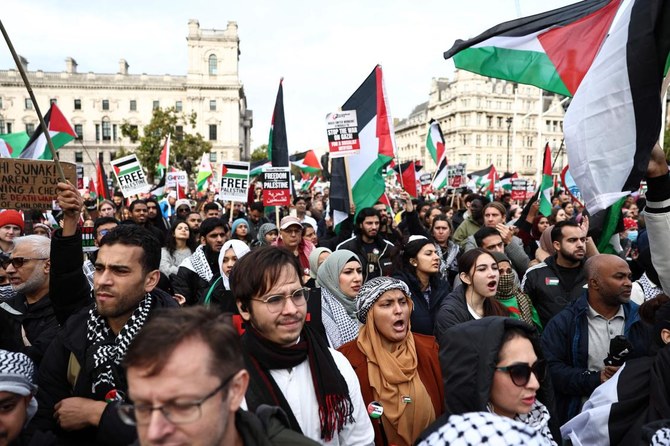
LONDON: Police in London said that five people had been charged on Sunday after their arrest during pro-Palestinian protests a day earlier, which saw tens of thousands march for a humanitarian cease-fire in Gaza.
The Metropolitan Police arrested nine people — two on suspicion of assaulting police officers and seven for public order offenses.
A further two people were arrested on Sunday morning, suspected of inciting racial hatred following an incident in Trafalgar Square on Saturday evening, the Met said in a statement.
Among the five charged, aged between 16 and 51, two were accused of racially aggravated offenses, including the display of a placard that was “threatening and racist in nature.”
The others were accused of throwing a beer can at a protester and verbal and physical assaults on police officers.
About 100,000 people joined the “March for Palestine” in London on Saturday according to British media, which also reported scuffles with police.
It was the third consecutive weekend that London hosted a large rally in support of Palestinians.
Organizers claimed that 500,000 people took part this Saturday, compared with 300,000 a week ago.
London’s Metropolitan Police deployed more than 1,000 officers to patrol the march.
On Sunday afternoon, around 200 people holding portraits of hostages taken by Hamas gathered outside the Qatari embassy in London to call for their release, according to an AFP photographer.
Hamas militants stormed across the Gaza border on October 7 in the deadliest attack in Israel’s history, killing 1,400 people, mostly civilians, and kidnapping 230 others, according to Israeli officials.
The health ministry in Gaza says the retaliatory Israeli bombardment has killed more than 8,000 people, mainly civilians and half of them children.
The conflict has led to a sharp rise in racist incidents in the UK.
Anti-Semitic acts in London have multiplied about 14-fold, and Islamophobic acts by almost three, Scotland Yard chief Mark Rowley told Sky News on Sunday.


![]()

Five charged after pro-Palestinian protests in London
Short Url
https://arab.news/yrr52
Five charged after pro-Palestinian protests in London
- The Metropolitan Police arrested nine people — two on suspicion of assaulting police officers and seven for public order offenses
- A further two people were arrested on Sunday morning, suspected of inciting racial hatred following an incident in Trafalgar Square on Saturday evening


Latest updates




© 2026 SAUDI RESEARCH & PUBLISHING COMPANY, All Rights Reserved And subject to Terms of Use Agreement.