

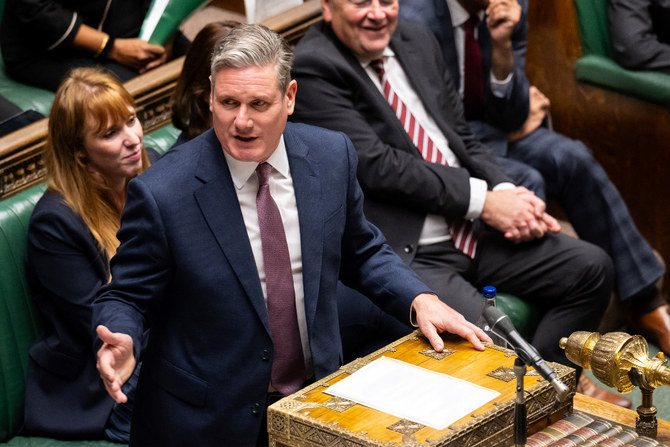

LONDON: Keir Starmer, leader of the UK’s opposition Labour Party, is contending with a grassroots rebellion over the Israel-Gaza war.
It comes after three senior Labour figures have ignored the party line and called for a ceasefire between the two warring sides, The Independent reported.
The breaking of ranks by mayor of London Sadiq Khan, Manchester mayor Andy Burnham, and leader of the Scottish Labour Party Anas Sarwar, took place as more than 250 Muslim councilors signed a joint letter to Starmer and his deputy, Angela Rayner, pushing for a ceasefire.
Labour’s position, set by Starmer, has seen the party reject calls for a ceasefire, instead backing the opening of humanitarian aid channels into the besieged Gaza Strip.
Dozens of Labour Party members have reportedly resigned, with members “heartbroken” and “angry” over the opposition’s stance.
Azhar Ali, Labour leader for Lancashire County Council, said: “I’m leader of the county council, 1.2 million people. My emails and my text messages and my contacts are with not only Labour people, but ordinary people around the county — people are heartbroken.
“They cannot see the logic of what’s been done in their name and what they want is a long-term solution. They want Keir to play that proactive role in ensuring that we get a ceasefire and putting (Prime Minister) Rishi Sunak and his government under pressure.”
At least 20 councilors across the UK have resigned in protest against the party’s position on a ceasefire.
In Glasgow, Scotland, 15 party officers quit after accusing Scottish Labour of “stifling democracy.” It followed a ruling by the party that a motion calling for end to military action on Gaza was out of order.
A memo released by the party’s general secretary, David Evans, advises local groups to avoid falling foul of the party by avoiding motions that are “grossly detrimental.”
It said: “I recognize that these tragic events in the Middle East will trigger great emotion and debate. However, I will not let that become a flashpoint for the expression of views that undermine the Labour party’s ability to provide a safe and welcoming space for all its members.
“This includes attempts to table motions at meetings that are prejudicial or grossly detrimental to the Labour party and risk infringing the party’s codes of conduct on antisemitism and Islamophobia.
“Accordingly, and consistent with previous precedent, any such motions will be ruled out of order.”
The memo has led to fears that the party, through its central command, will prevent local branches from calling for a ceasefire.
Nine councilors from Oxford City Council have resigned in the wake of the controversy, ending Labour’s overall control of the city. In Nottinghamshire, two councilors also resigned from Labour last week.
A Labour spokesperson said: “Of course, we understand why people want to call for a ceasefire. The Palestinian people are not Hamas, and they are suffering terribly.
“That’s why we support humanitarian pauses so that aid, fuel, water electricity and medicines can urgently get to those who need it. We also have to recognize Israel was subject to a vile terrorist attack. Israel has a right and a duty to defend itself, rescue the hostages and stop Hamas from being able to carry out that sort of terrorist attack ever again.
“Hamas are currently firing rockets into Israel and have built the infrastructure, including tunnels, from which to carry out further attacks, so that military operation is ongoing. That must be done within international law and aid must get in quickly, safely, and regularly to halt a humanitarian disaster.”


