

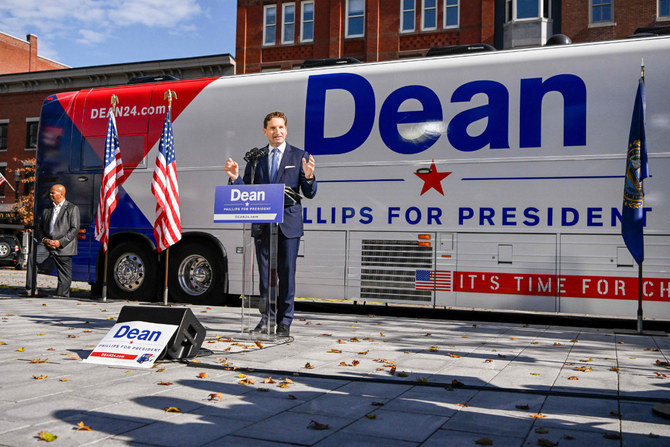

CONCORD, New Hampshite.: For months, Dean Phillips called for a Democratic primary challenge to President Joe Biden, drawing no public interest from governors, lawmakers, and other would-be alternatives.
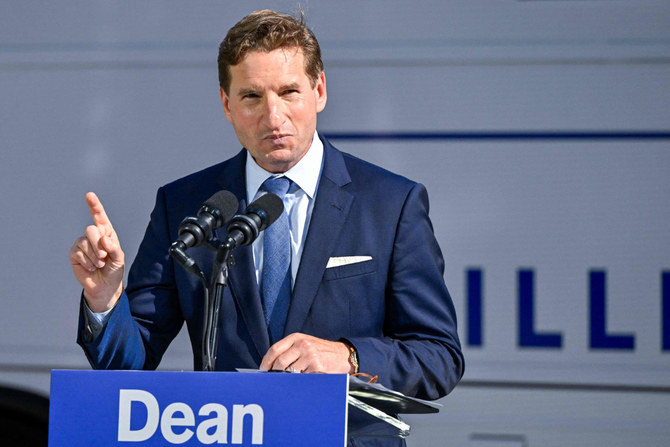
The 54-year-old Minnesota congressman finally entered the race himself on Friday in an event outside New Hampshire’s statehouse, saying, “It is time for the torch to be passed to a new generation of American leaders.”
Phillips is highly unlikely to beat Biden. Still, his run offers a symbolic challenge to national Democrats trying to project the idea that there is no reason to doubt the president’s electability — even as many Americans question whether the 80-year-old Biden should serve another term.
He said in his speech that he would try to fix the economy and warned about high prices and “the chaos at our border” — all issues that are potential vulnerabilities for Biden as he heads into a likely rematch against former President Donald Trump. And Phillips is trying to engage New Hampshire Democrats angry at Biden for diluting their state’s influence on the 2024 Democratic primary calendar, noting that the state had historically been “first to vet presidential candidates like me.”
Biden has long cast himself as uniquely qualified to beat Trump again after his 2020 win, and top Democrats have lined up behind him while also positioning themselves for a future primary run.
His re-election campaign issued a statement Friday saying it was “hard at work mobilizing the winning coalition that President Biden can uniquely bring together” to beat Trump.
Though Biden won’t officially run in New Hampshire’s primary and will rely on a write-in campaign, the president is planning to head next week to Phillips’ home state for an official event and fundraiser.
Phillips has already missed the deadline to enter Nevada’s primary and is little known nationally. His campaign’s account on X, formerly known as Twitter, was briefly suspended Friday before his launch. And shortly before Phillips spoke, the leader of his home state signed a fundraising pitch sent by the Biden campaign.
“You know, I have to say this about Minnesota: it’s a great state, full of great people. And sometimes they do crazy things,” wrote Minnesota Gov. Tim Walz, who added: “And sometimes … they make political side shows for themselves.”
Atlanta Mayor Andre Dickens, who sits on Biden’s reelection campaign’s national advisory board, dubbed Phillips’ bid an “attention-seeking stunt that is deeply insulting to Black voters and the coalition that saved our country from Donald Trump.”
“The stakes are too high in this election – especially for Black voters,” Dickens said, to focus on a “vanity project rather than what’s best for our party and our country.”
But New Hampshire primary challenges have a history of wounding incumbent presidents.
In 1968, another Minnesotan, Democratic Sen. Eugene McCarthy, built his campaign around opposing the Vietnam War and finished second in New Hampshire’s primary, helping push President Lyndon Johnson into forgoing a second term. Massachusetts Sen. Ted Kennedy’s challenge of President Jimmy Carter and Pat Buchanan’s run against President George H.W. Bush both failed, but Carter and Bush ultimately lost their reelection bids.
The state’s influence on Democrats also was curtailed this year by changes engineered by the Democratic National Committee at Biden’s behest and was meant to better empower Black and minority voters.
A new Democratic calendar has South Carolina leading off presidential primary voting on Feb. 3 and Nevada going three days later. New Hampshire has refused to comply, citing state laws saying its primary must go first, and plans a primary before South Carolina’s. The DNC could, in turn, strip the state of its nominating delegates.
Steve Shurtleff, a former speaker of the New Hampshire House, believes Phillips might appeal to some Democrats and independents who can choose to vote in the primary.
“I’m disappointed that he and the DNC have tried to take away our primary,” Shurtleff said. “It’s not that I want to see Joe lose. It’s that I want to see our primary win.”
But Terry Shumaker, a former DNC member from New Hampshire and longtime Biden supporter, said he expects the president to easily clinch the state as a write-in option. Shumaker recalled going door to door for McCarthy in 1968, but doesn’t see Phillips gaining similar traction.
“I’m not aware of what his message is,” he said. “To do well in the New Hampshire primary, you have to have a message.”
There are no Democratic primary debates scheduled. The only other Democrat running in the 2024 primary is self-help author Marianne Williamson.
Phillips is heir to his stepfather’s Phillips Distilling Company empire. He once served as that company’s president but also ran the gelato maker Talenti. His grandmother was the late Pauline Phillips, better known as the advice columnist “Dear Abby.”
Driving a gelato truck was a centerpiece of his first House campaign in 2018, when Phillips unseated five-term Republican Erik Paulsen. While his district in mostly affluent greater Minneapolis has become more Democratic-leaning, Phillips has stressed that he is a moderate focused on his suburban constituents.
An AP-NORC poll released in August found that the top words associated with Biden were “old” and “confused.” Nearly 70 percent of Democrats and 77 percent of US adults said they thought Biden was too old to be effective for four more years. The same poll found that respondents most frequently described Trump as “corrupt” and “dishonest.”
Leslie Blanding, a retired teacher and Democrat from Bow, New Hampshire, said she did not know Phillips but was “thoroughly conflicted” over whether Biden should face a primary challenger.
“I think Biden is too old. I think from the outset, he should’ve been looking to groom someone to succeed him, and he didn’t do that,” said Blanding, 75. “But I think he seems to be the only one positioned to have a strong chance of defeating Trump or whomever.”


