



QUETTA: Residents of Pakistan’s southwestern Chaman city located on the Afghanistan border continued their sit-in protest for the sixth consecutive day on Thursday, demanding the government reverse a new passport and visa policy which is due to be implemented from Nov. 1 at the border crossing.
The protest, which kicked off on Saturday at the Chaman border, took place in the wake of the Pakistani government’s move to tighten its travel policy for citizens of all neighboring countries, following deadly attacks in the country’s northwestern Khyber Pakhtunkhwa (KP) and southwestern Balochistan provinces earlier this year.
Pakistan shares a 2,600-kilometer porous border with Afghanistan which lies through KP and Balochistan. The Chaman border crossing is one of the key border crossings between the two countries.
Since Pakistan’s independence from British India, Islamabad has been practicing a relaxed travel policy for residents living in border towns on either side. But the Pakistani government has lately announced a strict policy that allows only the residents of Chaman and Kandahar province in Afghanistan to cross the border by showing their proof of residence.
The rest of the citizens from both countries are required to show passports and visas to travel across the border. After Nov. 1, travel across the border crossing would only be allowed on valid passports and visas, even for residents of Chaman and Kandahar.
“Thousands regularly travel to business markets in Afghanistan’s Spin Boldak town situated in Kandahar for business purposes and return to Chaman in the evening with a meager amount for their families,” Shahzada Qasim, a local businessman, told Arab News at the protest.
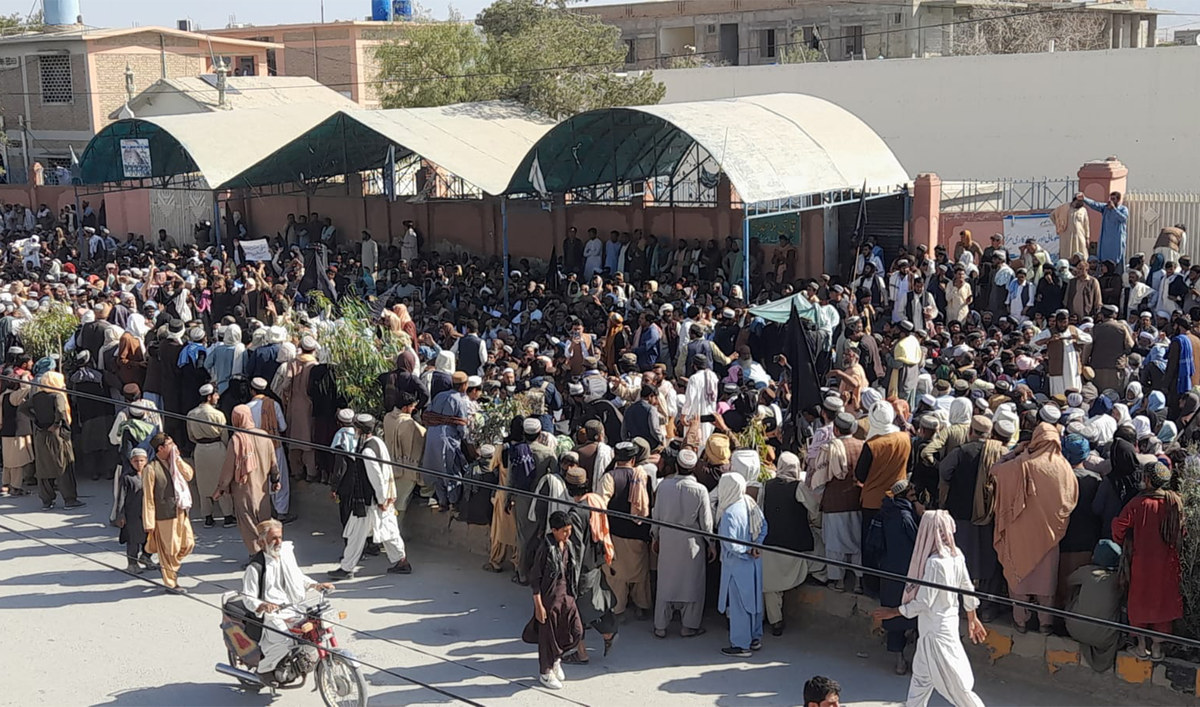
Pakistani residents are holding a demonstration against the new immigration policy, near Afghanistan-Pakistan border at Chaman district in Balochistan on October 26, 2023. (Photo courtesy : Zafar Achakzai)
Qasim, 39, has been taking part in the sit-in protest from day one at the protest camp set up on one of the key highways leading to the Pakistan-Afghanistan border. The protest attracted huge numbers on Thursday with the participation of local businesspersons, tribal elders and members of political parties.
Qasim feared the government’s new passport and visa policy decision would force thousands in Chaman to migrate to other cities.
Balochistan Information Minister Jan Achakzai traveled to Chaman on Wednesday to hold a dialogue with protesters. However, talks between the two sides ended inconclusively as protesters remained adamant on demanding the new policy be reversed.
“We have completed three rounds of negotiations with protesters but the talks were not fruitful,” Achakzai told Arab News.
“The government is ready to accept their feasible demands but the one-document regime policy will not be compromised at any cost after the given deadline.”
He said a large Jirga [tribal council] meeting was held today, Thursday, which was also attended by the country’s senior civil and military leadership.
“The government is ready to facilitate Chaman’s local residents with economic opportunities and facilities at the National Database and Registration Authority (NADRA) and passport centers,” Achakzai said.
Meanwhile, Chaman’s businessmen closed their shops in protest against the proposed visa policy and marched toward the deputy commissioner’s office.
“A strict bio-metric system is already in place between Kandahar and Quetta, everyone who crosses through the border gets scanned in the government’s data management system,” Hajji Sadiq Achakzai, president of the Chaman Traders Union, told Arab News over the phone.
“The Pakistani government should have taken into confidence the local residents of Chaman before announcing this decision.”
He warned that if the government did not reverse its decision, protesters would march on to the Friendship Gate located at the Chaman border and erect a “new” protest camp there.
Caretaker Interior Minister Sarfraz Bugti has clarified that the government would not target Afghans after the Nov. 1 deadline, but all undocumented immigrants in the country would be forcibly repatriated.


