Pakistan to host SCO conference on transport, connectivity this year — FM Jilani

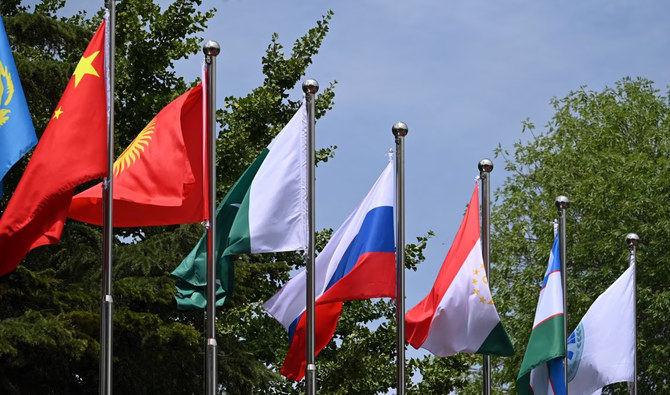
Flags flutter at the headquarters of the Shanghai Cooperation Organization in Beijing on July 4, 2023. (AFP/File)
Short Url
Updated 26 October 2023
Follow

Pakistan to host SCO conference on transport, connectivity this year — FM Jilani

  • Jalil Abbas Jilani is leading his country’s delegation to SCO’s Council of Heads of Government meeting in Bishkek
  • Pakistan has taken over the council’s chair for the next year and says it will give top priority to regional cooperation

ISLAMABAD: Caretaker Foreign Minister Jalil Abbas Jilani announced on Thursday that Pakistan, having assumed leadership of the Shanghai Cooperation Organization’s Council of Heads of Government for the coming year, aims to host a conference on transportation and connectivity later this year to enhance regional prosperity.
Jilani made these remarks while participating in the 22nd meeting of the council in Bishkek, Kyrgyzstan, where he is leading his country’s delegation.
The council is the second-highest body within the SCO and focuses on issues related to economy, finance, trade and socio-economic collaboration.
“Pakistan plans to host a conference on transport and connectivity for regional prosperity this year,” the interim foreign minister said, adding his country would give top priority to regional cooperation in critical and practical areas.
“These include enhancing connectivity and transport linkages, youth empowerment, investment in key sectors such as mining, agriculture, minerals, energy, climate change and information technology,” he added.
Jilani said Pakistan’s location made it an ideal trade conduit and its leadership knew that investing in connectivity was crucial to advancing the vision of shared prosperity.
“The SCO represents the collective voice and aspirations of 40 percent of the global population and the China-Pakistan Economic Corridor (CPEC) is a force multiplier for regional connectivity as lack of connectivity is an impediment to regional trade, investment and development,” he added.
Jilani noted the SCO business council could play a vital role in fostering economic and commercial cooperation.
“It can also facilitate investment in areas of mutual benefit and Pakistan proposes to host SCO businessmen conference early next year,” he continued.
Addressing the situation in Afghanistan, the minister said sustainable economic development could not be guaranteed without durable peace and stability in the post-war environment.
“The SCO Afghanistan contact group can play an important role and we need to revive it since it can assist Afghan authorities in overcoming their economic challenges and building their counter-terrorism capacity,” he added.
Jilani also mentioned environmental issues in his speech, saying climate-induced disasters demanded global solidarity for a collective response.
“Pakistan plans to host a meeting on prevention and response to emergency situations during our chairmanship [of the SCO body],” he added.


Pakistan urges ‘time-bound and irreversible’ path to Palestinian statehood at UN

Updated 5 sec ago
Follow

Pakistan urges ‘time-bound and irreversible’ path to Palestinian statehood at UN

  • Pakistan warns the Security Council Israeli settlement expansion has reached its highest level in the West Bank
  • It says Islamabad backs sustained ceasefire, expanded humanitarian access, protection of UNRWA’s role in Gaza

ISLAMABAD: Pakistan on Tuesday called for a time-bound and irreversible political process leading to the establishment of a sovereign Palestinian state, urging the international community to move beyond declarations and turn long-standing commitments into concrete action.

Addressing a Security Council briefing on the Middle East, Pakistan’s ambassador to the United Nations said repeated diplomatic initiatives had underscored that the status quo was untenable and that only a credible political horizon, grounded in international law, could deliver durable peace.

His remarks came as the Security Council reviewed the implementation of Resolution 2334, which calls on Israel to halt settlement activity in occupied Palestinian territory.

Pakistan said recent diplomatic efforts — including a high-level conference in July and the General Assembly’s endorsement of the New York Declaration reaffirming the two-state framework — had sought to preserve the possibility of a negotiated settlement between Israelis and Palestinians.

It said follow-up meetings at Sharm El-Sheikh, along with US-led initiatives under President Donald Trump aimed at halting the fighting, were intended to reopen a political process toward Palestinian statehood.

“A time-bound and irreversible political process, anchored in relevant UN resolutions must lead to the establishment of a sovereign, independent and contiguous State of Palestine on the basis of pre-1967 borders, with Al-Quds Al-Sharif as its capital,” Pakistan’s Permanent Representative Asim Iftikhar Ahmad told the council.

“It is high time to turn promises into action and speed up this process,” he added.

Ahmad said Pakistan backed Security Council Resolution 2803, which calls for efforts to sustain the ceasefire, expand aid access and restart a political track toward Palestinian statehood.

He said settlement activity in the occupied West Bank, including East Jerusalem, had reached its highest levels since the United Nations began systematic monitoring, citing UN findings that more than 6,300 housing units were advanced during the reporting period.

Such actions, he said, had “no legal validity” under international law but continued to undermine the viability of the two-state solution.

Pakistan also defended the role of the UN Relief and Works Agency (UNRWA), saying it remained indispensable for Palestinian refugees and must not be weakened by what it called unfounded criticism.

Ahmad condemned the storming of UNRWA’s headquarters in East Jerusalem earlier this month, calling it a violation of international law and the inviolability of UN premises, and urged full, safe and unimpeded humanitarian access to Gaza, along with the immediate start of reconstruction without annexation or forced displacement.