


CHICAGO: The scale of humanitarian suffering in the Gaza Strip has reached unprecedented levels as Israeli airstrikes continue to lay waste to large swaths of the territory, according to Juliette Touma, director of communications for the UN Relief and Works Agency.
During an appearance on the Ray Hanania Radio Show, she painted a grim picture of the situation on the ground, saying: “UNRWA is overwhelmed at the moment in Gaza. The needs are growing by the hour. We do not have supplies. We do not have enough fuel to continue delivering assistance.”
The Gaza Health Ministry said on Wednesday that the death toll since the war began on Oct. 7 had passed 6,500, with 756 Palestinians, including 344 children, killed by Israeli strikes in the previous 24 hours alone.
The unfolding humanitarian crisis is “unprecedented — four times more than what we had planned for in the worst-case scenario,” Touma said. “We are now hosting four times more people than we thought we would have in a worst-case scenario.”
Although Israel has now permitted humanitarian aid to enter Gaza from Egypt through the Rafah, border crossing, the territory’s only link to the outside world, Touma said it is only a fraction of what was being delivered prior to the conflict.
“We’ve seen a number of convoys that have been coming through for the past three days; 54 trucks have come into Gaza,” she said.
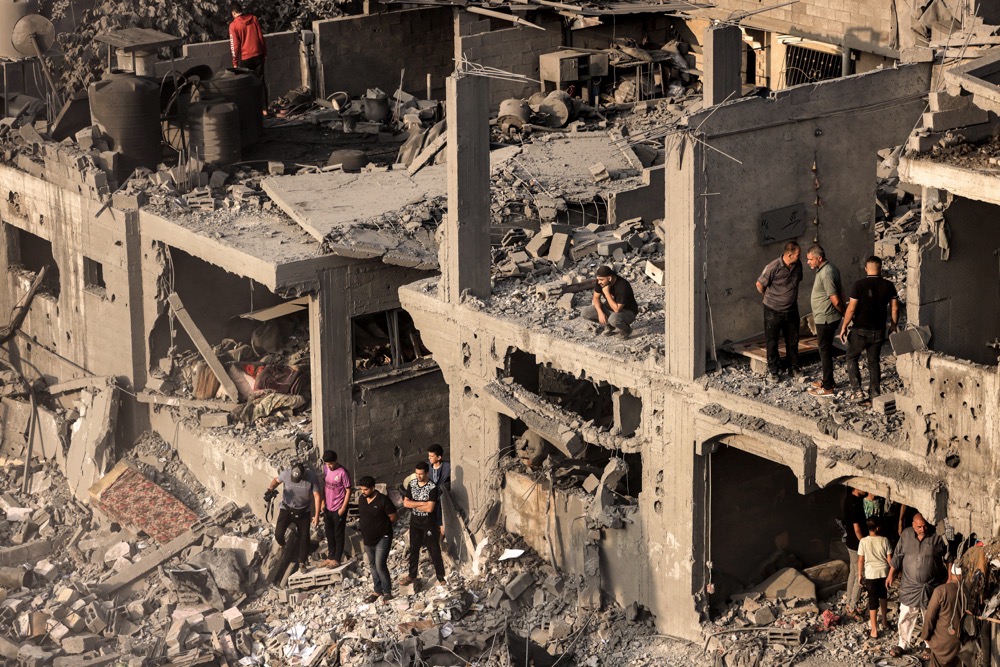
People search for survivors and the bodies of victims through buildings that were destroyed during Israeli bombardment in Khan Yunis. (AFP)
“That’s absolutely nothing. It’s peanuts. It’s crumbs. If you compare it with the numbers that, according to the UN and UNRWA as well, every day to Gaza we should have 500 trucks coming in, including for aid and 100 for fuel alone. So, we have, in three days, 54 trucks and none of these trucks had fuel on them.”
UNRWA, one of the oldest UN organizations, has been serving the people of Gaza for more than seven decades. It is also the largest UN agency active in the Gaza Strip, with 13,000 staff, many of them teachers. Indeed, it is the only UN agency that operates schools. Since the war began, however, UNRWA has been forced to close its schools in Gaza, depriving at least 300,000 children of education.
“Many of our schools have been turned into shelters where people have sought refuge,” said Touma.
The conflict has exacted a significant toll on the agency itself and its staff.
“We have already lost 35 colleagues at UNRWA,” said Touma. “They were killed. Half of them were teachers, half were men, half were women.”
In the wake of the Oct. 7 attack by Hamas, Israel imposed a strict embargo on Gaza, denying its impoverished population of 2.2 million people access to food, water, electricity and medicine. At the same time it launched a daily bombardment, killing thousands of civilians in the process.
Touma called for the blockade to be lifted and for an immediate ceasefire.
“Medicines, fuel, food, water, these are things that are very, very much missing,” she said. “And I don’t think it’s too much to ask. These are the basics that people need to live in dignity. And I also think for people to live in dignity, we need to have a ceasefire as soon as possible.”
Israeli attorney Daniel Seidemann, who also appeared on the Ray Hanania Radio Show this week, said that Israel’s failure to properly engage with the Palestinian Authority, and misconceptions about the true nature of Hamas, created the conditions for the unprecedented attack.
A resident of Jerusalem, member of the Israeli Bar Association and founder of the nongovernmental organization Terrestrial Jerusalem, he added that the dehumanization and violent suppression of Palestinians had contributed to the latest crisis.
Hamas took control of the Gaza Strip in 2007. The Sunni militia, with roots in the Muslim Brotherhood but with financing and support from Shiite Iran, has engaged in multiple conflicts with Israel, each ending in flimsy ceasefires.
However, the Oct. 7 attack in which 1,400 Israelis, mostly civilians, were killed by Hamas gunmen who breached the border in several places in the country’s south, marked a fundamental change in the long-running conflict.
“Israeli Prime Minister Benjamin Netanyahu for many years bolstered Hamas, favored Hamas, ironically because strengthening Hamas would give you a pretext of not negotiating with the Palestinian Authority and with Mahmoud Abbas,” Seidemann told The Ray Hanania Radio Show, which is sponsored by Arab News and broadcast weekly on the US Arab Radio network.
“He had an ideology, which was firmly entrenched in Israel, that Hamas can be contained. We’re not going to arrive at peace. We don’t have to give up anything. But they can be contained. And that collapsed on Oct. 7.”
According to Seidemann, Israel’s leveraging of Hamas as a tool to undermine the Palestinian Authority merely strengthened the armed group, while failing to recognize its true nature. Seidemann believes Hamas took inspiration for its ideology from Daesh and Al-Qaeda.
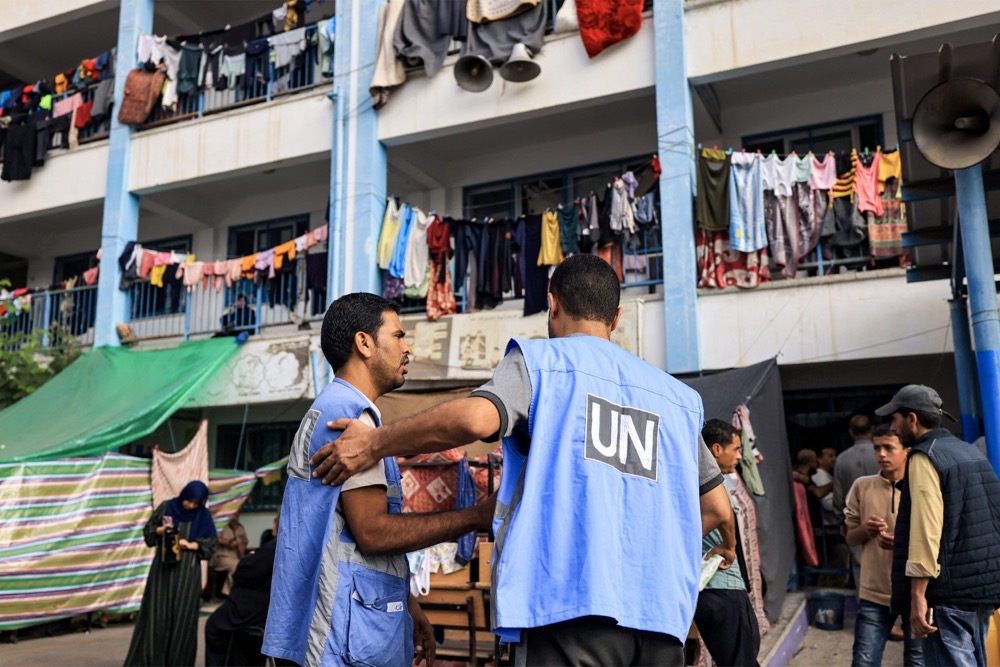
UN workers talk in the playground of an UNRWA-run school that has been converted into a shelter in Khan Yunis. (AFP)
“That is something that I did not anticipate, I don’t think many Israelis anticipated,” he said.
“Former Prime Minister Ehud Olmert … was the last Israeli leader to negotiate with the PA in good faith. And he lambasted Netanyahu and has been doing so for years: ‘This is a monster that you created. You made false assumptions about it because you didn’t want to deal with Mahmoud Abbas.’
“Israelis have been safe, in many ways, because of the stability of the Palestinian Authority. Netanyahu did everything he could to marginalize them and Hamas was the tool for it.”
While marginalizing the PA, Israeli authorities simultaneously dehumanized the Palestinian people, Seidemann said. A pervading viewpoint was created in which “Palestinian lives matter much less and sometimes don’t matter at all.”
He added: “I very much am sympathetic with the sense that there is a double standard. It’s a global double standard in all sorts of ways. It’s dangerous for me to express that among Israelis these days but, to be honest, that’s what it is.”
By violently repressing any form of dissent, and believing that high-tech military defenses could take the place of a peaceful and dignified solution, and that the world would go on treating the lives of Palestinians as having less worth, the conditions for a violent backlash were laid, according to Seidemann.
“We crush every political expression more radical than a scout meeting, and we have crushed meetings so the political energies go into the direction of people who don’t ask permission — and some of them are violent,” he said.
The blocking of avenues for peaceful resistance and the pushing of Palestinian opposition to the occupation down violent paths has not gone unnoticed, prompting efforts to improve the economic conditions for communities in the West Bank and Gaza.
“People in recent times have been speaking about making the lives of Palestinians better, the improvement of the Palestinian economy,” said Seidemann. “No — the deficit the Palestinians are suffering is the deficit of freedom. The deficit of dignity.
“My friends in East Jerusalem are telling me what the discourse is, on social media, their support for Hamas because ‘we’ve been ignored for years. Nobody has counted us. Everybody’s bypassed us. And regrettably, the only language that Israel understands is violence.’ And I have to concede, we’re proving that.”
Asked whether the peace process can recover from the Hamas attack and resulting assault on Gaza, Seidemann said the ultimate outcome is unknowable but the events of recent weeks have overturned some long-held assumptions.
“The Israeli public is traumatized and that is not auspicious circumstances in which to resume,” he said. “I believe that the notion that Israel can bully and break the will of the Palestinians with superior force has taken a hit and destroyed that myth.
“Yes, you’ve sent this Iron Dome. You’ve sent the soldiers. You haven’t said that’s the one thing that can work, and that is a political agreement, and that is fairness and decency.”
Seidemann is doubtful that the Netanyahu government will change its current course.
“What’s Israel’s goal? I wish I knew,” he said. “I doubt my prime minister knows. It’s one of the reasons, and there are numerous reasons, why it’s time for him to leave.
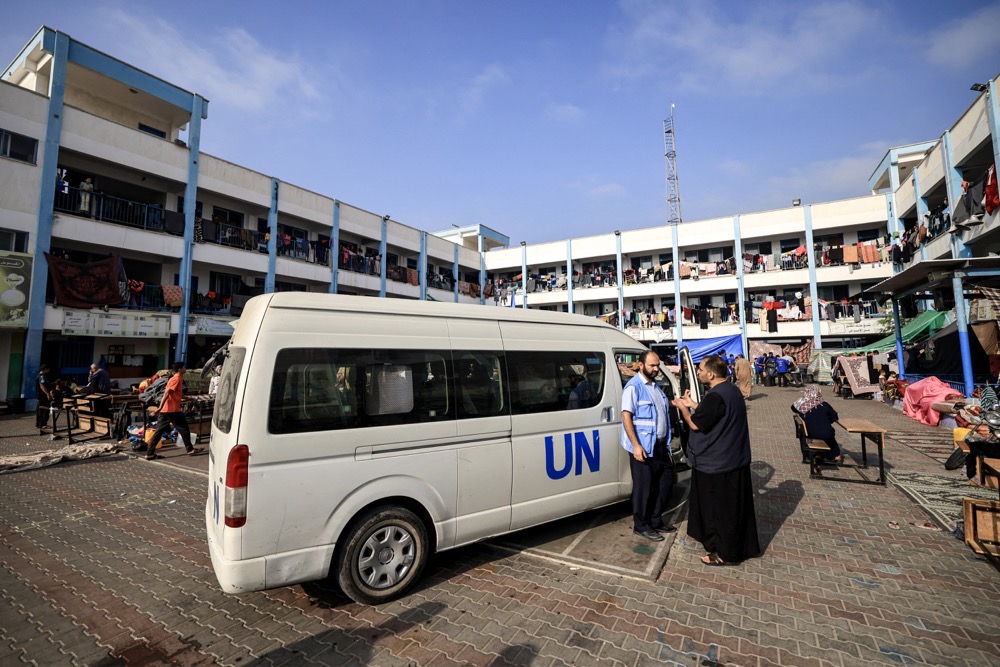
A shelter for displaced Palestinians in Khan Yunis. (AFP)
“But in his world of ‘we can defer this problem indefinitely; we can live alongside occupation without dealing with it; we can contain the Palestinians; the world doesn’t care; we could normalize and bypass the Palestinians’ — all of that is clearly not true or it hasn’t been true for many of us all along.
“But we’re now entering into a war. We’re in a war and ground operations. And it’s not clear to me what the objective is. I hear from our leaders, and some of them are in exemplary good faith saying we will be victorious. What do you mean by that? And they don’t explain it other than maybe implying that they will destroy Hamas and continue the way things have been.”
While many in the international community have expressed solidarity with Israel following the Hamas attack, they have also called on the Israeli government and military to exercise restraint and to permit humanitarian aid to reach civilians who have been prevented from leaving Gaza.
Israel has massed troops on the border with Gaza in preparation for a widely expected ground operation. The escalation has prompted fears of the conflict escalating into a wider regional war involving other Iranian proxies, including Lebanon’s Hezbollah.
Against this background, Seidemann believes a long-term vision is needed to establish peace between Israel and Palestine.
“We have to think of the day after,” he said. “There’s not going to be peace the day after. There are going to be deeply traumatized people on both sides who have suffered unspeakable horrors.
“And we have to pick up and rebuild. And we will be rebuilding in the Middle East, which has an entirely different architecture from what we’ve known in the past.
“It’s not only that the situation is unknown at the moment. It’s unknowable. But it doesn’t absolve us from preparing for it.”


