

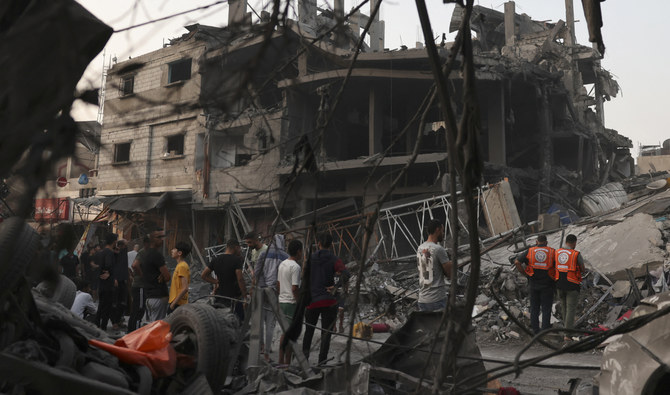

GAZA STRIP: With so many bodies, Palestinians in Gaza are burying the unidentified dead in mass graves, with a number instead of a name, residents say. Now some families are using bracelets in the hope of finding their loved ones should they be killed.
The El-Daba family has tried to reduce the risk of being struck down during the heaviest-ever Israeli bombardment of Gaza.
Ali El-Daba, 40, said he had seen bodies ripped apart by the bombing and were unrecognizable.
He said he decided to divide his family to prevent them from all dying in a single strike.
He said his wife Lina, 42, kept two of their sons and two daughters in Gaza City in the north and he moved to Khan Younis in the south with three other children.
El-Daba said he was preparing for the worst. He bought blue string bracelets for his family members and tied them around both wrists. “If something happens,” he said, “this way I will recognize them.”
Other Palestinian families were also buying or making bracelets for their children or writing their names on their arms.
Mass burials have been authorized by local Muslim clerics. Before burial, medics keep pictures and blood samples of the dead and give them numbers.
The Israeli military has told people to leave the north of the Gaza Strip, one of the most densely-populated places in the world, and head south because it is safer. But airstrikes have hit across the Hamas-ruled enclave.
An Israeli military spokesperson said: “The IDF has been encouraging residents of the northern Gaza Strip to move southward and not to stay in the vicinity of Hamas terror targets within Gaza City.”
“But, ultimately, Hamas has entrenched itself among the civilian population throughout the Gaza Strip. So wherever a Hamas target arises, the IDF will strike at it in order to thwart the terrorist capabilities of the group, while taking feasible precautions to mitigate the harm to uninvolved civilians.”
Hostages
More than half the estimated 220 hostages held by Hamas have foreign passports from 25 different countries, including 54 Thai nationals, the Israeli government said.
In providing updated figures, the government also said 328 people from 40 countries were confirmed as dead or missing after the surprise Oct. 7 attack by Hamas fighters on southern Israel. In all, an estimated 1,400 people were killed in the assault.
Israel said 138 of the hostages had foreign passports, including 15 Argentinians, 12 Germans, 12 Americans, six French and six Russians.
Many were believed to have had dual Israeli nationality, however some, like the Thais and five Nepalese hostages, almost certainly did not. There was also one Chinese hostage, one Sri Lankan, two from Tanzania and two from the Philippines.
Thais also made up the largest single group of foreign dead and missing, with 24 confirmed killed and 21 unaccounted for.


