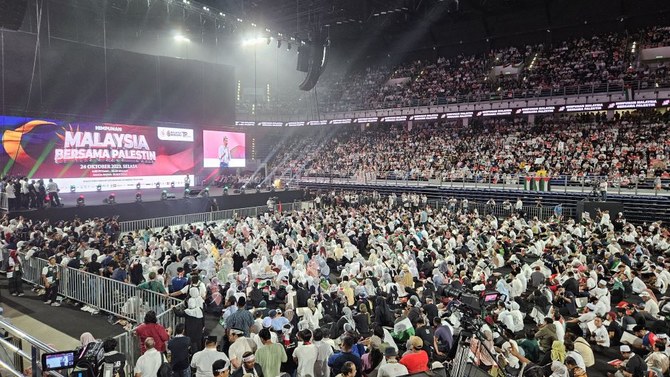
KUALA LUMPUR: Thousands of protesters gathered in Kuala Lumpur on Tuesday in Malaysia’s biggest display of solidarity with Palestinians since the beginning of the deadly Israeli onslaught on Gaza.
Malaysians have been taking to the streets since the escalation began over two weeks ago. Wearing traditional Palestinian scarves and carrying Palestinian flags, they have been calling for “Solidarity with Palestine,” and chanting “Save Palestine,” “Stop genocide in Gaza,” and “From the river to the sea, Palestine will be free.”
The protest on Tuesday, dubbed the “Malaysia is with Palestine” rally, took place at Axiata Arena Stadium in the south of Kuala Lumpur, and was the biggest so far, with the 16,000-seat venue full as Prime Minister Anwar Ibrahim addressed the crowd.
“We are with the Palestinian people ... yesterday, today and tomorrow,” Anwar said.
“Malaysians were there from the days of Yasser Arafat, struggling for an independent Palestine until today, and we will continue without fear.”
The number of people killed in Gaza has exceeded 5,000 since Oct. 7, when Israel began its bombardment of the densely populated enclave following an attack by the Gaza-based militant group Hamas.
Women and children make up 60 percent of the dead, according to Gaza’s Ministry of Health, while more than 15,200 people have been injured.
“It is a level of insanity to allow people to be butchered, babies to be killed, hospitals to be bombed, and schools to be destroyed,” Anwar said.
“We are not asking for anything extra. We want the Arabs, the Palestinians, the people of Gaza to be treated as human beings ... Stop the killing. Give them food. Give them medicine. Give the babies the right to live. Is that asking too much?”
Some of those who attended the rally, such as Mohammed Hassan Tahir, 65, told Arab News they wished they could go to Gaza and help — but they knew that was impossible.
“We can’t go,” Tahir said. “But we can give our moral support. That’s why we are here.”
Israel has said it is carrying out airstrikes to protect itself, but those who took part in the Kuala Lumpur protest disagree.
“Israel says it is defending itself, but for me, I don’t think so,” said Nurul Aina Ishak, a student. “The way they are seizing land, taking (it) from the Palestinians, that is wrong.”
In recent days, Israeli airstrikes on residential buildings and hospitals have intensified despite repeated calls by international organizations for a ceasefire and humanitarian access. Israel has also cut off power, water, food, fuel and medical supplies to Gaza, stepping up its 16-year blockade of the enclave that is home to 2.3 million people.
“They (Israel) are bombing places that should be considered safe, schools and mosques. They are even targeting hospitals. I feel unhappy with what is happening,” another protester, Shuhaimi Shukor, a 43-year-old executive, told Arab News.
“I support the Palestinians because what is happening is unjust. They are being suppressed.”
For Shazir Samsudin, a 21-year-old business owner, being at the rally was a matter of solidarity — and a sense of brotherhood that has been fostered for decades.
“We, as human beings, want to support the Palestinians,” Samsudin said. “Palestinians are our siblings. When our siblings are in trouble, we want to take care of them.”
Malaysia, a multicultural Southeast Asian nation, has no diplomatic relations with Israel, while it boasts historic links with Palestine, and support for the Palestinian cause, statehood, and the right of Palestinians to their land, that transcends both political and religious divisions.
“An overwhelming Muslim and non-Muslim population is supportive of the Palestinian cause in the name of humanitarian grounds and Malaysia’s legacy of standing up for the cause of the underprivileged,” Collins Chong Yew Keat, foreign policy and security strategist from the University of Malaya, told Arab News.
But while Malaysia has always been among “the most persistent and vocal defenders of the Palestinian cause,” more is needed for its stance to have any real impact, he said.
“It will need Malaysia’s diplomatic craft to exert more than diplomatic pressure or galvanize regional or global people-centered pressure.”


![]()

‘Malaysia is with Palestine’: Thousands rally in Kuala Lumpur to support Gaza
Short Url
https://arab.news/wd875
‘Malaysia is with Palestine’: Thousands rally in Kuala Lumpur to support Gaza
- PM Anwar Ibrahim says it is ‘insanity’ to allow people of Gaza ‘to be butchered’
- Rallies in solidarity with enclave have been ongoing in Malaysia for past two weeks


Latest updates


Recommended


© 2026 SAUDI RESEARCH & PUBLISHING COMPANY, All Rights Reserved And subject to Terms of Use Agreement.