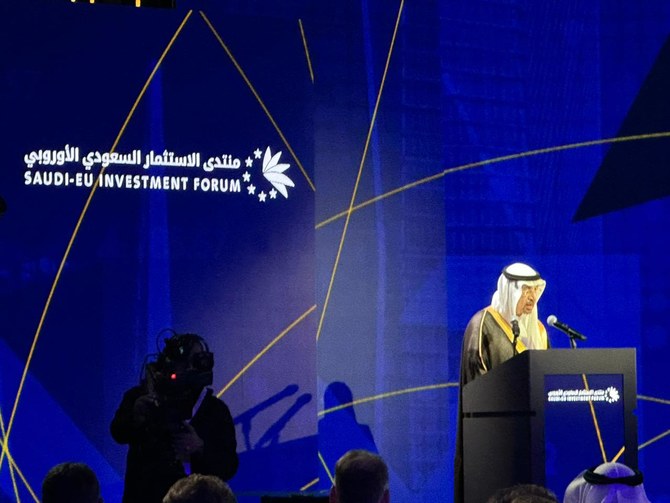

RIYADH: Saudi Arabia’s coordination with the EU has a vital role in the Kingdom’s ongoing economic transitions, as the Gulf nation is uniquely positioned to meet Europe’s needs “like no other,” said Investment Minister Khalid Al-Falih.
During the opening remarks of a business forum in Riyadh, Al-Falih emphasized the opportunities for investment and trade cooperation between the Kingdom and Europe.
“I am convinced there is still immense potential for expanding our partnership further, especially in terms of scale, diversity, and quality of our outbound and inbound investments,” he said at the commencement of the Saudi-EU Investment Forum on Monday.
The minister highlighted that over 1,300 European companies have invested in Saudi Arabia, emphasizing that “important Saudi investors are (present) in most EU countries.”
He added: “For European companies trying to navigate through this period of challenging transitions, the Kingdom offers unmatched political and economic stability.”
Reflecting the strong relations between Europe and the Kingdom, the minister pointed out that foreign direct investments from the EU to Saudi Arabia showed robust, healthy growth in various sectors.
Additionally, trade between the two countries reached 80 billion euros ($84.8 billion) in 2022, representing a 30 percent increase over the previous year.
“The EU and Saudi Arabia share an interest in continuing interactions on multilateral trade policy agendas, including the World Trade Organization,” said European Commission Executive Vice President Maros Sefcovic.
He added: “I am glad we agreed to accelerate the creation of a European Chamber of Commerce in Saudi Arabia, the first in the region.”
According to Sefcovic, the EU is interested in fostering closer cooperation with Saudi Arabia and the other countries of the Gulf Cooperation Council.
He noted that the aim is to enhance trade and investment flows to support the stability of the respective business and investment environments.
The forum also emphasized that a stable and secure environment provides the foundation for businesses to thrive and investments to grow.
It reduces risks, fosters confidence, and attracts domestic and foreign investments, critical economic development and prosperity drivers.
“Investments and economic development need predictability and a stable, secure environment. This is why the EU stands ready to support all the diplomatic efforts and initiatives, such as those led by Saudi Arabia or other nations in the region,” said Luigi Di Maio, EU’s special representative for the Gulf region.
The event hosted CEOs of major companies from the Kingdom and the EU member states and claimed the participation of over 1,000 representatives from the public and private sectors.
One of the voices belonged to Riyadh Air CEO Tony Douglas, who deliberated on the role of the aviation sector in driving economic ties between regions.
“People, geographies and economies, and the role of the national carriers is to connect all of those. The national carrier plays an important role in the economy,” said Douglas.
He also underlined the significance of leadership wisdom and the formulation of Vision 2030 within a comprehensive national development plan consisting of various vital pillars.
Talking to Arab News on the sidelines of the forum, Haifa Al-Jedea, ambassador and head of the Saudi mission to the EU and the European Atomic Energy Community, said that Saudi Arabia and the EU have several areas of mutual interest with vast investment potential.
“These areas include green hydrogen, renewable energies, and green technology. These are undersaturated today and hold vast potential.”
She said sectors such as mining, entrepreneurship, biotech, and raw materials present significant collaboration and investment opportunities.