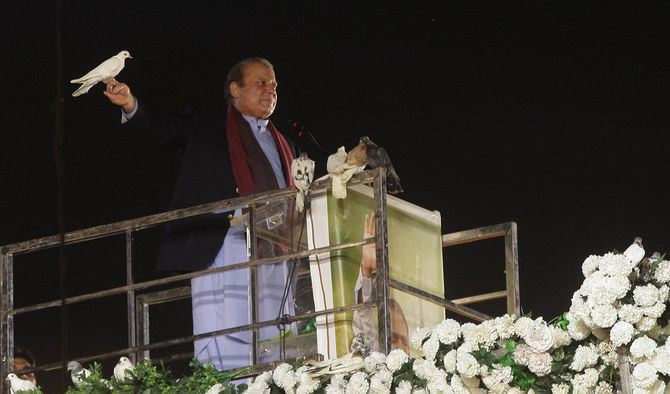

ISLAMABAD: Political analysts said on Sunday that the return of Nawaz Sharif, three-time former prime minister of Pakistan, to the country was “significant” for the national politics, but said the signs of establishment’s support could tarnish his reputation as a democratic leader.
Sharif, who returned to Pakistan on Saturday after four years in self-imposed exile, held a public gathering at Lahore’s iconic Minar-e-Pakistan, which was attended by thousands of his supporters.
His homecoming comes at a time when Pakistan grapples with political, economic and security issues, while his main opponent, Imran Khan, is in jail due to his conviction in a case related to the sale of state gifts during his tenure as prime minister from 2018 to 2022.
Many see the return of Sharif months after the incarceration of his arch-rival as a sign of support from Pakistan’s powerful military establishment for the three-time former premier, who is also a convict in two corruption cases. Both Sharif and Khan have said the cases against them were politically motivated.
“Sharif’s return to the country at this stage is extremely significant for him, his party and the country’s political landscape,” Ahmed Bilal Mehboob, president of the Pakistan Institute of Legislative Development and Transparency (PILDAT) think tank, told Arab News.
The huge public gathering on his return would rejuvenate Sharif’s Pakistan Muslim League-Nawaz (PMLN) party and reactivate its workers, according to the analyst. The focus of his speech was to raise public hopes for the future.
“His speech had all the right ingredients for the public, his own workers, and the establishment,” Mehboob said. “He effectively narrated the unfair treatment which he, his daughter, family, and the party underwent, while narrating Ghalib’s couplet also softly sounded warning that he should not be messed with if and when he comes to power.”
Sharif was also blunt about rebuilding ties with neighbors, including India, the key reason he was booted out of his second term in 1999, Mehboob noted.
Sharif’s last three terms as prime minister in 1990-93, 1997-99, and 2013-17 ended before he could complete his tenures, as he was removed by a military-backed president in 1993, ousted in a military coup in 1999, and disqualified by the Supreme Court in 2017. The 2018 election was won by the party of now-jailed former prime minister Khan.
Ahead of his return on Saturday afternoon, Sharif was granted protective bail by the Islamabad High Court, an order under which authorities cannot arrest him until he himself appears before a court on Oct. 24.
But Dr. Huma Baqai, another political analyst, said the effort that went into creating a hype and to pose Sharif as a “messiah” had failed miserably, despite all the facilitation that preceded his return.
“I cannot imagine that those in the corridors of power will not take notice of that,” she told Arab News.
More importantly, Baqai said, the understanding was that Sharif’s path to the prime minister’s office would be “lined with flowers and he would be able to get there without an issue.”
“We already see that major political parties do not even think they are in the game as the Pakistan Peoples Party... and of course the PTI (Khan-led Pakistan Tehreek-e-Insaf) we do not even know if it is in the game or not.”
Khan’s PTI party has been facing a crackdown since its supporters attacked military and government installation in reaction to the cricket star-turned-politician’s arrest in May. His ouster in a no-trust vote in April 2022 is also believed to be an outcome of his fallout with the then military leadership.
Zahid Hussain, a renowned journalist and columnist, said one thing was very clear about Sharif’s return that he had come back with “some kind of understanding” with the establishment.
On the contrary, Sharif, who has accused the military of orchestrating his ouster as well, appeared to have softened his stance at Saturday’s homecoming rally.
“That is a huge change in his narrative that has also put a question mark on his credential as a man who has always said that he was fighting for democracy,” he told Arab News.
“The challenges are also huge for him to revive the vote bank, PML-N vote bank in Punjab, which has been challenged by the PTI.”
Hussain believed the crackdown on the PTI would serve to Sharif’s advantage as he would get an open field.
“This means the credibility of the forthcoming elections has already become questionable with the allegation of pre-election rigging as we all know that most of the PTI leaders are either in jail or have been forced to leave the party,” he said.
Aasiya Riaz, a former joint-director at PILDAT, said Sharif’s arrival and the welcome had set the stage where his narrative had “reverberated with voters.”
“His return and narrative-building would be a key element of the present and future political landscape of Pakistan,” she told Arab News.