

ACWA Power signs seven agreements with Chinese entities  

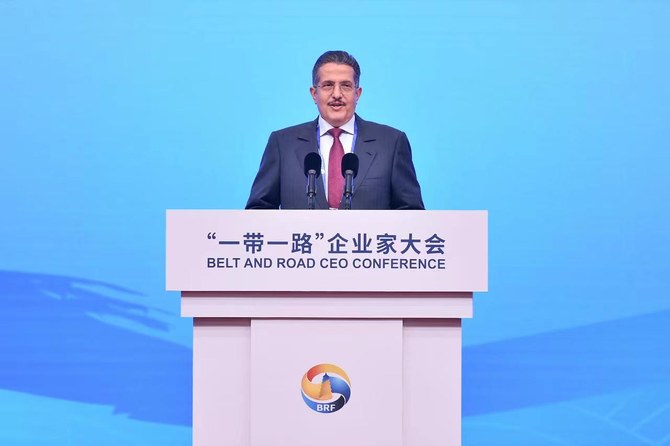
Mohammed Abunayyan, founder and chairman of ACWA Power, speaks at the forum. Supplied
Short Url
Updated 18 October 2023
Follow

ACWA Power signs seven agreements with Chinese entities  

RIYADH: Saudi Arabia’s utility company ACWA Power has entered into seven cooperation agreements with various Chinese firms across multiple sectors, including solar energy, green hydrogen, and water desalination.  

These deals were signed during the third Belt and Road Forum held in Beijing on Wednesday.

In a press statement, ACWA Power said that these agreements were signed with Chinese entities, including State Power Investment Corp. specializing in energy generation, Bank of China headquartered in Beijing, and Power China Group, a civil engineering firm.

The Saudi firm also signed deals with other companies such as Energy China Group, a provider of power and infrastructure solutions, and Jinko Solar, a solar panel manufacturer.

Mohammed Abunayyan, founder and chairman of ACWA Power, said: “ACWA Power’s journey with China has been one of genuine friendship and fruitful cooperation, going back years and across geographies. Over the years, we have nurtured strong relationships with key Chinese partners, which have enabled us to drive transformative projects in the fields of renewables, green hydrogen, and water desalination.”  

He added: “The agreements signed today further advance our common interest of developing projects that support positive climate ambitions.”  

The forum also marked the 10th anniversary of China’s Belt and Road Initiative, a global infrastructure development program initiated in 2013 to enhance connectivity and trade among participating nations. 

Abunayyan indicated that Saudi Arabia sees significant potential for further collaboration with China under the BRI.  

“We are dedicated to nurturing this enduring partnership. ACWA Power is resolute in our commitment to the Chinese market, and we recognize the critical role we play in the global clean energy landscape,” he added.  

The press statement revealed that ACWA Power established its Beijing office in 2009, marking the beginning of its association with China.  

Since then, Chinese investors and financiers have contributed $10 billion to ACWA Power’s global project portfolio, and Chinese engineering, procurement, and construction contractors, material suppliers, and financiers have participated in 47 projects and signed contracts worth more than $30 billion. 

In a report released by UK-based Global Water Intelligence in August, ACWA Power was recognized as the world’s largest water developer outside of China.  

It leads the list of top global water developers with a gross capacity of 6.8 million cubic meters per day and a net capacity of 3.2 million m3 per day.


Supply chains reel as carriers halt Gulf routes and impose war risk surcharges in response to Iran-US conflict

Updated 11 min 38 sec ago
Follow

Supply chains reel as carriers halt Gulf routes and impose war risk surcharges in response to Iran-US conflict

RIYADH: Global supply chains were disrupted on March 2 as the US-Iran conflict forced shipping lines and airlines to suspend routes, reroute traffic, and impose emergency surcharges across the Middle East.

As traffic slowed through the Strait of Hormuz and airspace restrictions spread across Gulf hubs, logistics providers halted new container bookings and adjusted operations, driving longer transit times, higher freight costs, and greater uncertainty for cargo owners worldwide.

Ship-tracking data cited by Reuters showed a maritime standstill taking shape near the Hormuz chokepoint, with roughly 150 crude and liquefied natural gas tankers anchored in open waters beyond the strait and additional vessels stationary on both sides, clustered near the coasts of Iraq, Saudi Arabia, and Kuwait, as well as the UAE and Qatar.

Industry guidance warned of heightened naval activity, anchorage congestion and potential insurance volatility, even as no formal international suspension of commercial shipping had been declared.

Rising tensions in the Gulf forced operational pullbacks, with Reuters reporting at least three tankers damaged and one seafarer killed, prompting shipowners to reassess their exposure in regional waters.

Container carriers acted to limit risk, with MSC Mediterranean Shipping Co. suspending new bookings for Middle East cargo amid security concerns and network uncertainty.

A.P. Moller–Maersk paused sailings through the Suez Canal and Bab el-Mandeb and suspended vessel crossings through the Strait of Hormuz, attributing the move to the worsening security situation following the start of the US-Israeli attack on Iran.

Rival operators began diverting vessels around the Cape of Good Hope, extending voyage times between Asia and Europe and tightening effective capacity. The longer routings are increasing fuel consumption and disrupting equipment repositioning cycles, adding strain to already stretched container availability in key export markets.

Freight costs rose further after Hapag-Lloyd introduced a formal War Risk Surcharge for cargo moving to and from the Upper Gulf, Arabian Gulf and Persian Gulf, citing what it described as the “dynamic situation around the Strait of Hormuz” and associated operational adjustments across its network.

The surcharge, effective March 2 until further notice, is set at $1,500 per twenty-foot equivalent unit for standard containers and $3,500 per unit for reefer containers and special equipment.  

The surcharge will apply to any booking made on or after March 2 that has not yet shipped, as well as cargo already in transit to or from affected Gulf regions. It will be paid by the booking party and excludes shipments regulated by the Federal Maritime Commission or SSE.

France-based shipping group CMA CGM said March 2 it will introduce an “Emergency Conflict Surcharge,” effective immediately, citing escalating security risks in the region. The surcharge will be set at $2,000 per 20-foot dry container, $3,000 per 40-foot dry container, and $4,000 per reefer or special equipment container.  

The measure applies to cargo moving to and from Iraq, Bahrain, and Kuwait, as well as Yemen, Qatar, Oman, the UAE, and Saudi Arabia. It also covers shipments to Jordan, Egypt via the Port of Ain Sokhna, Djibouti, Sudan, and Eritrea, encompassing trade linked to Gulf and Red Sea countries.

On the port side, DP World said operations had resumed at Jebel Ali Port in the UAE following precautionary disruption. The reopening restored activity at the Gulf’s largest transshipment hub, though the broader impact of rerouted vessels, suspended bookings and insurance constraints continues to limit throughput predictability.

Marine insurers added to the strain by issuing notices canceling war-risk cover for vessels operating in Iranian waters and surrounding areas, with changes taking effect on March 5.

The withdrawal of coverage complicates voyage approvals and introduces further pricing volatility for shipowners and charterers considering calls within the region.

Air freight networks have also been affected. Widespread flight cancellations and airspace restrictions across the Middle East disrupted passenger and cargo flows through key hubs, including Dubai.  

FedEx said it had temporarily suspended services in specific Middle East markets, including Bahrain, Israel, and Qatar, as well as Saudi Arabia, Kuwait, and the UAE, and halted pickup and delivery services in several Gulf countries due to escalating tensions and airspace closures, affecting time-sensitive shipments across several nations.

Shipping group NORDEN said it has suspended all new business requiring transit through the Strait of Hormuz, citing the escalating security situation in the region, according to a company statement.

Air cargo disruption appears to be significant. Ryan Petersen, CEO of Flexport, a US multinational corporation that focuses on supply chain management and logistics, wrote on X on March 2 that “18 percent of global air freight capacity has been taken out of the market by conflict in the Middle East this weekend,” highlighting the scale of network dislocation as airspace closures and flight cancellations ripple across Gulf hubs.

While the figure has not been independently verified, it underscores the degree to which capacity constraints are tightening for time-sensitive shipments, including pharmaceuticals, electronics and industrial components.

Data from Lloyd’s List Intelligence underscores the scale of disruption to maritime throughput. Daily deadweight tonnage of tankers and gas carriers transiting the Strait of Hormuz fell sharply by March 1, reflecting what industry sources describe as a de facto halt in normal vessel movements.

The combined effect of halted transits, booking suspensions, war-risk pricing measures and air service interruptions is beginning to ripple through global supply chains. Energy exports remain the most immediately exposed given the strategic importance of the Strait of Hormuz, but sectors dependent on just-in-time inventory, from manufacturing to retail, are also facing longer lead times and rising logistics costs.

As of March 2, carriers and freight operators were prioritizing crew safety and asset protection while monitoring military developments. The duration of the conflict will determine whether the current disruption remains a short-term operational shock or develops into a prolonged restructuring of trade routes serving the Middle East.