

‘Much higher, much bigger’: In meeting with Pakistani PM, Putin highlights potential for economic cooperation

1 / 2
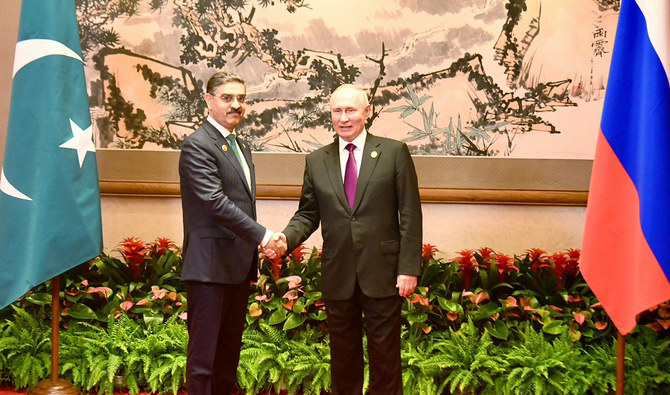
Pakistan's Caretaker Prime Minister Anwaar-ul-Haq Kakar (left) shakes hands with the President of Russia, Vladimir Putin, at the 3rd Belt and Road Forum in Beijing, China on October 17, 2023. (Photo courtesy: @PakPMO/X)
2 / 2
The still image taken from a video shows Pakistan's Caretaker Prime Minister Anwaar-ul-Haq Kakar (left) meeting the President of Russia, Vladimir Putin, at the 3rd Belt and Road Forum in Beijing, China on October 17, 2023. (Photo courtesy: Prime Minister's Office)
Short Url
Updated 18 October 2023
Follow

‘Much higher, much bigger’: In meeting with Pakistani PM, Putin highlights potential for economic cooperation

  • Kakar discusses regional security and connectivity, trade, counter-terrorism, with Putin at Belt and Road Forum
  • Says energy deficient Pakistan, nation of 240 million people, ‘huge’ potential market for Russian energy exports

ISLAMABAD: The potential for economic cooperation with Pakistan was “much higher, much bigger” than at present and both nations would discuss steps to enhance ties, Russian President Vladimir Putin said in a meeting with Pakistani Prime Minister Anwaar-ul-Haq Kakar in Beijing, where the two leaders are attending the Belt and Road Forum.

Pakistan and Russia have recently moved to improve ties, with Islamabad receiving first deliveries of Russian crude under a deal struck between the two countries earlier this year. Last month, Pakistan also received its first shipment of liquified petroleum gas from Moscow.

“The trade between our countries has increased and it has reached good levels,” Putin told Kakar on the sidelines of the forum, as the two leaders sat across from each other.

“Our potential of economic cooperation, our potential is much higher, much bigger and we are going to discuss that … I hope we will be able to listen to your colleagues as well and we will exchange our visions of how and what additional steps could be taken to enhance our cooperation in all areas.”

Kakar told Russian president Islamabad and Moscow had a convergence of interests, particularly on the issue of terrorism, which deserved a more “regional and common approach.”

“I think we are the first who would have [face] the implications [of terrrism] so we should be the foremost to take the initiative,” Kakar said, adding that both countries should increase coordination and cooperation in defense, intelligence, and counter-terrorism. 

Kakar told Putin Pakistan was a “huge market” for Russia as an energy-deficient country with a population of 240 million people.

Kakar arrived in Beijing on Monday to attend the Belt and Road Forum, which marks the 10th anniversary of the Belt and Road Initiative (BRI) championed by President Xi Jinping. Prior to his meeting with Putin, Kakar met the presidents of Sri Lanka and Kenya in sideline meetings, as well as other world leaders during a dinner hosted by the Chinese president at the Great Hall of the People.

The BRI is a plan for global infrastructure and energy networks that China launched a decade ago to connect Asia with Africa and Europe through land and maritime routes. But critics see the plan — billed as recreating the ancient Silk Road to boost global trade — as a tool for China to spread its geopolitical and economic influence.

Under the BRI, Beijing has pledged over $60 billion for energy, infrastructure and other projects in Pakistan.


Pakistan’s president condemns Kabul blast, accuses Taliban of allowing militant ‘safe havens’

Updated 12 sec ago
Follow

Pakistan’s president condemns Kabul blast, accuses Taliban of allowing militant ‘safe havens’

  • President Zardari links attack on Chinese-run restaurant to Kabul’s failure to meet Doha commitments
  • He highlights the ‘failure’ of Afghanistan’s Taliban to establish a ‘broad-based and inclusive government’

KARACHI: President Asif Ali Zardari on Monday condemned a blast that ripped through a Chinese-run restaurant in Kabul, killing at least seven people, while criticizing Afghanistan’s Taliban administration for allowing “safe havens” to militant groups to export extremist violence in the region.

The explosion struck the restaurant in Kabul’s Shahr-e-Naw commercial district, an area considered one of the safest in the Afghan capital, killing one Chinese national and six Afghans and wounding several others, including a child, according to Afghan authorities.

The Afghan affiliate of Daesh militant group claimed responsibility, saying the attack was carried out by a suicide bomber.

“The Taliban regime in Afghanistan has failed to honor the commitments made under the Doha Peace Agreement, particularly the obligation to prevent the use of Afghan soil for the export of terrorism,” Zardari said in a statement circulated by his office.

“Pakistan has repeatedly stressed that no terrorist groups should be allowed safe havens in Afghanistan and that regional peace and security must be upheld,” he continued, adding that “it is not just Pakistan but other neighbors of Afghanistan, including Tajikistan, [that] have recently been affected by the terrorists operating out of Afghan soil.”

Pakistan has frequently accused Afghanistan of sheltering proscribed armed factions such as the Tehreek-e-Taliban Pakistan and the Balochistan Liberation Army, and of facilitating attacks on Pakistani civilians and security forces, allegations the Taliban deny.

The two countries witnessed major border skirmishes in October last year, followed by talks mediated by Qatar and Türkiye.

Pakistan subsequently closed its border and suspended bilateral and transit trade with Afghanistan, a move that led to a 17% drop in “cross-border attacks,” according to the Center for Research and Security Studies.

Late November also saw a series of deadly incidents along the Tajikistan–Afghanistan border, with militants on the Afghan side firing across the frontier into Tajikistan, killing five Chinese workers employed on Chinese–Tajik mining and construction projects.

In December, Tajik border forces clashed with armed individuals who crossed from Afghanistan, killing several assailants but losing a border guard in the fighting.

Zardari paid tribute to Chinese nationals working in Afghanistan “despite rising insecurity” and expressed solidarity with the victims and their families, while reiterating calls for political reform in Kabul.

“The failure to establish a broad based and inclusive government by the Taliban is contrary to the Doha Agreement,” he said in the statement.