Dwindling humanitarian aid for Rohingya refugees threatens to exacerbate one of the world’s largest humanitarian crises, the UN’s refugee chief said on Tuesday.
Bangladesh is home to around a million members of the mostly stateless minority, many of whom fled a Myanmar military crackdown in 2017 that is now subject to a genocide probe at the International Criminal Court.
Frustration is widespread over the lack of progress in a repatriation deal, rampant lawlessness in the refugee settlements and cuts to international humanitarian aid.
Humanitarian assistance “is declining” amid crises in Ethiopia, Sudan, Afghanistan, Ukraine and Israel, Filippo Grandi told reporters on the sidelines of a regional meeting.
“This is a crisis that should not be forgotten... If contributions decline, we are in trouble.”
The Rohingya crisis had only 42 percent of the $875.9 million funding needed this year, he said.
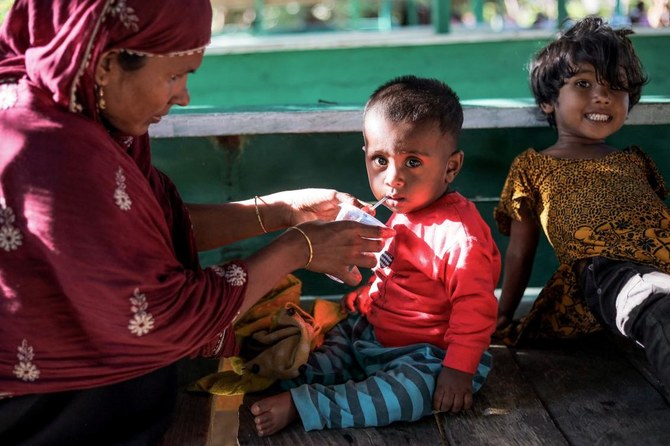
Budget cuts have forced the UN World Food Programme to steeply reduce humanitarian aid to the Rohingya camps this year, with funding for rations now at $8 per refugee per month.
Malnutrition in the sprawling camps is already rampant, rights groups say.
The United Kingdom’s Minister for the Indo-Pacific Anne-Marie Trevelyan announced a 4.5 million pound ($5.4 million) funding contribution on Tuesday.
Grandi said repatriation to Myanmar was still “Plan A,” even as he acknowledged many Rohingya were still afraid to return to the country where they are widely viewed as interlopers from Bangladesh.
Bangladesh and Myanmar are working on a pilot program to begin repatriating a limited number of Rohingya, despite concerns from rights groups who say conditions are not safe for their return.
Rohingya in Myanmar are denied citizenship and access to health care and require permission to travel outside of their townships.
Myanmar junta chief Min Aung Hlaing — who was head of the army during the crackdown — has dismissed the term Rohingya as “imaginary.”
“Plan B is the status quo, people continue to be in host countries... but this is not sustainable in the long term,” Grandi said.


UN refugee chief rallies support for Rohingya
https://arab.news/6cgu5
UN refugee chief rallies support for Rohingya

- Humanitarian assistance “is declining” amid crises in Ethiopia, Sudan, Afghanistan, Ukraine and Israel

Proposed EU mission to blocked pipeline awaiting Ukraine approval
- European Union member Hungary has in turn blocked a vital $106-billion EU loan to Ukraine
- “We have proposed a mission to inspect the pipeline to Ukraine,” said Itkonen
BRUSSELS: The EU said Thursday it had proposed a mission to inspect a blocked oil pipeline at the center of a row between Ukraine and Hungary — and was waiting for Kyiv to respond.
Hungary and Slovakia accuse Kyiv of deliberately delaying reopening the Druzhba pipeline, which pumps Russian oil to the two landlocked states and Ukraine says was damaged by Russian strikes in January.
European Union member Hungary has in turn blocked a vital 90-billion-euro ($106-billion) EU loan to Ukraine as well as a fresh round of sanctions on Russia.
“We have proposed a mission to inspect the pipeline to Ukraine,” Anna-Kaisa Itkonen, a spokeswoman for the European Commission told journalists in Brussels. “We are awaiting their response.”
The suggestion of an EU fact-finding mission came on the back of two weeks of “intense discussions and contact with Ukraine on this issue,” she added.
On Wednesday, Budapest said it had sent its own mission to assess the pipeline and hold talks with Ukrainian authorities — only for Kyiv to deny there were any discussions planned.
Ukrainian President Volodymyr Zelensky said last week it could take four to six weeks to make the pipeline operational again.
The dispute comes as Hungary’s nationalist Prime Minister Viktor Orban, has ramped up political attacks on Ukraine ahead of a closely fought parliamentary election in Hungary on April 12.
Orban, Russian President Vladimir Putin’s closest ally in the EU, has also urged the 27-nation bloc to suspend sanctions on Russian oil and gas to counter rising prices since the Middle East war erupted.