

Pakistan looks to tame high inflation with fuel price cuts — PM

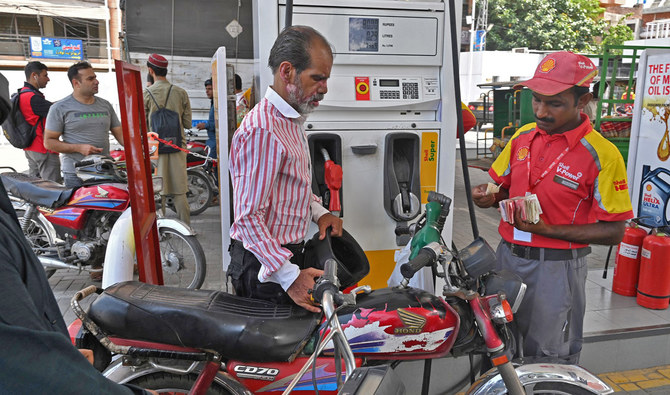
An employee fills petrol in a motorcycle at a fuel station in Lahore, Pakistan, on August 1, 2023. (AFP/File)
Short Url
Updated 16 October 2023
Follow

Pakistan looks to tame high inflation with fuel price cuts — PM

  • Pakistan is embarking on a tricky path to economic recovery under a caretaker government after a $3 billion IMF bailout
  • Effective Monday, petrol dropped by Rs40 to Rs283.38 rupees a litre, while high-speed diesel cost fell by Rs15 to Rs303.18

KARACHI: The Pakistani government is looking to tame inflation with fuel price cuts and a price-control mechanism, caretaker Prime Minister Anwaar ul Haq Kakar said on Monday. 

The South Asian country is embarking on a tricky path to economic recovery under a caretaker government after a $3 billion loan programme approved by the International Monetary Fund in July averted a sovereign debt default, but with conditions that complicated efforts to control inflation. 

"Consequent to substantial reduction in fuel prices, I have directed the concerned authorities at Federal and Provincial level to activate a strict price control mechanism," Kakar said in a post on X, formerly known as Twitter. 

He added that efforts should be maintained in transferring the benefit of the cut on prices of commodities. 

Effective Monday, the price of petrol dropped by 40 Pakistani rupees to 283.38 rupees a litre, while high-speed diesel cost fell by 15 rupees to 303.18 a litre, as per the ministry. 

The finance ministry, in a press release, said the decreasing trend of petroleum prices in the international market and the appreciation of the rupee against the U.S. dollar as reasons for the cut. 

Pakistan's inflation rate rose to 31.4% year-on-year in September from 27.4% in August, primarily due to high fuel and energy prices. 

The rupee hit all-time lows in August before recovering in September to become the best performing currency following a clampdown by authorities on unregulated FX trade. 

Analysts, however, expect the fuel price cut to be short- lived and ineffective at taming inflation. 

"The current cut in fuel prices has been led by a lower ex-refinery price, which is a function of international prices and the rupee parity. The sustainability of this cut is subject to future movements in these factors," said Amreen Soorani, Head Of Research at JS Global Capital. 

She added that the crackdown in illicit trade had been a key factor in the appreciating rupee against the dollar and that continued efforts on the same path would likely keep the rupee trend stable. 

"Pakistan is a trade deficit country with limited dollar inflow avenues in its balance of payments. In the longer term, present information suggests the rupee would likely continue a depreciating trend, albeit, ongoing efforts may limit the quantum of depreciation," she added. 

Fahad Rauf, Head of Research at Ismail Iqbal Securities, pointed out the downward sticky nature of prices. 

"When the fuel prices go up, the transportation cost and product prices also rise, but when the prices fall, the impact is not passed on to consumers to same extent," Rauf added. 

The war between Islamist group Hamas and Israel poses one of the most significant geopolitical risks to oil markets since Russia's invasion of Ukraine last year, analysts say. 

"...we believe the oil price warrants a risk premium of USD5–10/bbl, due to the supply risk," ANZ research said in a note on Monday. 


Sri Lanka seal gritty T20 win over Pakistan to level series

Updated 11 January 2026
Follow

Sri Lanka seal gritty T20 win over Pakistan to level series

  • In a contest trimmed to 12 overs a side, Sri Lanka scored 160 runs before choking Pakistan to 146-8
  • The series saw the visitors clinch the opener by six wickets before rain washed out the second game

Dambulla: Sri Lanka eked out a hard fought 14-run victory over Pakistan in the third T20 at rain-hit Dambulla on Sunday, easing their batting jitters and squaring the three-match series 1-1.

The series, a warm-up for the T20 World Cup with Pakistan set to play all their matches in Sri Lanka due to political tensions with nuclear-armed neighbors India, saw the visitors clinch the opener by six wickets before rain washed out the second game.

“We were a bit worried about our batting and I’m glad we addressed that today,” said Wanindu Hasaranga, who walked away with both Player of the Match and Player of the Series honors.

“The bowlers did a good job too. The ball was wet and it wasn’t easy. We tried to bowl wide and slow and asked them to take risks.”

Hasaranga took four wickets in the game and in the process completed 150 wickets in T20Is.

In a contest trimmed to 12 overs a side, Sri Lanka muscled their way to a competitive 160 before choking Pakistan to 146-8.

Having been bowled out inside 20 overs in the series opener, Sri Lanka needed a statement with the bat and duly ticked every box after being put in.

The top order laid the platform and the middle order applied the finishing touches.

Wicket-keeper Kusal Mendis made hay under the Power Play, blasting 30 off 16 balls while Dhananjaya de Silva (22 off 15) and Charith Asalanka (21 off 13) kept the scoreboard ticking.

Skipper Dasun Shanaka then swung the momentum decisively, clubbing 34 off just nine deliveries, peppered with five towering sixes.

The sixth-wicket stand between Shanaka and Janith Liyanage produced 52 runs in just 15 balls and proved the turning point, shifting the game firmly Sri Lanka’s way.

Pakistan came out swinging in reply, racing to 50 in just 19 balls with captain Salman Agha hammering 45 off 12 balls, including five fours and three sixes.

But once the field spread, Sri Lanka tightened the screws, applied the choke and forced the asking rate to spiral.

“It was a good game of cricket,” Agha said.

“We conceded too many runs, but our batting effort was good. Unfortunately, we fell short. We know we are going to play all our World Cup games in Sri Lanka and it’s important that we played in similar conditions,” he added.