

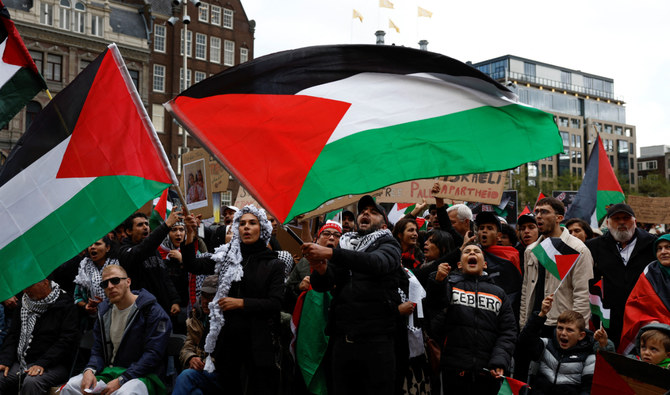
Thousands march in Amsterdam in support of Palestinians

People hold a demonstration on Sunday in support of Palestinians in Amsterdam, Netherlands. The protesters turned the central Amsterdam square into a sea of Palestinian flags and placards. (Reuters)
Short Url
Updated 15 October 2023
Follow

Thousands march in Amsterdam in support of Palestinians

AMSTERDAM: Thousands marched through the streets of Amsterdam Sunday in a pro-Palestinian demonstration as Israeli forces prepared to invade the Gaza Strip in response to last week’s unprecedented attack by Hamas.

The protesters turned the central Amsterdam square into a sea of Palestinian flags and placards reading: “Free Palestine,” “Stop The War,” and “Stop The Attack on Gaza,” according to AFP reporters at the scene.

Three planes flew overhead trailing messages “Love Hummus, not Hamas,” “Make falafel, not war,” and “Shalom, Salam,” the word “peace” in Hebrew and Arabic, respectively.

Similar marches took place over the weekend in major Western capitals, including Washington, London, and Geneva.

James Casey, a 63-year-old retired tourist from Canada, said: “It’s horrible. You know I have no solution for it ... but what I’m feeling is sadness.”

“I do feel support for the Palestinian people ... but what has just happened recently is horrific,” he said, referring to the Hamas attacks on Israel that claimed the lives of more than 1,300 people.

“So it’s really mixed you know. I have mixed feelings. Peace is what we would love, a path to peace,” Casey said.

The route of the Amsterdam march was initially scheduled to end in Amsterdam’s old Jewish quarter. 

This was changed during the week to avoid potential confrontation.

The beginning of the march passed off peacefully in a drizzle with a heavy police presence.

On Saturday, tens of thousands rallied across Britain to support Palestinians in demonstrations that passed off largely peacefully amid a large police presence.


Uganda army denies seizing opposition leader as vote result looms

Updated 58 min 6 sec ago
Follow

Uganda army denies seizing opposition leader as vote result looms

  • Election day was marred by significant technical problems after biometric machines
  • There were also reports of violence against the opposition in other parts of the country

KAMPALA: Uganda’s army denied claims on Saturday that opposition leader Bobi Wine had been abducted from his home, as counting continued in an election marred by reports of at least 10 deaths amid an Internet blackout.
President Yoweri Museveni, 81, looked set to be declared winner and extend his 40-year rule later on Saturday, with a commanding lead against Wine, a former singer turned politician.
Wine said Friday that he was under house arrest, and his party later wrote on X that he had been “forcibly taken” by an army helicopter from his compound.
The army denied that claim.
“The rumors of his so-called arrest are baseless and unfounded,” army spokesman Chris Magezi told AFP.
“They are designed to incite his supporters into acts of violence,” he added.
AFP journalists said the situation was calm outside Wine’s residence early Saturday, but they were unable to contact members of the party due to continued communications interruptions.
A nearby stall-owner, 29-year-old Prince Jerard, said he heard a drone and helicopter at the home the previous night, with a heavy security presence.
“Many people have left (the area),” he said. “We have a lot of fear.”
With more than 80 percent of votes counted on Friday, Museveni was leading on 73.7 percent to Wine’s 22.7, the Electoral Commission said.
Final results were due around 1300 GMT on Saturday.
Wine, 43, whose real name is Robert Kyagulanyi, has emerged as the main challenger to Museveni in recent years, styling himself the “ghetto president” after the slum areas where he grew up in the capital, Kampala.
He has accused the government of “massive ballot stuffing” and attacking several of his party officials under cover of the Internet blackout, which was imposed ahead of Thursday’s polls and remained in place on Saturday.
His claims could not be independently verified, but the United Nations rights office said last week that the elections were taking place in an environment marked by “widespread repression and intimidation” against the opposition.

- Reports of violence -

Analysts have long viewed the election as a formality.
Museveni, a former guerrilla fighter who seized power in 1986, has total control over the state and security apparatus, and has ruthlessly crushed any challenger during his rule.
Election day was marred by significant technical problems after biometric machines — used to confirm voters’ identities — malfunctioned and ballot papers were undelivered for several hours in many areas.
There were reports of violence against the opposition in other parts of the country.
Muwanga Kivumbi, member of parliament for Wine’s party in the Butambala area of central Uganda, told AFP’s Nairobi office by phone that security forces had killed 10 of his campaign agents after storming his home.